
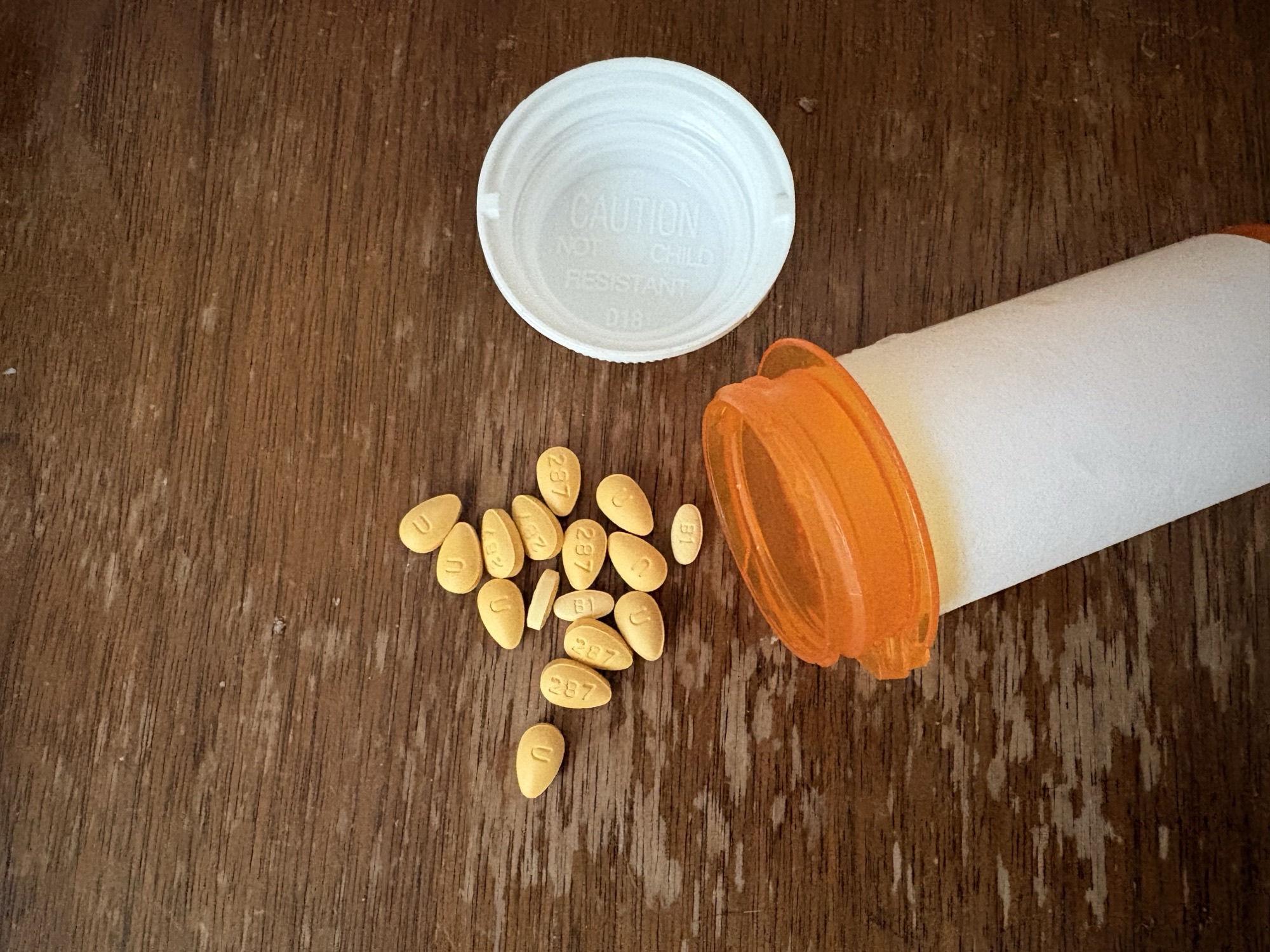
My TRT clinic prescribed five milligrams a day, and the main thing I notice is a better pump in the garage. But the solid evidence is for two specific medical uses, and the prostate-protection, workout, and longevity claims are a lot shakier than the internet makes them sound.
When I started testosterone replacement last year, my clinic added a second prescription almost as an afterthought. Five milligrams of tadalafil, every day. That is the drug in Cialis, so you can probably guess what people assume it is for. I did not start it for erectile dysfunction, though. My clinic described it loosely as a blood-flow add-on, and the main change I noticed day to day was a better pump when I trained. That is my observation, not proof of anything, and I will come back to why that distinction matters.
One safety note up front. I take this under medical supervision. Never combine tadalafil with nitrates, such as the nitroglycerin given for chest pain, because together they can drop your blood pressure dangerously. If chest pain ever sends you to the ER, say out loud that you take tadalafil before anyone reaches for nitroglycerin.
It turned out to be tangled up with more than blood flow. It is a real prostate drug. The erectile-dysfunction angle I first waved off as irrelevant to me is the one a cardiologist would care about most. And a good deal of what gets said about it online sits somewhere between plausible and made up. So this is my attempt to sort what daily tadalafil actually does from what it is merely rumored to do.
The prostate drug wearing an ED pill’s clothes
Most men meet tadalafil through the ads, so they file it under “sex pill” and never think about it again. But the American Urological Association, which writes the rulebook American urologists actually follow, lists daily 5 mg tadalafil as a treatment option for the urinary symptoms of an enlarging prostate, whether or not you have any erectile trouble at all. The AUA’s 2026 benign prostatic hyperplasia guideline (American Urological Association, published in the Journal of Urology) says that for men with those lower urinary tract symptoms, “irrespective of comorbid erectile dysfunction,” 5 mg daily tadalafil should be discussed as an option.
An enlarging prostate is one of the most ordinary things that happens to a man’s body. Most men develop some degree of it by their seventies, and the early version is the familiar stuff: a weaker stream, getting up in the night, the sense that the tank never quite empties. So the same small pill can, in principle, cover the bathroom complaints and the bedroom ones at once. That is the actual two-for-one, and it is the part the advertising never mentions.
It treats the bother, not the flow
There is a catch, though, and it is the reason I wanted to write this down instead of just cheerleading. Tadalafil helps how the prostate symptoms feel more than it changes the plumbing. It does not shrink the prostate the way finasteride does, and it does not force the channel open the way the older prostate drugs do. What it does is take the edge off the day-to-day bother.
On the standard symptom questionnaire urologists use, which runs from 0 to 35, daily tadalafil lowers the score by under two points versus a placebo, and some men respond more than that. The AUA itself treats a drop of about three points as the smallest change a man is likely to actually notice, so on average this lands below the line where a man would feel much difference at all. Some men do better than the average, but nobody should expect a return to their twenties. And it does not measurably improve your urine flow rate. The AUA’s own review notes the flow measurements barely move, and it warns against leaning on the drug when the real problem is a bladder that is backing up or not emptying.
So it treats the bother, not a mechanical blockage. If your stream has slowed to the point that things are physically backing up, this is not the pill that fixes that, and a good doctor will tell you so. The signs that mean don’t wait and don’t self-treat are things like being unable to urinate at all, blood in the urine, or repeated urinary infections. Short of those, knowing what the drug does and doesn’t do is worth more than any marketing claim.
New ED can be a cardiovascular warning sign
The most useful thing I have picked up since starting this pill has nothing to do with the pill. It is what erectile trouble actually tells you. The Princeton IV Consensus (Mayo Clinic Proceedings, 2024), the fourth Princeton conference on the subject, is careful about how it frames this: new erectile dysfunction can be a cardiovascular risk marker, and when the likely cause is vascular, it counts as a risk-enhancing factor worth raising with your doctor. The reason comes down to plumbing. The arteries that fill the penis are narrow, one to two millimeters across. The ones feeding the heart are wider, three to four millimeters. Vascular disease, and the endothelial dysfunction behind it, tends to show up in the smaller penile arteries before the larger coronary ones, so erectile problems often surface a few years ahead of a cardiac event. The number people usually cite is a two-to-five-year head start.
And the risk behind that is real, not hand-waving. A 2013 meta-analysis of nearly 93,000 men (Vlachopoulos et al.) found that men with erectile dysfunction had about a 44% higher rate of cardiovascular events and a 25% higher rate of death from any cause. Not every case is about plaque. Hormones, medications, diabetes, sleep apnea, stress, depression, alcohol, and pelvic surgery can all cause erectile trouble on their own, so this is not a diagnosis to make yourself. But new ED is still worth treating as a cardiovascular clue until your doctor has looked. The newer advice, for a man roughly 40 to 60 who has likely vascular ED plus a borderline or intermediate result on the standard ten-year heart-risk estimate, is to ask about a coronary artery calcium scan, a low-radiation CT that counts the plaque already sitting in his heart’s arteries. My insurance did not cover mine, but my primary care doctor was happy to order it and I paid about $150 out of pocket.
The claim that the pill itself protects your heart is much weaker, and worth keeping separate. A 2025 study in the American Journal of Medicine (Jehle et al.) looked at more than 500,000 men with erectile dysfunction, and the tadalafil users among them logged lower rates of death, heart attack, and stroke. That is worth noticing, but it is not proof. Nobody was randomized, and men who fill and keep refilling any prescription tend to be healthier to begin with, so they would log fewer heart attacks even on a sugar pill. No large randomized trial has tested whether daily low-dose tadalafil prevents heart attacks or extends life in otherwise typical men taking it for ED or urinary symptoms.
I am not taking tadalafil as heart medicine, and daily 5 mg tadalafil is not approved or guideline-recommended as a heart-disease prevention drug. The lasting point has nothing to do with the pill. When your blood vessels start struggling, the penis is often the first place you feel it. That is one reason I watch my ApoB, the cholesterol-particle count that tracks heart risk, and my blood pressure.
Get the next one in your inbox
I write about longevity, training, and preventive health weekly — without the guru worship. Free, no spam, unsubscribe whenever.
What’s proven, what’s plausible, and what isn’t
So which bucket am I in, and which are you? Only two uses are actually nailed down. Tadalafil works for erectile dysfunction, and it works for the urinary symptoms of an enlarging prostate. Those are the uses the guideline and the FDA label cover, and if either is your reason, you are on solid ground.
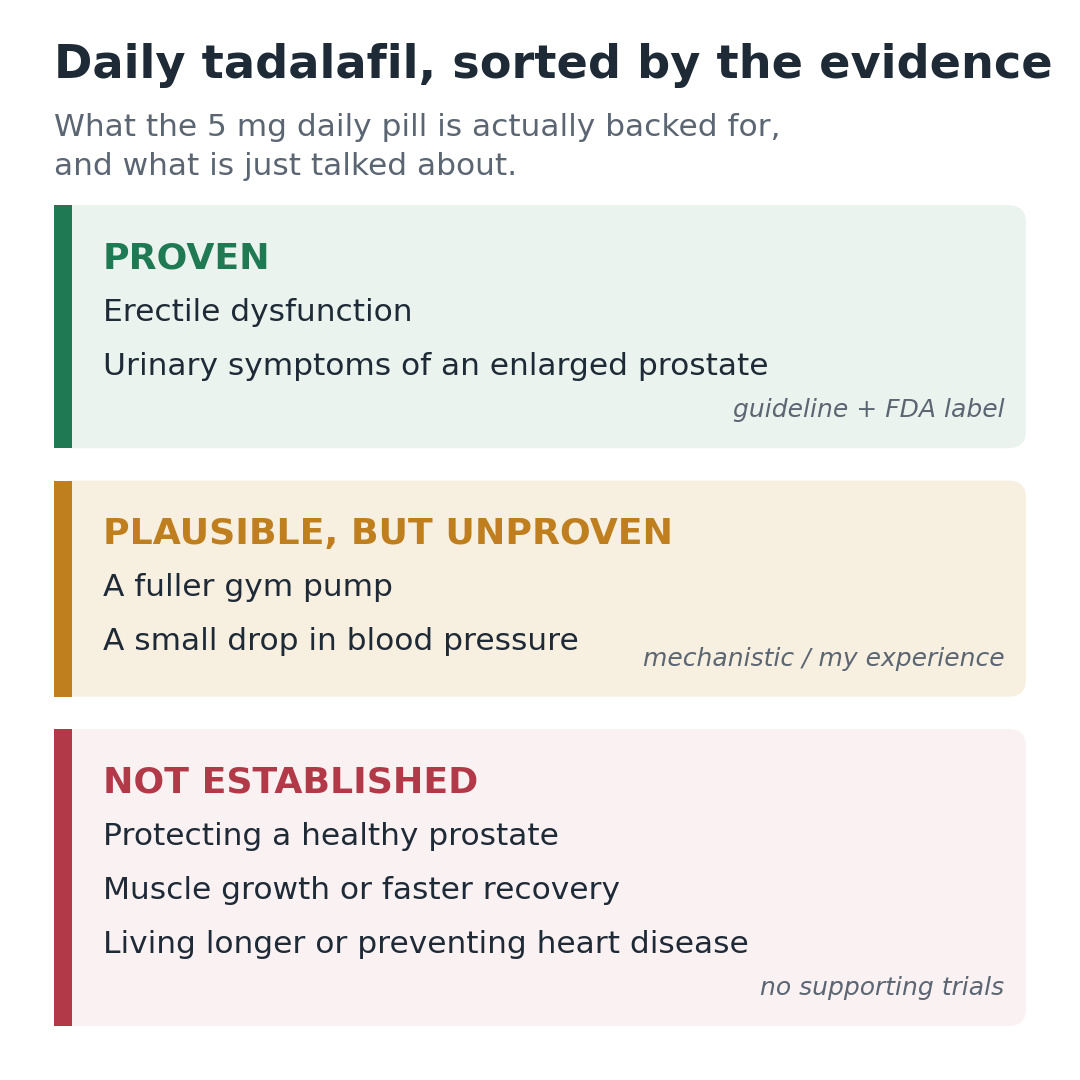
My gym pump is a step down from that. It is real to me, and it makes mechanical sense, since tadalafil widens blood vessels. But the studies on these drugs as workout aids are small and they contradict each other, so I notice a difference and still would not sell it to you as proven. The small blood-pressure drop is the same kind of thing. Expected from a vasodilator, real enough, but not a reason anyone should start the drug.
Most of the rest is speculation, and it is the part the internet likes best. If you spend any time in the health-optimization corner of it, you have heard the bigger version, where people like Andrew Huberman and the physician Kyle Gillett discuss prescribing low-dose daily tadalafil to men with no urinary or erectile symptoms, purely to push more blood flow through the prostate and keep it healthy, framed as a quiet longevity move. It does not hold up. A randomized trial that measured prostate and bladder-neck perfusion (Pinggera et al., Urology, 2014) found no detectable increase with tadalafil versus placebo. That does not rule out every possible mechanism, but pushing more blood through the prostate is not an established explanation for what the drug does. Nobody has shown daily tadalafil keeps a healthy prostate out of trouble. It has not been shown to build muscle or speed recovery either. And those lower death rates in the big observational study are a correlation, not a longevity benefit you can bank on. I am on the drug myself, and honestly I lean closer to the optimize camp than the treat-real-symptoms one, so I am not knocking the instinct. I just think people hear a maybe on a big podcast and repeat it as fact.
Nitrates, poppers, and the one interaction to never ignore
If you go looking, you will find scary-sounding warnings about mixing tadalafil with other prostate drugs. Some of those combinations are used under a doctor’s supervision, and this is exactly where a medication review matters. The guideline discusses pairing daily tadalafil with an alpha-blocker (a prostate-and-blood-pressure relaxer such as tamsulosin) or with finasteride, and in the finasteride case tadalafil even blunts the sexual side effects that drug is notorious for. The alpha-blocker pairing is the one to be careful with, since both drugs lower blood pressure, and tadalafil’s own label is cautious about combining them, especially if your blood pressure is already being treated.
The combination that is genuinely dangerous is nitrates. Nitroglycerin and the other nitrate heart drugs also lower blood pressure, and stacked with tadalafil the drop can turn dangerous. That warning also includes recreational “poppers,” such as amyl or butyl nitrite, which can produce the same dangerous interaction. One prescription drug belongs on the same do-not-combine list: riociguat, used for pulmonary hypertension, which works on the same pathway. So keep tadalafil on your medication list, and if you ever call 911 or land in an ER with chest pain, say out loud that you take it before anyone reaches for nitroglycerin.
Most of the other side effects are mild and boring: a headache, some back stiffness, a stuffy nose, only slightly more often than on a placebo. Two rare ones are worth knowing so you don’t sit on them. An erection that lasts more than four hours, or a sudden change in your vision or hearing, both mean seek urgent medical care rather than wait it out. And there is a gentler version of the blood-pressure issue in my own case. Tadalafil lowers blood pressure a little on its own, and I already take a blood-pressure medicine for a vascular condition I watch closely. The testosterone cuts the other way: FDA labeling now warns that testosterone therapy can raise blood pressure in some men, which is one more reason my doctor keeps an eye on mine. For me the balance is probably fine, but it is the kind of judgment to hand to your doctor rather than make alone. My primary care doctor asks me at every visit whether I have noticed any signs of low blood pressure, and I never have, but yours should be watching the same way.
Worth asking about, not ordering online
If you are a man past about forty-five who is up twice a night to pee, or things have clearly changed in bed, this is worth raising, and I would name daily low-dose tadalafil specifically. It is generic now, and it is in the guideline. The reason to get it through a real doctor rather than some online men’s-health mill is not the pill, which is well tolerated. It is that new erectile dysfunction earns a proper look at your blood pressure, your cholesterol, your other medications, and maybe that calcium scan, and the nitrate interaction only bites when nobody knows to check for it.
I started on it through my TRT clinic, where it came bundled in with everything else, but after a while I moved the prescription to my primary care doctor. She was glad to take it over. It gives her the full picture of what I am on instead of a drug floating outside her chart, and as a side benefit, my insurance covers it that way. Whichever doctor writes it, it stays a supervised prescription, with my blood pressure and my PSA, the prostate blood test, checked on a schedule, though that monitoring is really about the testosterone, my age, and ordinary prostate screening, not anything the tadalafil itself demands.
So if you have the urinary symptoms, or things changed in the bedroom without warning, don’t just order a pill. Get the workup. The tadalafil is the easy part.
About Gunnar
Gunnar is 53. He lost about 170 pounds, trains in a garage gym, and writes DadStrengthDaily from personal experience, citing primary sources where he can. He also moderates r/ProactiveHealth. He is not a doctor, and nothing here is medical advice. Talk to your own doctor before acting on anything, especially GLP-1s, TRT, blood pressure, and prostate or cancer screening.