
I first felt it doing split squats. That lift puts a lot of weight on the rear foot’s big toe, fully bent, and the bent joint is exactly where the pain showed up.
Then last November a radiologist put one word on my right-foot X-ray: severe. Severe first-MTP joint space narrowing, sclerosis, cysts, osteophytes. That’s the big-toe knuckle. In plain English, the cushioning in the joint is mostly gone and it’s growing extra bone, and it’s doing that while I keep training.
I’d made peace with managing it. Then a study landed that, read at headline speed, tells me to get that joint fused for good.
What the trial actually found
This month, Finnish surgeons published the first randomized trial to test surgery against simply leaving an arthritic big toe alone, in Annals of Internal Medicine. Ninety adults with painful hallux rigidus (the medical name for the stiff, arthritic big toe I’ve got) split down the middle. One group had the joint surgically fused: welded solid with a lag screw and a plate. The other got “watchful waiting”: education, over-the-counter painkillers, optional footwear changes. Then their walking pain got measured a year later; 89 of the 90 finished.
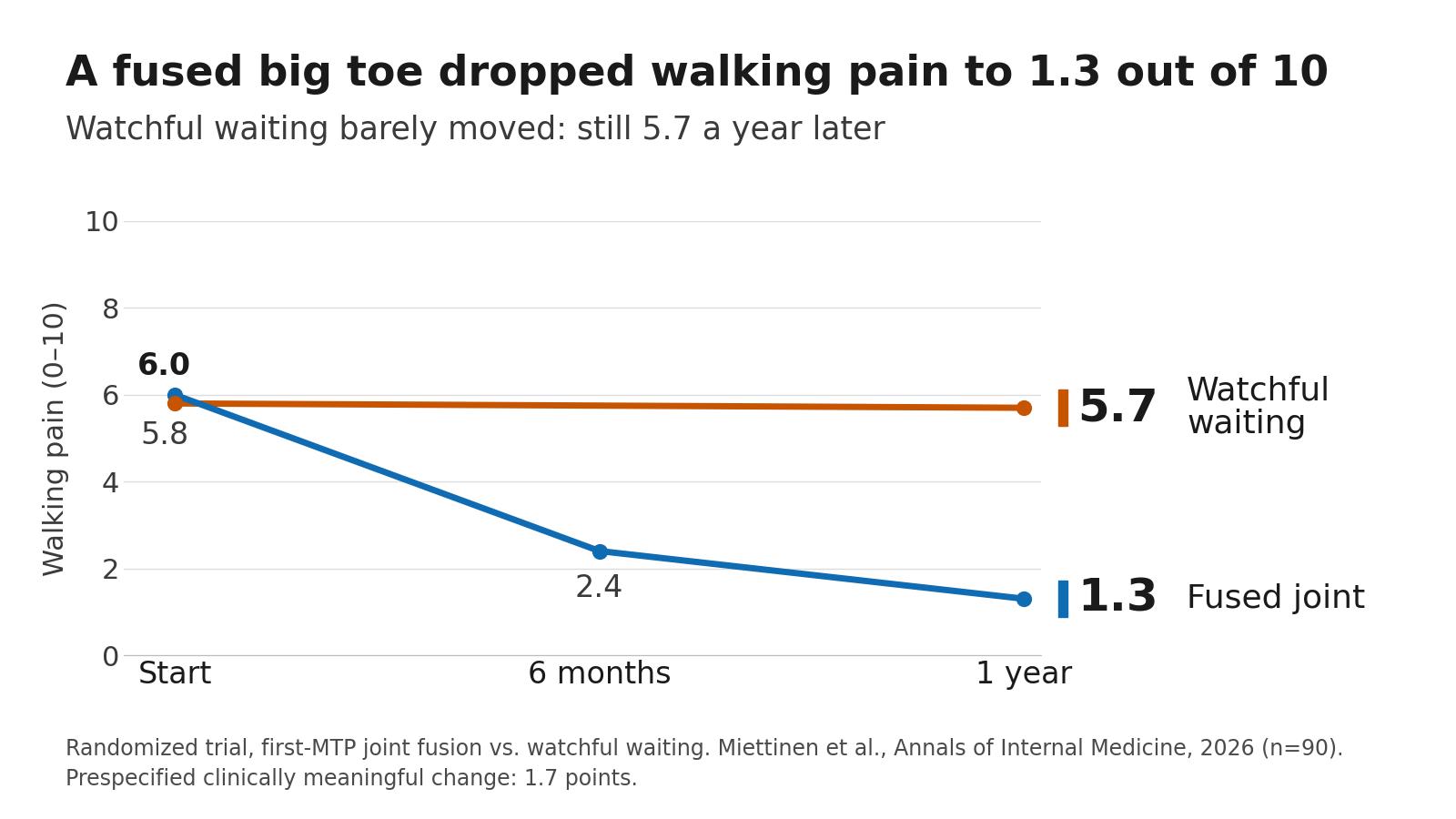
The gap is not subtle. Walking pain started around 6 out of 10 in both groups. At twelve months the fused group averaged 1.3. The watchful-waiting group sat at 5.7, basically where it began. Before the trial started the researchers had decided 1.7 points would count as a clinically meaningful change; the gap between the groups, adjusted for their baseline differences, came out to 5.0, three times that. Nearly 90% of the surgery patients said they were satisfied; 20% of the waiters did.
There were no serious complications in either group. Four of the 45 surgical patients, about 9%, ended up with a nonunion, the term for a fusion that didn’t fully knit, and a couple of toes healed slightly overcorrected. None of that caused symptoms or needed a second operation inside the year the trial ran. A year is also a short window for judging a fusion: the known late costs, hardware that ends up needing removal, arthritis in the neighboring joints, pain shifting elsewhere in the foot, mostly show up after a follow-up this short has ended.
If your big toe hurts when you walk, a 4 or more out of 10 and for a year or more, that’s a real result, the first randomized evidence anyone has on big toe arthritis surgery versus waiting. The authors said it plainly: fusion gave a superior, clinically meaningful drop in walking pain. What they did not say is “don’t wait to operate.” That was the press coverage, not the paper.
That entry bar is also where I fall out of the picture. My day-to-day pain is minimal now, nowhere near the walking pain the trial required. By the trial’s own criteria I am probably not a candidate for surgery. Its result describes men in real daily pain. Mine only complains when I load it fully bent in a split squat.
Get the next one in your inbox
I write about longevity, training, and preventive health weekly — without the guru worship. Free, no spam, unsubscribe whenever.
Three things the headline skips
First, look at what surgery beat: that light-touch waiting program and nothing else. Not physical therapy. Not a steroid injection. Not a joint-preserving operation. None of those got tested against fusion at all. So the trial shows fusion beats near-nothing; it can’t tell me whether fusion beats a cortisone shot or a joint-sparing surgery, which are the moves I haven’t tried yet.
Second, nobody was blinded. The surgery patients knew they’d been operated on; the waiters knew they’d been handed a leaflet. That matters more than it sounds, because the headline number is a score each patient reports about his own pain, and orthopedics has been burned by exactly this setup before. When knee arthroscopy for arthritis (Moseley, 2002) and keyhole meniscus surgery (Sihvonen, 2013) were finally tested against fake operations, both turned out no better than the sham. I’m not claiming fusion is another one of those. A fusion removes the worn joint surfaces entirely, so there’s a real mechanical reason it should work, and a five-point drop is a lot to pin on expectation alone. But with no fake-surgery group in this trial, nobody can say how much of the swing is the fusion and how much is having had an operation at all.
Third, fusion is permanent. It locks the joint at a fixed angle and kills the toe’s motion for good; on film, a finished fusion is a pair of screws crossed through the knuckle. For a guy who trains, that’s not a footnote. A split squat bends the big toe about as far as it will go and loads it there; that is the exact motion fusion removes. Could I still split squat on a fused toe? That’s the first question I’d want answered, and this trial doesn’t ask it.
Cycling and rowing are safe harbors for a bad big toe; the foot stays flat or strapped and never has to bend it, so my KICKR sessions and my erg barely notice. Running is what suffers, and I already can’t run; my left knee is bone-on-bone. On paper that makes me the ideal fusion customer. That’s exactly the kind of arithmetic I don’t want to do with a permanent operation on the strength of one unblinded trial.
My X-ray says severe. My doctor says wait.
The film reads severe, the radiologist’s word, not a formal grade. And yet my podiatrist wrote that I’m “not yet a candidate” for surgery. I told him the symptoms were “manageable and tolerable,” and I meant it.
Big-toe surgery is elective and driven by symptoms, not by how the film looks. You can carry a severe-looking X-ray and stay non-surgical for years, as long as the pain is controlled and you haven’t worked through the conservative options. I haven’t. I’ve never had a cortisone injection, and I’ve barely committed to the footwear fixes: the carbon-fiber plate for the shoe, the rocker-soled Hokas my podiatrist keeps pushing. And cheilectomy (shaving off the bone spur while keeping the joint’s motion) is a joint-sparing operation I’d want to ask about before anyone talks fusion, though its track record is mostly in milder joints than my film shows, so it may not even be on the table. None of those options carries trial evidence anywhere near this fusion result. What they offer instead is that they leave the joint moving, and none of them closes the fusion door later.
What “waiting” has to actually mean
What the trial did change is how I read that word. Sixty-four percent of the control group ended up wanting the operation anyway. Wanting isn’t getting, but the plain reading is hard to dodge: their pain sat at 5.7 a year in and they were tired of hurting. I don’t take that as a nudge toward the knife. I take it as a warning about the word itself: watchful waiting curdles into plain old waiting the moment I stop being honest about the trend. So the watching is getting concrete. I’m tracking walking pain as an actual number, 0 to 10, the way the trial did, so I can see the line moving before it’s a cliff. I’m committing to the stiff sole for real; a carbon plate or a Morton’s-extension insole (a rigid strip that stops the big toe from bending) takes the toe out of the job. In training the toe stays short of the angle that hurts instead of getting loaded at full bend. And I’ll ask my podiatrist about the cortisone shot he mentioned, and about the joint-sparing options, instead of treating fusion as the only door.
What I’m taking from this trial isn’t rush to the surgeon. It’s a lower bar for admitting the joint is getting worse. The waiting group sat at 5.7 a year later; if the number I’m tracking starts climbing toward that, the plan changes. The trial didn’t tell me to operate. It told me not to look away.