
Two of the biggest employers in the country made opposite calls on GLP-1 coverage in the same week. Both were reacting to the same price.
Update, August 26, 2026: Add PepsiCo to the Starbucks pile.
On August 5, 2026, Bank of America’s CEO, Brian Moynihan, told CNBC the bank spends more than $250 million a year covering GLP-1 drugs for its 211,000-odd employees. Wegovy, Zepbound, Ozempic, Mounjaro. That’s about 13% of the bank’s entire $2 billion health budget, up from basically nothing four or five years ago. He called it a good investment.
Two days later, Business Insider reported that Starbucks is doing the reverse. Come October, it stops covering those same drugs for weight loss for its baristas. They stay covered for diabetes.
It would be lazy to read the split as one generous company and one stingy one. Both are answering a question every employer in America is now stuck with, whether they say it out loud or not. Is your health something they invest in, or a cost they’d rather cut?
GLP-1s didn’t invent that question. Employers have always decided how much of your body they’re willing to pay for. What these drugs did was force the decision into the open, because millions of people want them at once and the bill shows up every single month.
The whole fight is over what a month of the drug costs
Strip the press releases away and Bank of America and Starbucks are not disagreeing about whether the drugs work. They are disagreeing about one number: what a health plan pays for a month of the drug, which today runs somewhere between $617 and $766.
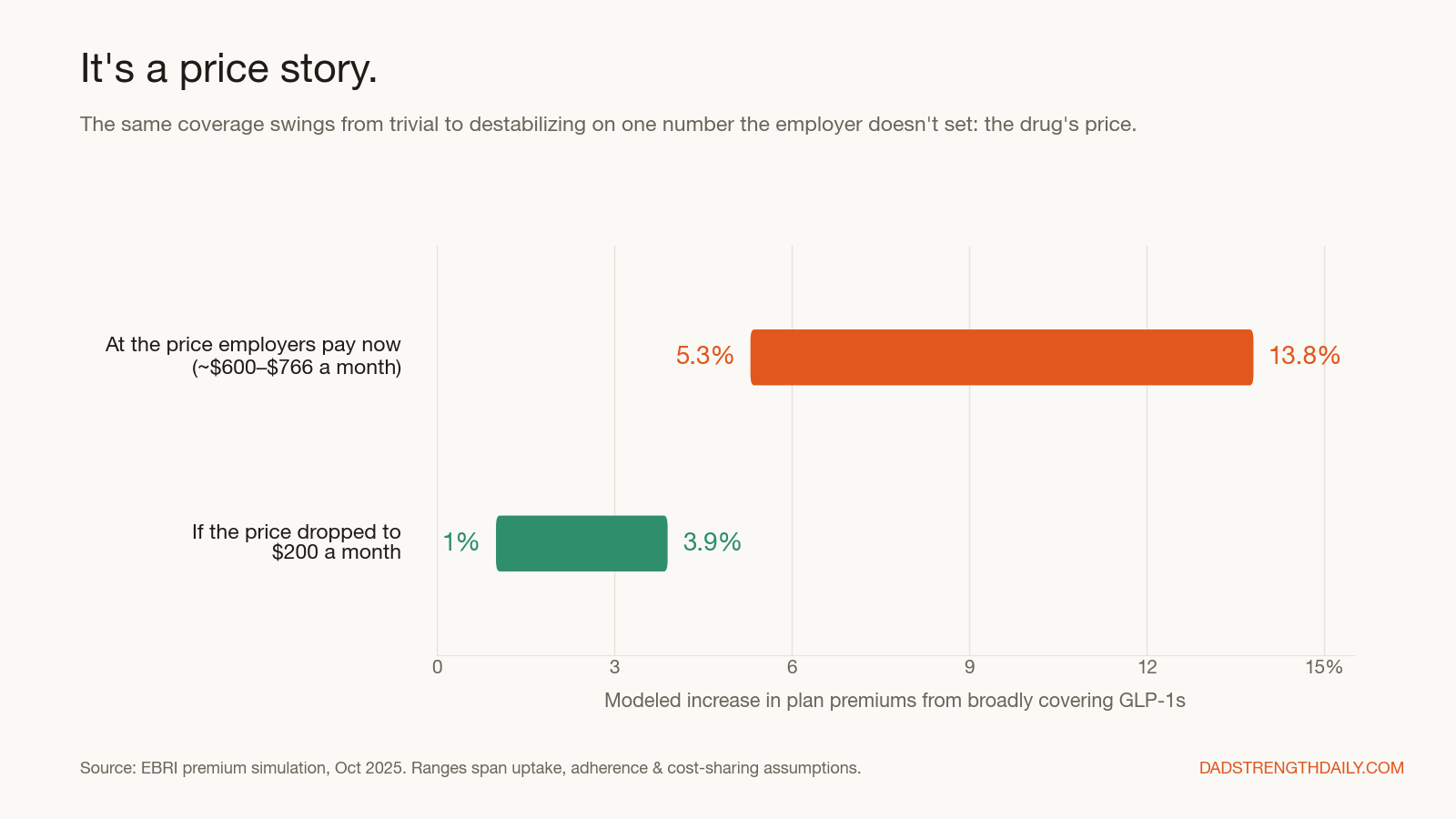
The study that convinced me of that came from EBRI, a research shop that studies employee benefits, in October 2025. They simulated what happens to a plan’s premiums when GLP-1 coverage is added. At today’s prices, premiums rise 5.3% to 13.8%, with the spread depending on how many eligible employees actually start the drug and how much of the cost gets pushed onto them. Then they reran the same simulation with the drug priced at $200 a month. The increase nearly disappeared: 1% to 3.9%. The employees and the coverage rules stayed identical; only the price moved.
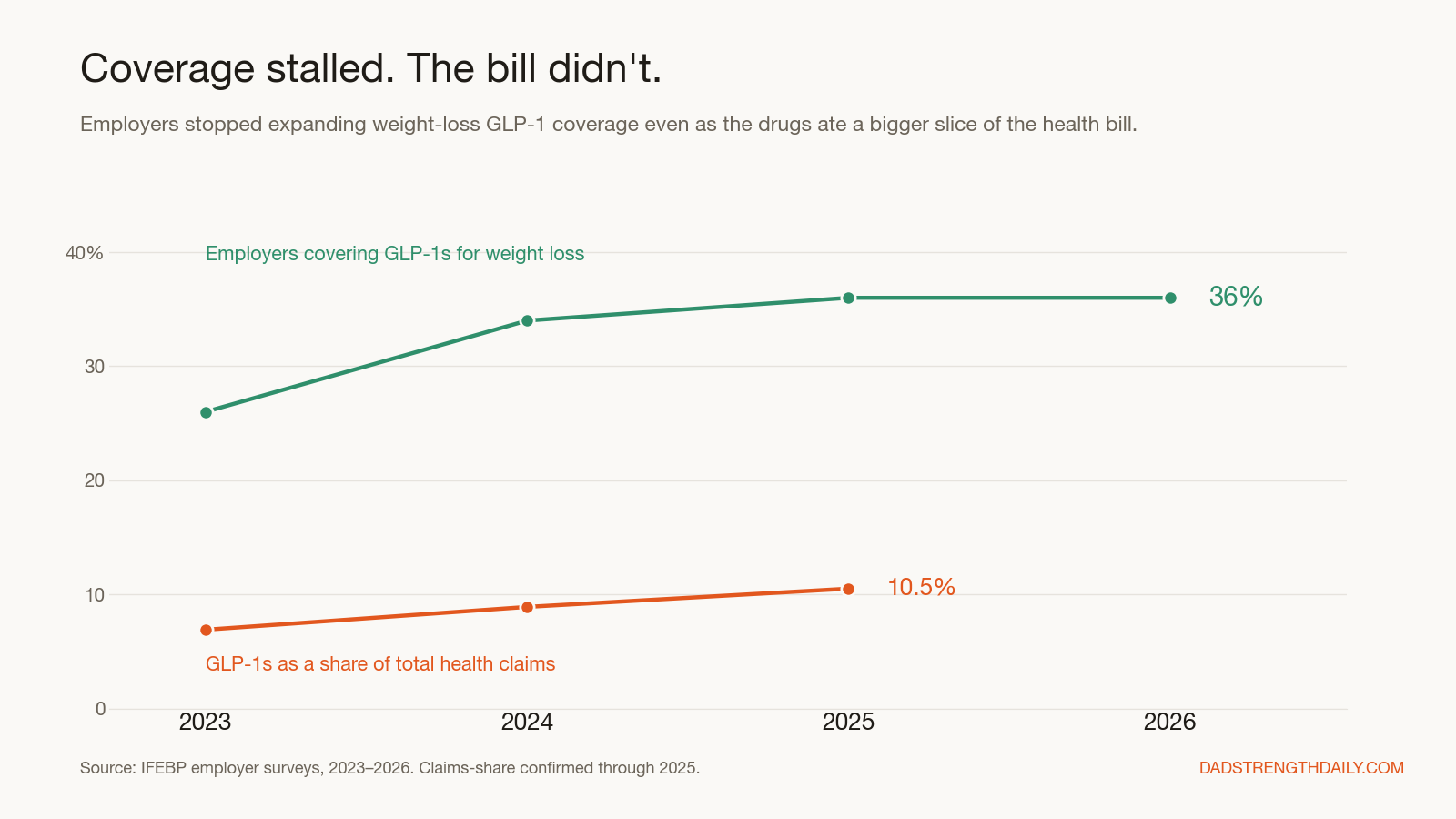
So at today’s price, these drugs are a tenth of the bill. They went from under 7% of employers’ total health claims in 2023 to more than 10% by 2025. At $200 they would be a rounding error. And that price is the one thing in this story an employer does not control. Lilly and Novo set it; an employer can negotiate rebates around the edges.
You would think the fix is to skip the PBM and buy straight from the manufacturer, and since March that option exists: Lilly’s Employer Connect program offers self-insured employers Zepbound at a $449-a-month drug price, before program fees, and Novo has similar routes through partners. But notice who set that number: Lilly again. And $449 is roughly what a large rebated plan already nets after its PBM discounts, which is why five months in I could not find one employer publicly using it. There is also a catch: pulling one drug out of a PBM contract can void the rebates on everything else in it, diabetes drugs included. Going direct swaps a negotiated price for a posted one. It still is not the employer deciding what the drug costs.
That’s why so much of what employers do next is less a grand strategy than a reaction to a price somebody else set.
Get the next one in your inbox
I cover the latest GLP-1 trials and access changes weekly. Free, no spam, unsubscribe whenever.
What they’re actually doing
Be suspicious of anyone who quotes you a national coverage rate, because it depends entirely on who got asked. Depending on the survey, it’s anywhere from 19% of employers to two-thirds of them: KFF found 19% of companies with 200-plus workers but 43% of the giants, while a survey of big self-insured employers put it near 67%. They’re all counting different rooms.
What’s the same in every room is the behavior. Coverage isn’t so much disappearing as getting walled off. In Mercer’s 2026 survey, 6% of large employers had already dropped the benefit and another 5% were thinking about it. The more common move is to keep covering and make it hard to actually use.
So a few employers still cover the drugs cleanly, Bank of America among them, with coaching attached. That list is short. Far more are keeping coverage but bolting on gates: prior authorization, which roughly 80% of covering employers now require; BMI floors, like Kansas at 35 or Fairview Health at 40; lifetime dollar caps, like Mayo Clinic’s $20,000; and mandatory lifestyle programs you have to join before the drug unlocks, which is what Michigan and Jefferson Health do. The share of employers demanding a coaching or clinical hoop before approval jumped from 10% to 34% in a single year.
Kalamazoo County, Michigan gave me the most ordinary version of this. On August 5, the same day Moynihan was making his case, the county board voted 8 to 0 to keep covering GLP-1s and slap a flat $200-a-month copay on them starting in 2027. The drugs were running about $1.6 million, roughly 2% of the county’s operating budget by its own math. Keep covering as-is, premiums jump 11.5%. Kill it, they jump 5.5%. So the commissioners split the difference and moved part of the cost onto the workers taking the drug. They rejected a 50% coinsurance option, where you pay a percentage of the bill instead of a flat fee, because it would have gutted lower-paid staff. They called the copay a temporary stopgap, which is what most of these turn out to be.
There’s a version of this that looks colder than it is. When North Carolina’s state plan tried to narrow Wegovy coverage instead of dropping it, Novo’s contract voided a 40% rebate if the plan restricted use at all. Cover everyone or cover no one. Some employers that look heartless got backed into it.
The vendors can’t agree with each other
A whole industry has sprung up to sell employers a way through this, and its marketing argues with itself. One camp gets paid to keep you on the drug: Omada sells a “GLP-1 Companion.” The other gets paid to get you off it: Twin Health advertises “85% GLP-1 elimination,” and Virta says “68% of GLP-1 spend is wasted.” Same buyer, your employer, and directly opposite promises.
Read a few of these pages back to back and the tell jumps out: they’re barely pretending to sell health to you. The customer is your employer, and the product is a smaller drug bill. 9amHealth’s page doesn’t say get healthier; it says “Take control of GLP-1 spend.” Every number on both sides is self-reported. So when your benefits packet introduces a new “weight health partner,” figure out which side of that bet they’re getting paid to be on.
Why the cutters think they’re right
The strongest case for dropping coverage is arithmetic.
An employer who pays for your weight loss today may never see a dime of the return. The payoff, fewer heart attacks and less diabetes down the line, shows up ten or twenty years out. But the median American changes jobs every 3.9 years, and the Peterson Health Technology Institute said it plainly: at today’s prices, GLP-1 costs run past any savings “over the 3–4-year period in which most workers are covered by their employer-sponsored insurance.”
Run it the way a CFO does: I pay $700 a month, right now, for an employee who will probably quit the drug inside two years and quit the company inside four. The heart attack I might have spared him lands sometime around 2037, on the next company’s books, or on Medicare’s. Fang and Gavazza modeled this in an American Economic Review paper back in 2011: high-turnover employers rationally skimp on prevention, because the benefit lands in somebody else’s lap. Every employer plays it that way, so society eats the cost, and no single company is being irrational.
Turnover isn’t even the whole problem, because most people don’t stay on the drug anyway. Mercer and the pharmacy manager Prime found only about 1 in 12 people are still on a GLP-1 three years in. And one employer’s numbers, reported through KFF, made the near-term math almost cartoonishly bad: its GLP-1 users saved about $560 a year in other medical costs against roughly $6,540 a year in drug spend. That’s one company’s experience, not a law of nature, but it’s the kind of ratio that ends coverage. Even ICER, which runs cost-effectiveness analysis for insurers, came down in a split place: announcing its final report on these drugs in December 2025, its chief medical officer called them “highly cost-effective” on average, then said the population that needs them is so large the US system “will be strained to provide them to most people who need them in an affordable manner.”
I don’t love that conclusion, but I can’t call it stupid.
What Moynihan actually did
Moynihan did not win the turnover argument. He didn’t even try. If you watch the clip, the reporters are the ones who bring up the objection, how do you justify a quarter-billion dollars when people leave, and he just declines to argue it on those terms. “We see a great impact on the employees.” “It’s the right thing to do for your teammates.” “We want to be the great place to work.” The one economic thing he said was small and honest, that the drugs cut near-term heart problems in the people taking them, and that’s the payback.
I think he’d tell you the turnover numbers are basically right, and that he just doesn’t believe a spreadsheet gets the final say on something like this. You can call that admirable or you can call it naive, and honestly which one you land on probably tells you what kind of boss you’d be.
Before you decide the big spenders are the heroes
Spending freely isn’t a free pass either. Employers are getting sued now over how they run their health plans. The cases against Johnson & Johnson, Wells Fargo, and JPMorgan aren’t about GLP-1s; they’re about employers overpaying the pharmacy middlemen. But the principle reaches this fight too: a benefits manager is increasingly on the hook for getting a defensible price, which makes writing an unquestioned check for GLP-1s harder to justify, not easier.
So “just pay whatever it costs” isn’t a health philosophy either, it’s surrender. The employers I’d actually trust are doing the harder version: they dig out what the drug really costs after the rebates and lean on that number, they’re upfront about the hoops they add, and they don’t pull the plug over one bad year of claims.
The companies that treat health as an investment usually looked different long before GLP-1s showed up. Rosen Hotels has run its own clinic since 1971. QuadMed rebuilt itself from a buyer of insurance into an investor in its own workers, clinics and all. Bank of America pairs the drugs with coaching and tracks whether anyone actually gets healthier. None of these are soft outfits. They decided a healthy workforce is worth building and then went looking for the numbers to back it up.
The companies cutting aren’t villains either; they’re following a short horizon and a punishing price. But the person deciding whether your health is worth paying for may not have you on the payroll five years from now. GLP-1s just made that visible. The next drug that’s expensive and effective and wanted by everyone, and it’s coming, lands on the same desk and gets sorted into the same two piles. Your employer has already picked a pile. It’s written in your plan documents, if you go looking.
Before open enrollment
- Read your plan before you need it. Find out whether your employer covers GLP-1s for weight loss at all, then find the catch. A prior-auth step, a BMI floor, a required coaching program, a lifetime cap, or a $200 copay can each be the difference between covered and covered on paper. Open enrollment is when it’s decided and the summary of benefits is where it’s buried. If it isn’t spelled out, make HR say it in writing.
- If you get dropped, there are cash routes. Zepbound runs $449 a month at most doses straight from Lilly, and injectable Wegovy $349 a month through NovoCare after two $199 starter fills, no insurance in the loop. Those are savings-program prices, published through the end of 2026. Not cheap. But sometimes cheaper than the coinsurance you were paying on the list price, so it’s worth doing the comparison. I priced all the cash routes, prescribing fees included, in a separate post.
- If you snore like a freight train, sleep apnea is a separate door. Zepbound is FDA-approved for moderate-to-severe obstructive sleep apnea in adults with obesity, so a weight-loss carve-out doesn’t necessarily settle the coverage question for someone who also has OSA. It’s gated behind a sleep study and no plan is forced to honor it. But if you’re a 50-year-old guy whose wife has opinions about your breathing, that study is worth getting for reasons that have nothing to do with a prescription.
Update, August 26, 2026: Add PepsiCo to the Starbucks pile. Bloomberg reports Pepsi is dropping weight-loss GLP-1 coverage, in an email sent to employees not by Pepsi but by Express Scripts, its PBM. Workers can keep the drugs by paying cash — the email helpfully notes the manufacturer pathways I priced above now exist. The stated reason: keeping the plan “sustainable and affordable for every employee.” Same arithmetic as everyone else. The twist is who’s cutting: a snack company whose customers eat less on these drugs, deciding they’re too expensive to buy for its own workers.