
Updated with Novo’s REIMAGINE 5 and REDEFINE 9 toplines.
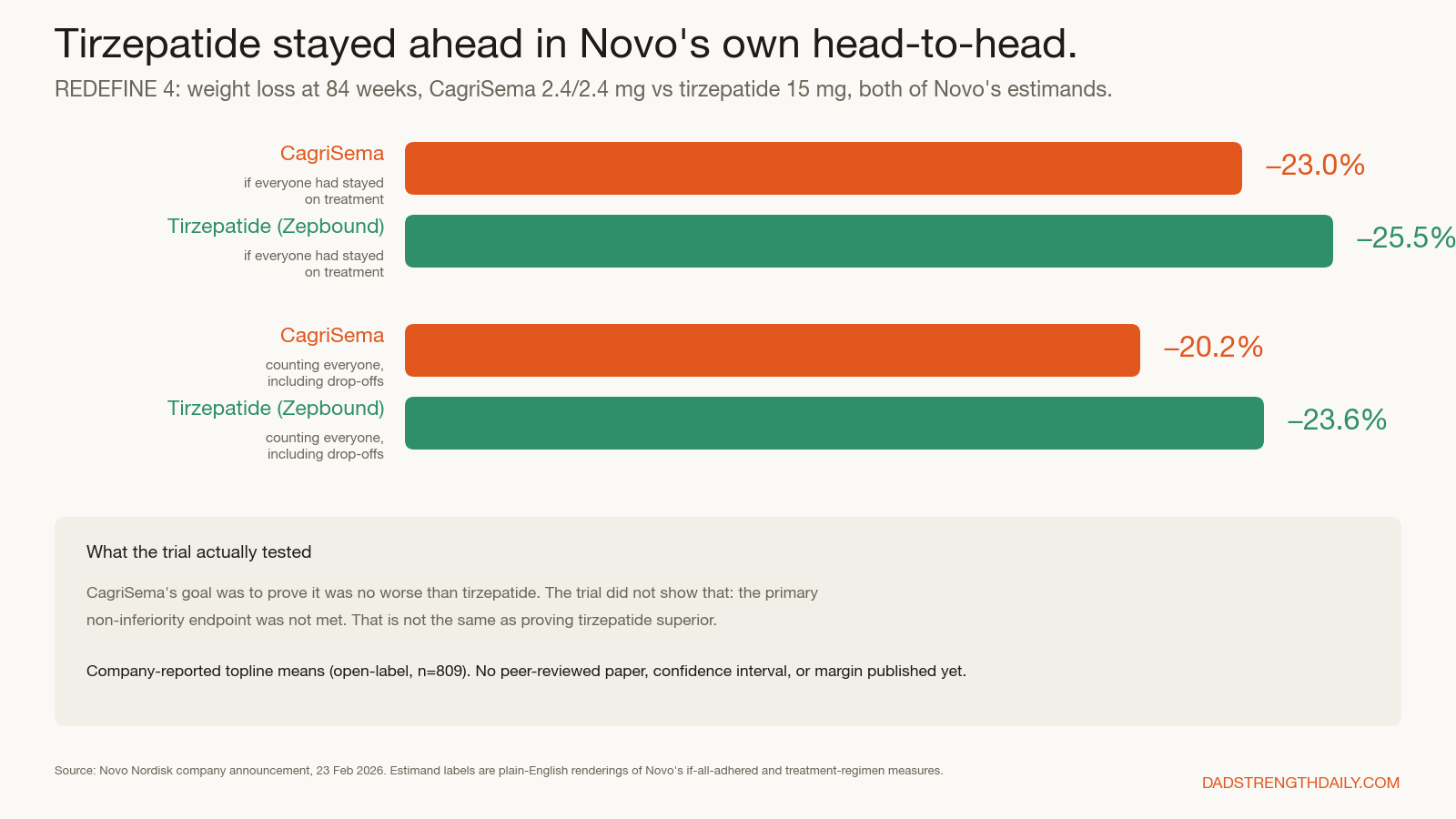
CagriSema vs Zepbound is a comparison Novo Nordisk ran itself: it put its new weight-loss combination head-to-head against tirzepatide, the drug in the Zepbound pen I inject every week. The trial’s job was to show that CagriSema was no worse than tirzepatide, and it did not show that. Tirzepatide came out ahead on both of the measures Novo reported, and the trial missed its primary endpoint. Novo announced that result in February 2026.
Disclosure: I take Zepbound, and I own Eli Lilly stock, the only pharmaceutical stock I hold. Nobody paid for this page.
What are the two drugs in CagriSema?
One weekly injection carrying two drugs at fixed doses. Semaglutide 2.4 mg is the Wegovy molecule. Cagrilintide 2.4 mg is the new half, a long-acting analogue of amylin, a hormone your pancreas releases alongside insulin when you eat. Amylin slows the stomach and signals fullness through different receptors than GLP-1 does, and that second pathway is the point. Semaglutide on its own lost to tirzepatide in SURMOUNT-5 by six and a half points. Novo’s case for the combination is that cagrilintide adds to what semaglutide does alone.
In its pivotal trial, REDEFINE 1, 3,417 adults without diabetes were randomized across four arms for 68 weeks. Counting everyone who was randomized, CagriSema cut body weight by 20.4 percent, against 14.9 percent for semaglutide alone, 11.5 for cagrilintide alone and 3.0 for placebo, so the combination adds 5.5 points over semaglutide inside the same trial. Novo filed CagriSema with the FDA in December 2025 on the strength of that trial and a second one in type 2 diabetes.
Is CagriSema better than tirzepatide?
Not on the evidence that exists. The one obesity trial that compared them directly found tirzepatide ahead. REDEFINE 4 randomized 809 adults with obesity and one or more other health conditions to CagriSema or tirzepatide 15 mg, the top Zepbound dose, for 84 weeks. It was open-label, so everyone knew which pen they held, which can bias how people report side effects and whether they stick with the drug. Novo reported the result two ways, what statisticians call two estimands. Using everyone who was randomized, including people who stopped injecting, the result was 20.2 percent for CagriSema and 23.6 for tirzepatide. Novo also published the estimate that assumes everyone stayed on treatment, which runs higher for both drugs, and there it was 23.0 against 25.5. Novo’s headline used CagriSema’s 23 percent figure, and tirzepatide was ahead either way. On the trial’s average starting weight of 114.2 kilograms, about 252 pounds, the 3.4-point gap on the count-everyone numbers works out to roughly eight and a half pounds, a group average rather than a prediction for any one person.
The primary endpoint was non-inferiority. Novo set out to show CagriSema was not meaningfully worse than tirzepatide, which is a lower bar than beating it, and the trial did not clear it. I would not call that proof that tirzepatide is superior. Superiority was a secondary endpoint, and Novo has not reported a result for it, has not released the margin it was aiming for or the confidence intervals, and all anyone has is a press release, not a paper. Still, Novo designed this trial and ran it, and its drug came in behind on both counts.
Novo also ran the diabetes version, REIMAGINE 4, over 68 weeks. There CagriSema was non-inferior to tirzepatide on weight but did not show non-inferiority on HbA1c, the blood-sugar endpoint, with tirzepatide numerically ahead on both: 15.8 versus 15.2 percent weight loss, and 2.2 versus 1.9 points off HbA1c, if everyone had stayed on treatment, per Novo’s second-quarter report. In two head-to-heads, CagriSema never finished ahead.
Update, September 26, 2026: Novo reported two more trials on September 21, as a press release and investor slides, not papers. In REIMAGINE 5, in people with type 2 diabetes, CagriSema beat tirzepatide on weight over 60 weeks, 12.42 percent against 9.12 percent, and matched it on HbA1c. That is the first head-to-head CagriSema won, but the comparison was tirzepatide 5 mg, its lowest maintenance dose, not the 15 mg in REDEFINE 4. In REDEFINE 9, an obesity trial of lower doses, CagriSema 1.0/1.0 mg gave 20.95 percent weight loss against 2.0 percent on placebo. A footnote on Novo’s slides shows the higher 1.7/1.7 mg arm gave 20.75 percent, slightly less. All of these are the if-everyone-stayed-on-treatment figures, so they don’t line up with the 20.4 percent REDEFINE 1 number above. The FDA decision on the obesity application is still due in the fourth quarter of 2026.
CagriSema vs Zepbound side effects
Novo has not released the side-effect numbers from REDEFINE 4, so a CagriSema vs Zepbound comparison on side effects is not possible yet. The announcement says CagriSema’s most common side effects were gastrointestinal and that “the vast majority were mild to moderate and diminished over time”, and it gives no rates for either drug and no dropout numbers. What exists is CagriSema against placebo: in REDEFINE 1, 79.6 percent of people on CagriSema had a gastrointestinal side effect versus 39.9 percent on placebo, most commonly nausea (55 percent versus 12.6), and 5.9 percent quit because of side effects versus 3.5 percent. Tirzepatide’s own trials report the same pattern of stomach trouble, but rates from different trials cannot be lined up against each other. Until the REDEFINE 4 paper is published, which one is easier to live with is unknown.
When is CagriSema’s FDA approval date?
It isn’t approved, and no date exists. Novo submitted the application in December 2025, and its guidance is an FDA decision “by late 2026”, listed as the fourth quarter of 2026 in the second-quarter report. There is no launch date and no price yet, and I wouldn’t guess at either. My GLP-1 pipeline tracker follows the decision.
What is CagriSema’s brand name?
Novo has not announced one. CagriSema is a development name, and Novo has eleven invented names alive at the US Patent and Trademark Office that could end up on the box, plus Wegovy+ and Wegovy Plus, which both finished registering this summer. The one I would watch is Wegovamy, and I list the trademark and domain records in my CagriSema brand-name post.
One warning: the day this drug gets famous, peptide sites will sell vials labeled cagrilintide plus semaglutide. The trials tested one manufactured fixed-dose product, not two research chemicals mixed at home; my hierarchy for anything injectable covers why that gap matters.
What I would actually do. I am staying on tirzepatide, and it isn’t a hard call. The trial gave me no reason to move, and it never looked at switching: REDEFINE 4 compared people who started one drug with people who started the other, so nothing in it says what dose a switcher would land on or whether the weight holds.
If I were starting today, I would start with Zepbound. It is approved, I can get it, and the one direct comparison had it ahead. Someone whose insurance covers one drug and not the other could reasonably land elsewhere once CagriSema is approved, and whether people who cannot tolerate tirzepatide do better on it is a fair question for a doctor, because REDEFINE 4 did not test it. If you are on Medicare, what would have to happen for it to be covered is its own question, and I answered it separately. What would change my own answer is a price. If Novo sells cagrilintide plus semaglutide for meaningfully less than Lilly sells tirzepatide, the math changes for a lot of people. Novo has not named one.
Get the next one in your inbox
I cover the latest GLP-1 trials and access changes weekly. Free, no spam, unsubscribe whenever.