
Updated with corrected approval timing in the deck, BMI thresholds, hero alt text and generic drug names.
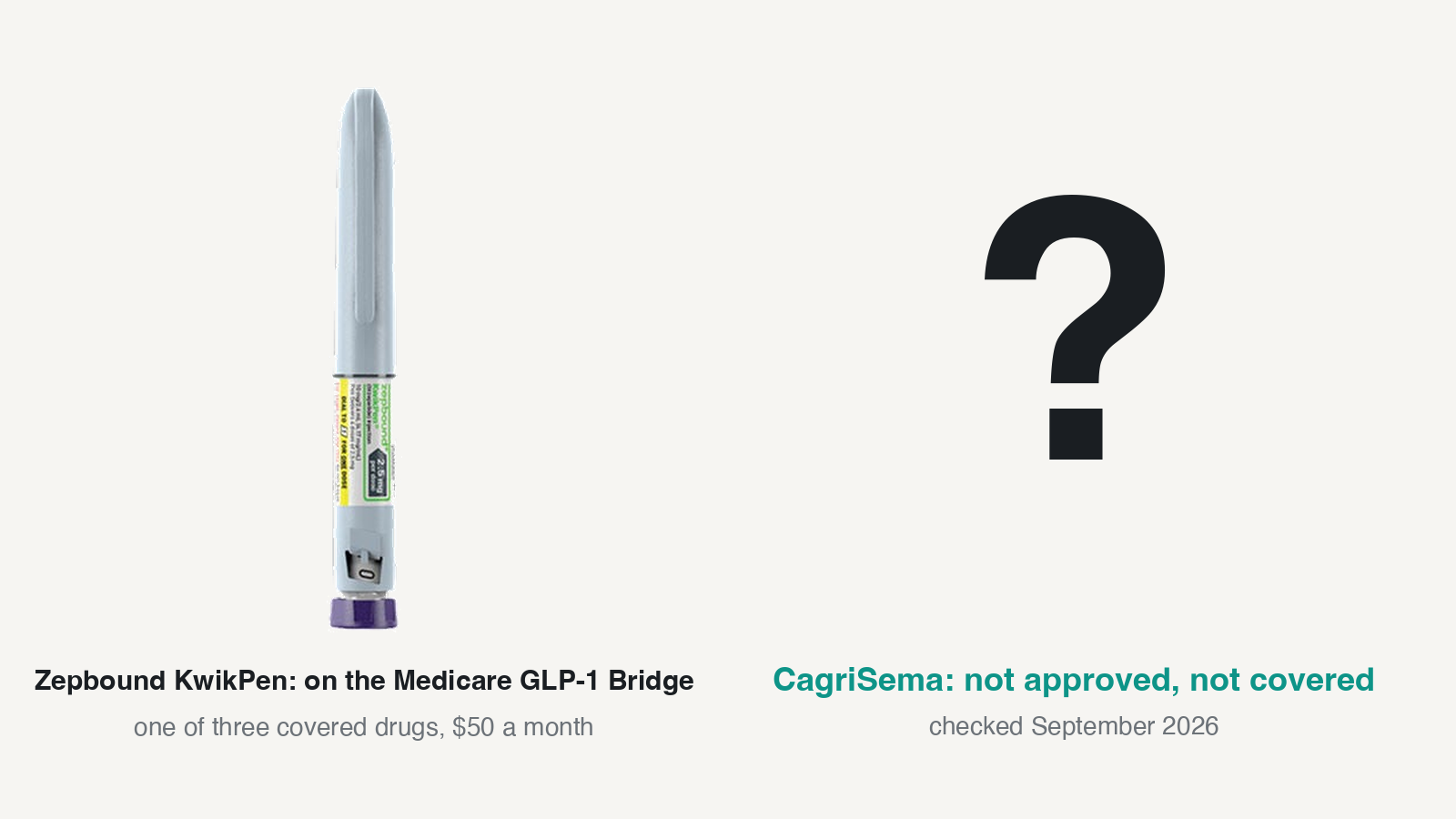
If the FDA approves CagriSema, there are three ways in: a CMS list the agency says it may update, a second FDA indication that lets regular Part D plans review coverage, or paying cash.
Is CagriSema covered by Medicare today? No. The drug is not approved, and Medicare does not cover a drug the FDA has not approved. Novo Nordisk filed for approval in December 2025 and expects a decision in the fourth quarter of 2026. If it is approved, the Bridge is the likeliest way in, because CMS can add drugs to that program and has done it once already. Regular Part D is far less likely: the application Novo filed is for weight management, and Part D cannot pay for that. If neither opens, what is left is the cash price.
Disclosure: I take Zepbound, and I own Eli Lilly stock, the only pharmaceutical stock I hold. Lilly makes two of the three drugs the Bridge covers today.
What is in CagriSema?
One weekly injection carrying two drugs: semaglutide 2.4 mg, the Wegovy molecule, and cagrilintide 2.4 mg, a long-acting analogue of amylin, a fullness hormone your pancreas releases with insulin. Novo has not announced a brand name. It has registered Wegovy+ and Wegovy Plus, and has eleven invented names on file covering weight reduction, one of them Wegovamy, so the name on a plan’s drug list may not say CagriSema. In its pivotal trial, REDEFINE 1, the combination averaged 20.4 percent weight loss at 68 weeks against 14.9 percent for semaglutide alone. In Novo’s own 84-week head-to-head against tirzepatide, the drug in Zepbound, it averaged 20.2 percent against tirzepatide’s 23.6, counting people whether or not they stayed on the drug, and could not show it was as good. I go through both trials in my CagriSema vs Zepbound comparison.
Will the Medicare GLP-1 Bridge cover CagriSema?
The Bridge is a CMS demonstration that runs from July 1, 2026 through December 31, 2027 and gets eligible Part D enrollees a covered GLP-1 for a flat $50 a month, outside the regular Part D benefit. It covers a named list: Wegovy, injection and tablets; Zepbound, KwikPen only; and Foundayo. That list can be updated. CMS added Foundayo on April 6, 2026, within a week of the FDA approving it, and the same page says the product list “may be updated over the course of the Medicare GLP-1 Bridge.” So CMS can add a newly approved drug, and it has done so once. Whether it does that for CagriSema, semaglutide plus cagrilintide, is a decision nobody has made in public.
If you are counting on this route, check whether you would qualify at all. A BMI of 35 is enough on its own. Below that you need one of CMS’s listed conditions: at a BMI of 30 or more, heart failure with preserved ejection fraction, blood pressure still above 140 systolic or 90 diastolic on two blood-pressure medications, or kidney disease at stage 3a or worse; at 27 or more, prediabetes, a prior heart attack or stroke, or symptomatic leg-artery disease. You need a Part D or Medicare Advantage drug plan. And if you have type 2 diabetes, moderate to severe obstructive sleep apnea, or noncirrhotic MASH, the fatty-liver disease, with moderate to advanced scarring, you do not qualify for the Bridge, because CMS treats those as diagnoses Part D can cover and routes you there instead. My guide to the Medicare GLP-1 Bridge has the full rules and the paperwork. Timing is the other problem. A drug approved late in 2026 and reaching pharmacies in 2027 would get at most a year on a program scheduled to end December 31, 2027. CMS has already extended the Bridge once, from an initial six months to the end of 2027, after the permanent program meant to replace it was postponed, so that date has moved before.
Is CagriSema covered by Medicare Part D?
Narrowed to weight loss, is CagriSema covered by Medicare Part D? No, and approval will not change that. Part D is barred by law from paying for drugs used to lose weight; Medicare’s own prescription drug manual lists “Agents when used for anorexia, weight loss, or weight gain” among the excluded drugs, “even if used for a non-cosmetic purpose (i.e., morbid obesity)”. Part D only pays for one of these drugs once the FDA has approved that drug for something else as well. Having the condition yourself does not do it; the drug has to carry the indication. Wegovy got regular Part D coverage once the FDA approved it to lower the risk of major cardiovascular events in people with established cardiovascular disease, and Zepbound got it through obstructive sleep apnea. A type 2 diabetes or MASH indication counts the same way.
CagriSema’s own trial, for semaglutide plus cagrilintide, is already running. REDEFINE 3 is a 7,101-person cardiovascular outcomes trial, one that counts heart attacks, strokes and cardiovascular deaths, in people 55 and older with a prior heart attack, a prior stroke, or symptomatic leg-artery disease. The registry lists an estimated primary completion of September 2027. Novo would still need FDA approval for that indication, and even then a plan does not have to add the drug the day an indication exists. Medicare’s formulary rules let a plan add a drug at any point in the year, and give its pharmacy committee 180 days from when a new drug or a new indication reaches the market to make a call, or to explain why it did not. Regular Part D coverage is probably years away.
What will CagriSema cost without insurance?
Novo has announced no list price, no cash-pay program and no savings card for CagriSema, semaglutide plus cagrilintide. If Novo issues a savings card on the terms of its current Wegovy offer, it will not help anyone on Medicare: that offer says “Government beneficiaries excluded.” Until Novo names a price, the reference point is the current cash market for Wegovy and Zepbound, which I keep updated in what they cost without insurance.
What I would actually do
If you are on Medicare and waiting for CagriSema, stop waiting. The Bridge already covers three drugs, and one of them is the tirzepatide that came out ahead of CagriSema in Novo’s own trial. If CMS ever adds CagriSema to the Bridge under today’s rules, the authorization would need your prescriber to attest to what the Bridge asks for now: your BMI, a qualifying diagnosis unless your BMI is 35 or more, and an ongoing nutrition and activity plan. Get those into your chart, and if you qualify, talk to your doctor about starting one of the drugs that is covered now.
Most people will watch for the FDA decision. If you are on Medicare, watch CMS’s product list instead.
Get the next one in your inbox
I cover the latest GLP-1 trials and access changes weekly. Free, no spam, unsubscribe whenever.