
My own doctor told me to quit creatine because a number on my bloodwork went up. That number was never measuring what he thought it was.
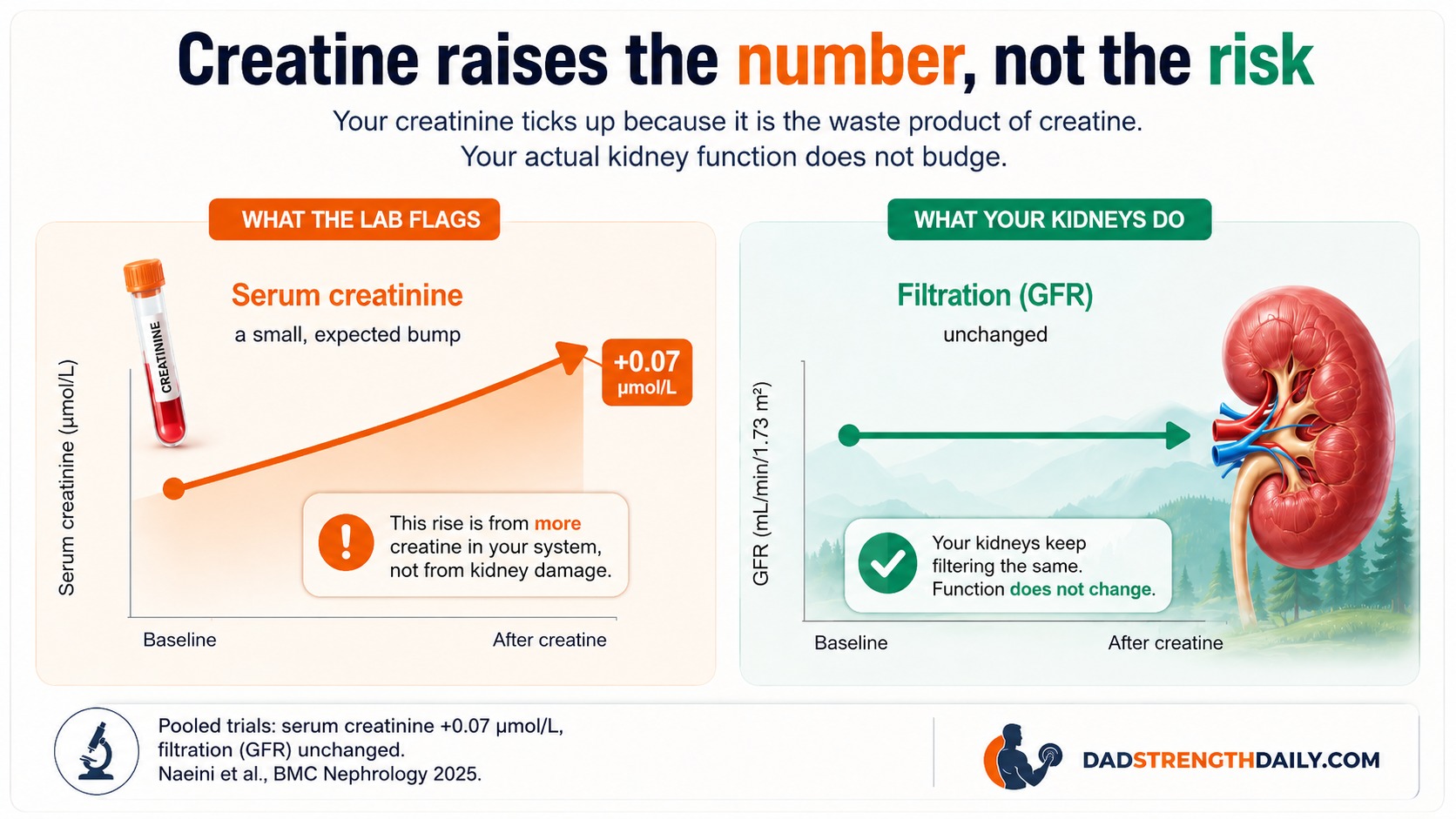
I take creatine every day, and at my last physical my doctor told me to stop. His reason: my creatinine had crept up on the panel, and creatinine is one of the markers used to judge how your kidneys are doing. He is a good doctor. He was also wrong, and he was wrong for the same reason a big chunk of the internet still thinks creatine wrecks your kidneys.
Creatine and creatinine are not the same thing. They are close cousins, and the lab measures the cousin. Creatinine is the waste your body makes when it breaks creatine down, and about two percent of the creatine in you converts to it every day through a plain chemical reaction, no enzyme and no organ required (Longobardi et al., Nutrients, 2023). Pack more creatine into your muscles, which is the whole point of taking it, and you make a bit more creatinine as exhaust. So more of it turns up in your blood. The kidneys never changed.
Your lab is measuring the wrong thing
The eGFR your doctor reads off the panel is not measured. It is calculated backward from your creatinine, and the equation assumes you make creatinine at a steady rate for your age, sex, and size. That assumption breaks for two groups: people carrying real muscle, and people who supplement creatine. Both make more creatinine than the formula expects. The formula doesn’t know why, so it reports a lower eGFR and flags reduced kidney function, even though your actual filtering is untouched.
There is a clean way to settle it. A marker called cystatin C estimates kidney function without going near creatinine, so your muscle and your supplement can’t skew it. In people who take creatine, cystatin C reads normal while the creatinine number slips. That is the test to ask for.
What the trials actually found
The research here isn’t ambiguous. A 2019 meta-analysis in the Journal of Renal Nutrition (de Souza e Silva et al.) pooled the controlled trials and found no harm to kidney function. A 2025 one in BMC Nephrology (Naeini et al.) found the same in plainer terms: creatinine ticked up a hair, actual filtration did not budge. The gap between those two is basically the entire argument. And the International Society of Sports Nutrition, after combing the whole literature for its 2017 position stand, put it flatly: creatine monohydrate at normal doses doesn’t damage the kidneys or liver of healthy people.
Where the scare came from
I went looking for where the warning actually started, and it mostly traces to a handful of case reports from the late 1990s and 2000s. Someone had bad kidney numbers, they happened to be taking creatine, and the two got welded together. The Longobardi review goes through them one by one. The most-cited case, from 1998, was a man who already had a kidney disease and was on cyclosporine, a drug notorious for being hard on the kidneys. His creatine was the least suspicious thing in the chart. The rest are similar: no baseline data, self-reported use, other drugs or existing disease in the mix. That is the whole foundation.
I would treat this differently if I already had kidney disease. Those patients were not who the safety trials enrolled, so that is a nephrologist conversation, not a blog one. Pregnancy too, where the data is genuinely thin. But if your kidneys are healthy, and most of ours are, the fear has it backward.
If your doctor tells you to stop
Don’t just nod and quit, and don’t argue in the exam room either. Ask one thing: can we check a cystatin C, or at least note that I take creatine before we read anything into this creatinine? A good doctor gets it the second you say it out loud. Mine did. I came close to dropping something with a decade of muscle and strength data behind it, which matters more every year past fifty, over a number that never meant what it looked like.
On the practical side, brand barely matters, but get micronized creatine monohydrate. It dissolves better and sits easier. I use Thorne for the third-party testing and the taste, and cheap Nutricost from Amazon when I just want a tub that works. Skip the HCL and buffered versions charging triple for the same five grams. Five a day, every day. No loading phase.
Get the next one in your inbox
I write about longevity, training, and preventive health weekly — without the guru worship. Free, no spam, unsubscribe whenever.
About Gunnar
Gunnar is 53. He lost about 170 pounds, trains in a garage gym, and writes DadStrengthDaily from personal experience, citing primary sources where he can. He also moderates r/ProactiveHealth. He is not a doctor, and nothing here is medical advice. Talk to your own doctor before acting on anything, especially GLP-1s, TRT, blood pressure, sleep apnea, and cancer screening.