
I keep hearing about NAD+. Andrew Huberman talks about it on his podcast. Bryan Johnson takes it as part of his Blueprint protocol. Gary Brecka pitches it on Joe Rogan. Goop has run pieces on it. Walgreens and Walmart now stock the supplements next to the multivitamins. After months of seeing the same claim repeated across podcasts and Instagram, I still could not tell you whether NAD+ is a real breakthrough or well-marketed snake oil.
Two new studies in the last few months gave me the clearest answer I have read. The first landed this month in Nature Metabolism, from a group at Amsterdam University Medical Center. The second was a preprint posted in February. Both reached the same conclusion. That conclusion is not the one the supplement industry has been selling.
What NAD+ actually does inside a cell
Get the next one in your inbox
I write about longevity, training, and preventive health weekly — without the guru worship. Free, no spam, unsubscribe whenever.
NAD+ stands for nicotinamide adenine dinucleotide. It is a coenzyme, which means it is a small molecule that other proteins need to function. NAD+ shuttles electrons during cellular metabolism, helping mitochondria produce ATP and helping enzymes called sirtuins repair DNA damage. Every cell in your body uses it constantly. Without enough NAD+, basic cellular operations grind to a halt.
About twenty years ago, researchers working with yeast, worms, and mice noticed something interesting. Increasing NAD+ in those organisms extended their lifespans. The mechanism seemed clean. As animals aged, NAD+ levels in their cells declined. That decline appeared to correlate with worse mitochondrial function, more DNA damage, and shorter life. Topping NAD+ back up reversed at least some of those changes in laboratory animals.
So does any of this hold up in actual people? That is where it got messy. Measuring NAD+ in human blood turned out to be technically very tricky. The molecule degrades quickly when blood is drawn, and small handling errors can shift the readout by orders of magnitude. For most of the last twenty years, the answer to “does human NAD+ actually decline with age” was a shrug, paired with a wave at the animal data.
The supplement industry did not wait for the answer. Companies began selling precursors to NAD+, primarily two molecules called nicotinamide riboside (sold as Niagen, Tru Niagen, and Basis) and nicotinamide mononucleotide (the generic NMN you see on Amazon). The pitch was simple and intuitive. Your NAD+ drops as you age. Taking these precursors restores it. Restoring it slows or reverses aging-related decline. By 2025, the NAD+ supplement market was a real business, with retail distribution and influencer endorsements that put it next to creatine and protein powder in the cultural conversation.
One big problem. Nobody had actually shown the age-related drop in humans. Lots of talk, no clean human data.
Where the decline-with-age story came from
The animal evidence is real. NAD+ levels do drop with age in yeast. They drop in worms. They drop in some mouse tissues. Increasing NAD+ in those organisms produces measurable improvements in lifespan markers. The science is not invented.
The leap was applying that finding to humans without the data.
Matt Kaeberlein, a longevity researcher at the University of Washington who has studied NAD+ for years and was not part of the new research, put it bluntly to the New York Times. The idea that NAD+ levels decline with age universally and that this decline drives age-related dysfunction, in his words, “did sort of become dogma.” He said the theory had “outpaced the actual data.” His description of how the supplement industry took hold around the unproven premise is worth quoting directly. “You get high-profile people writing review articles, talking at conferences, nowadays going on podcasts stating what I would say are early stage models as if they are proven fact. And as soon as it got into the supplement space, the need for data kind of went out the window, and it all became a marketing exercise.”
That sentence is the story of a lot of the longevity supplement market, not just NAD+.
The Amsterdam paper that did not find the decline
The new study, published in Nature Metabolism in May 2026, comes out of the lab of Riekelt Houtkooper, a professor of translational metabolism at Amsterdam University Medical Center. His team did not set out to debunk NAD+. They set out to do the opposite. Houtkooper told the Times his original goal had been to build a simple blood test. The idea was that if NAD+ levels reliably dropped with age, a quick lab draw could identify people whose levels had fallen into a range where supplementation might actually help. That would have been a useful product and a useful science result at the same time.
So his group pulled together seven datasets containing more than 300 people. Some of the data compared younger adults to older adults. Some compared frail individuals to elite athletes. The combinations let the team look at NAD+ blood levels across age, fitness, and physical robustness all at once. If NAD+ really declined with age the way the theory said, this design would have caught it.
It did not catch it.
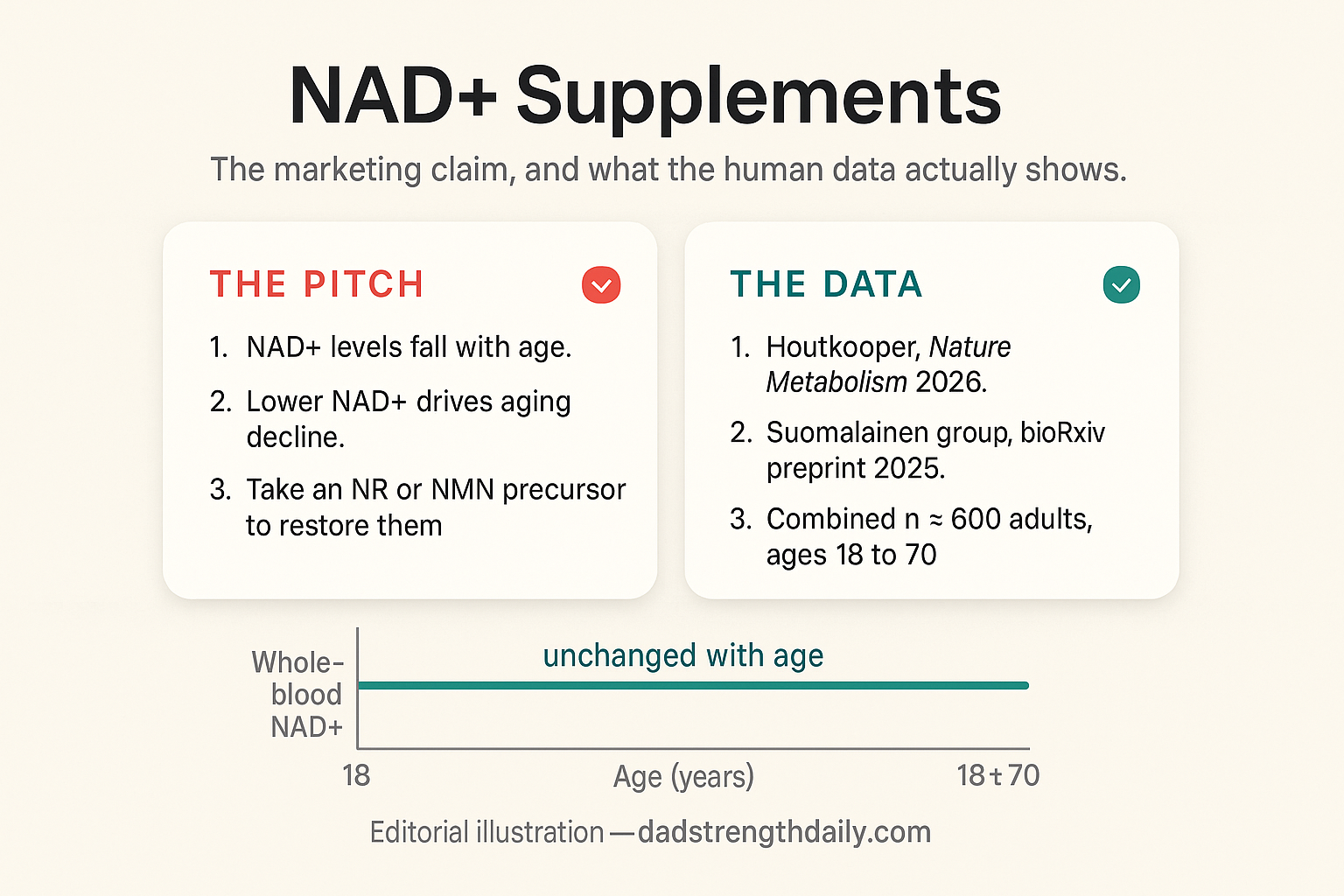
The Houtkooper paper showed no evidence that blood NAD+ levels fall with age. Older adults did not have less NAD+ in their blood than younger adults. Elite athletes did not have more than frail individuals. Test the premise that drives the entire NAD+ supplement industry in actual people and it falls over. Not subtle.
Houtkooper used the word “disappointed” to describe his reaction. His team had been looking for a biomarker. They found that the biomarker they wanted to build did not exist, because the underlying signal they were trying to measure was not there.
The study did show one thing the supplement industry probably wants people to know. If you take nicotinamide riboside or NMN, your blood NAD+ goes up. The pills do that part. They just raise it from a baseline that, according to this paper, was not actually low to begin with.
A preprint posted in February 2025 by a separate group at the University of Helsinki, looking at 299 healthy adults aged 18 to 70, reported the same thing. Blood NAD+ followed a normal distribution and did not change with age. Two independent groups looked, both found the same answer.
The industry’s pivot to tissue
When a foundational claim gets gutted, the next move in the supplement industry is almost always a pivot to a slightly more complicated version of the same claim. The NAD+ pivot is already underway, and it goes like this: well, blood is not the right thing to measure. Tissue is what matters.
That pivot is technically defensible. Joseph Baur, a physiologist at the University of Pennsylvania who studies NAD+ but was not on the new paper, told the Times he does not think the Houtkooper result “changes things in a major way,” because a handful of other studies have found NAD+ levels dropping in specific tissues like muscle and brain. Houtkooper himself published one such tissue paper back in 2022. So there is some real evidence that whatever is happening in blood, the picture in the tissues where NAD+ actually does the work might be different.
Andrew Shao, who runs global regulatory and scientific affairs at Niagen Bioscience, the company that sells most of the nicotinamide riboside on the market, made exactly that pivot in his comment to the Times. The new study, he said, “changes very little.” The tissue evidence, in his view, is what matters.
Here is where it loses me.
Baur called the tissue NAD+ data “preliminary.” That is thin ice. It is a small set of papers using methods that are also technically difficult. The new study used blood because you can draw blood reliably and at scale. Tissue NAD+ measurements come from muscle biopsies and samples taken at autopsy. Squishier evidence.
And even if NAD+ does drop in muscle and brain with age, does that drop actually break anything? The early answer looks like no.
A mouse study published last year took muscle NAD+ down by 85 percent. Not 30 percent, which is roughly the size of the decline some human tissue studies have estimated. Eighty-five. If tissue NAD+ levels were doing essential work in muscle, you would expect cataclysmic problems at that depletion level. The mice were fine. Their muscle function did not noticeably change.
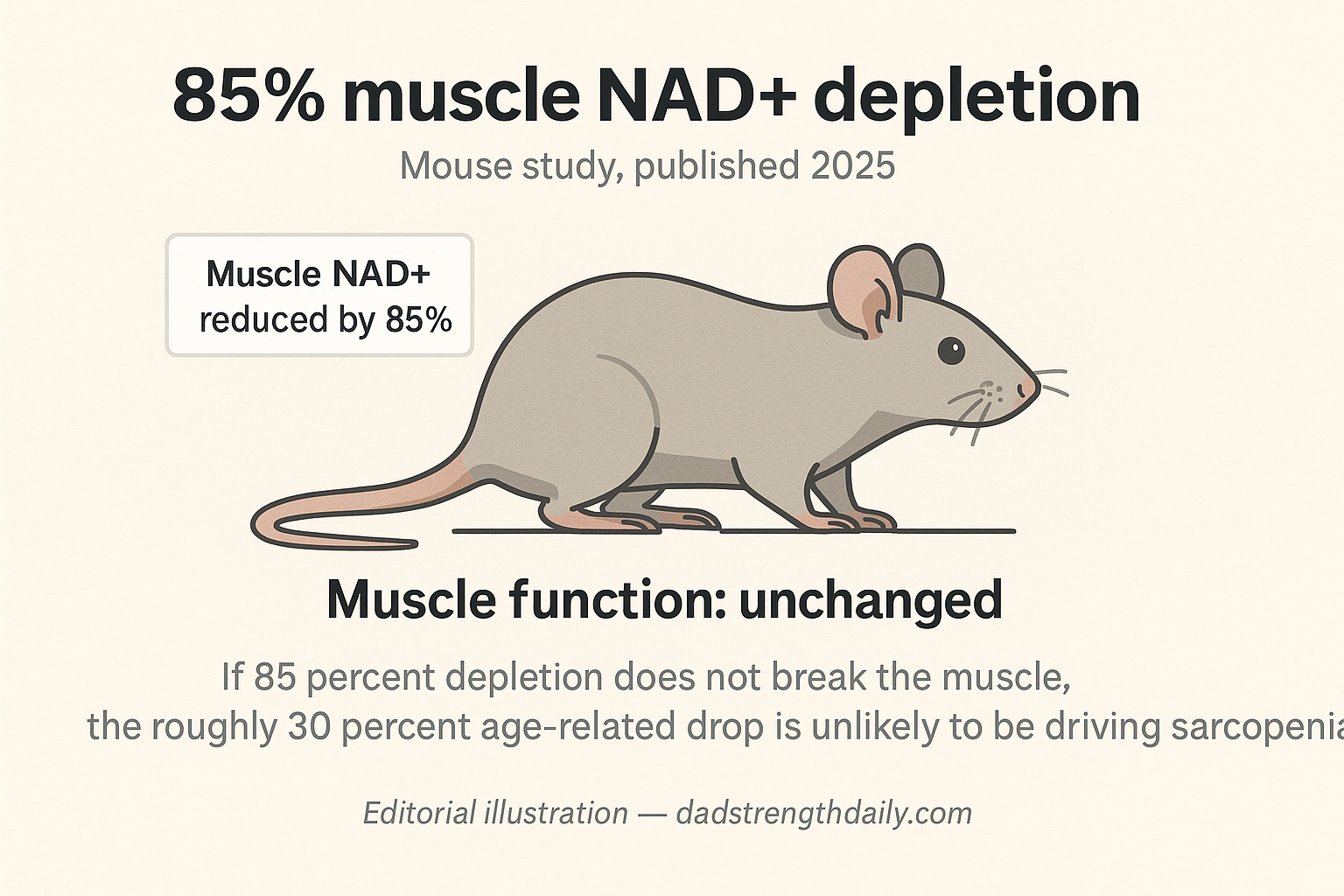
This is the part the supplement marketing has not absorbed yet. If you can drop muscle NAD+ by 85 percent in a healthy mouse and the muscle keeps working, the idea that a 30 percent age-related drop is the thing driving sarcopenia or weakness in aging humans gets very hard to defend. The body appears to have a lot more headroom on NAD+ than the marketing implies.
Shao, to his credit, conceded one important point. “The message to the consumers and messages spread by influencers out there has probably been oversimplified,” he told the Times. He added that the industry “probably needs to do some education” to clarify that tissue NAD+ is what they actually meant. That is a remarkable thing for a supplement company vice president to say in print. The product was sold to consumers under a simpler story than the science supports. The pivot is now to a more complicated story that is also still not well supported.
What I would do with this
Houtkooper, the researcher whose own study just dismantled the central marketing pitch, was the most direct of anyone the Times quoted. He does not think there is any reason for normal, healthy people to take NAD+ supplements. His research is now shifting to rare genetic conditions that affect cellular metabolism, where NAD+ deficits are real and severe and a targeted intervention might genuinely matter. That is a fair medical question. It is not the same as the question of whether someone in their fifties should add an NR or NMN supplement to their morning coffee.
For me, the answer to the question I started with is now obvious. NAD+ is not snake oil. The biology is real and important and the supplements really do raise blood levels. But the case for healthy adults taking them is essentially propped up by a claim that has now failed to replicate in humans. The pivot to tissue is doing a lot of work to keep the industry afloat, and the mouse data suggests even the tissue story may not deliver the functional benefit consumers think they are buying.
If you are already taking an NAD+ supplement and you feel great on it, I am not going to tell you to stop. Some of that is probably placebo, some of it is probably the better habits people adopt when they start any “longevity protocol.” And absence of evidence for benefit is not the same as evidence of harm. The supplements are generally well tolerated. The financial cost is the most consistent downside, and that is your call.
If you are about to start, this is the moment to ask the question Houtkooper’s paper makes uncomfortable. What problem are you actually trying to solve, and is there any reason to believe this molecule solves it? The answer the supplement industry has been giving you for the last few years was based on a premise that, when finally tested in humans, did not hold up. Kaeberlein’s “marketing exercise” line is the most honest description of what happened next. Whether you keep paying for it is up to you. I am going to stay on the sidelines.
The deeper point I have come away with is not specific to NAD+. It is that the standard pattern for longevity supplements is to take a real but small effect in yeast or worms or mice, scale it up rhetorically to a human-relevant claim, and then build a market around the claim before anyone tests it in humans. NAD+ is the most expensive recent example. It will not be the last. The next time a podcast guest confidently describes a cellular pathway that “everyone knows” declines with age and offers me a $50-a-month subscription to restore it, I will remember the Houtkooper paper and the 85 percent mouse muscle that worked fine.
About Gunnar
Gunnar is 53. He lost about 170 pounds, trains in a garage gym, and writes DadStrengthDaily from personal experience, citing primary sources where he can. He also moderates r/ProactiveHealth. He is not a doctor, and nothing here is medical advice. Talk to your own doctor before acting on anything, especially GLP-1s, TRT, blood pressure, sleep apnea, and cancer screening.