
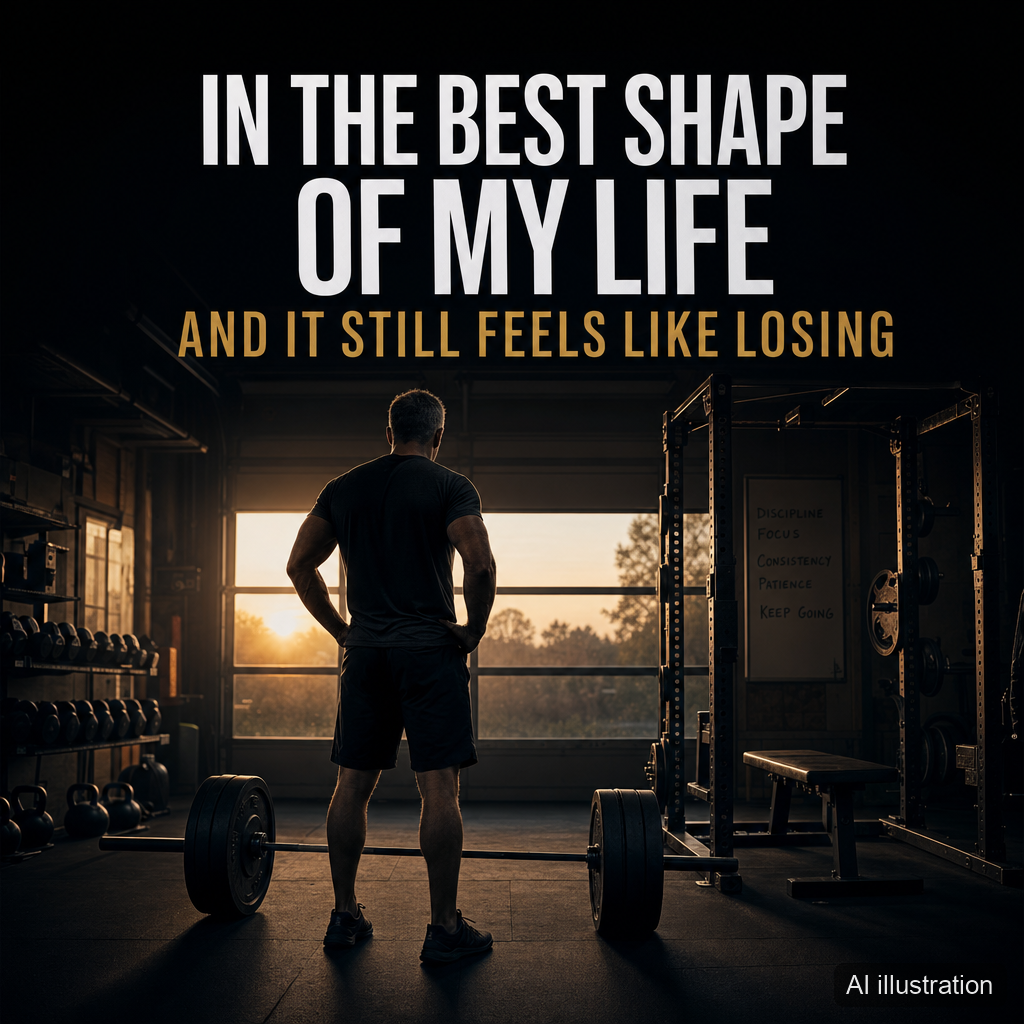
After losing 170 pounds and getting into the best shape of my life, I still felt behind. The problem was not my body. It was the scoreboard.
A while back I watched two men in a Pentagon gym throw down a challenge: a hundred push-ups and fifty pull-ups, in under ten minutes. The caption bragged that Marines had done it in under three. My first honest reaction was not “I should train for that.” It was “fifty pull-ups in ten minutes is insane.”
So why did watching it still make me feel a little soft?
Because here is the contradiction I live in. I am, by any measure I can actually put my hands on, in the best shape of my life. I have lost about 170 pounds. I lift in my garage every weekday. My bloodwork is the best it has ever been and my doctor is happy. And I can still scroll for ten minutes through marathon medals, shirtless transformations, and sub-three-hour finish times and come away feeling like I am quietly failing at something everyone else has figured out. It feels like everyone at work is running a marathon or training for an Ironman. The honest word for the feeling is inferior, and I recognize it, because I get the same thing in other parts of my life. It is imposter syndrome, wearing gym clothes.
And the challenge was never a fair fight to begin with. It is a Marine benchmark, not a general-fitness one. Plenty of healthy adults cannot do a single pull-up, let alone fifty in ten minutes. So I did what I do with everything else. I looked at the actual numbers, and they turned out to be the most reassuring thing I have read in months.
Your feed is not a fair comparison
Get the next one in your inbox
I write about longevity, training, and preventive health weekly — without the guru worship. Free, no spam, unsubscribe whenever.
Your social media feed hides something simple. The country is not fit. The Sports and Fitness Industry Association loves to report that 250 million Americans did some kind of activity last year, and that is true. But most American adults still do not hit 150 minutes of activity a week, the basic floor in the federal guidelines, and that floor is not heroic. A pickup game in July is genuinely good for you. It is just not the same as a routine that holds all year.
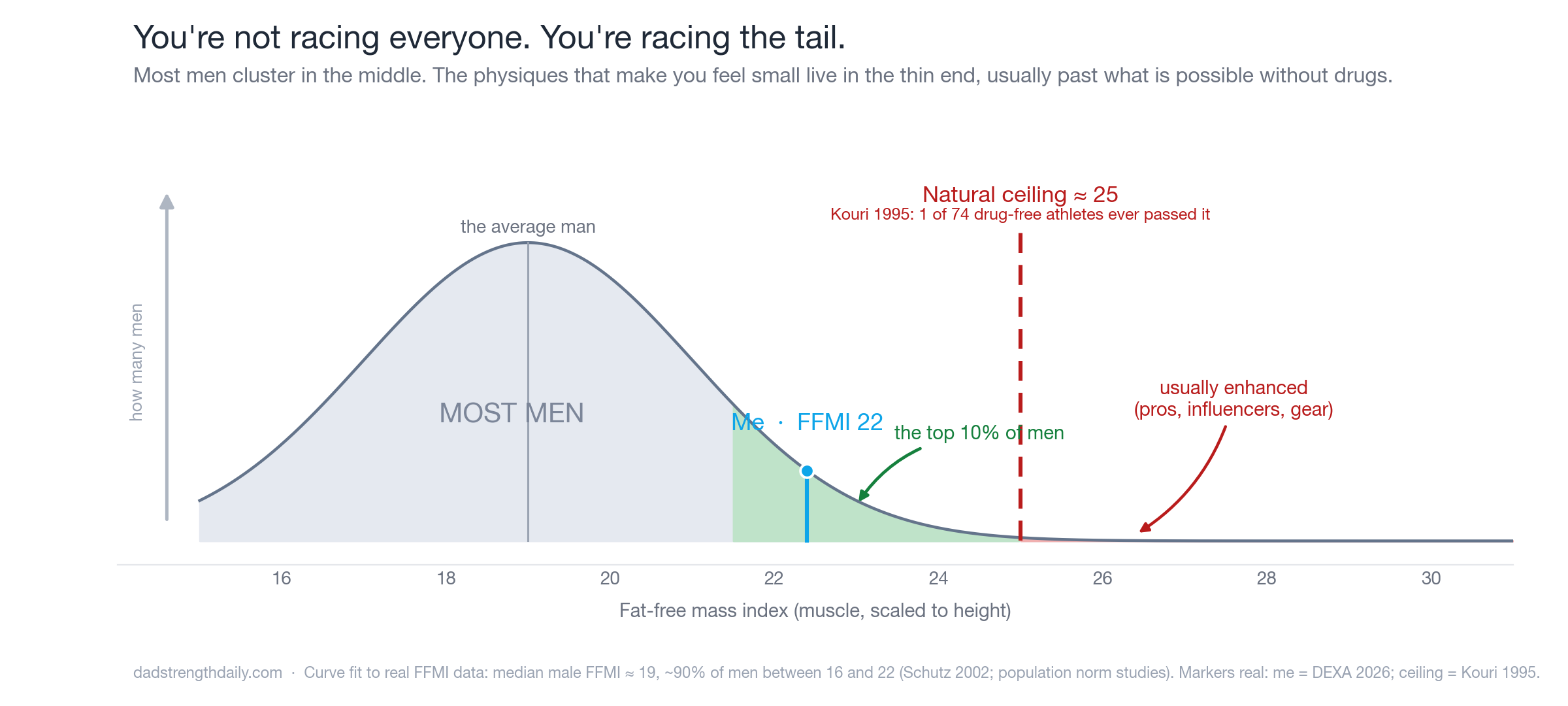
None of that is a feed. The feed is something else. The men posting are not a random sample of American men. They are the lean 35-year-old with the race medal, the guy whose transformation actually worked, the coached athlete, the genetically gifted, the ones selling something. Social media takes the entire range of human bodies and quietly deletes everyone in the middle, which is most of us. You are not seeing a normal distribution of men. You are seeing the extreme high end, the right tail of the curve, on a loop, and then comparing your Tuesday to it.
When you put a real number on the people you are measuring yourself against, the comparison falls apart. In a given year, about a tenth of a percent of Americans finish a marathon, something like one in 800. Ironman finishers are rarer still. The whole coworker-marathon phenomenon that makes me feel behind is a fraction of a percent of people, who, reasonably enough, post about the hardest thing they have ever done. Even the running boom that is genuinely real, with top race fields growing and Strava clubs multiplying, is a loud, visible minority training and racing and posting intensely while most adults stay well short of the basics.
The standards themselves stack up on a spectrum almost nobody bothers to separate. Some are reasonable, and a good general-fitness test will humble the right people. When the muscular exercise scientist Mike Israetel took the Army’s new fitness test on camera, he maxed the strength events and could not finish the two-mile run. A jacked man can fail a fitness test, because looking strong and being fit are not the same thing.
That distinction is the one almost nobody draws. A health standard tells you whether you are building a body that lasts. A performance standard ranks you against people who have organized their lives around winning. Confusing the two is where the trouble starts.
And then there is the other end of the spectrum, the part that is pure performance: the viral pull-up challenge built for a stopwatch and a highlight clip, the shredded influencer, the leaderboard that turns your own workout into a public ranking against strangers. Even Peter Attia, who is careful and evidence-driven, tells people to aim for a VO2 max that would be elite for a man a decade younger. He has good reasons, but look at his goal: be elite, for a person ten years younger than you, as the number you are supposed to aim for. That is the water we are all swimming in.
The trap is assuming visibility equals prevalence. It does not. The feed is the few percent who can, performing for the rest of us, who mostly cannot, and feeling worse for watching.
Bigorexia is the disorder that looks like discipline
The disorder is called muscle dysmorphia, or bigorexia, and the clinicians who named it in the 1990s first called it reverse anorexia. It is recognized now as a form of body dysmorphic disorder. The core of it is a man who is convinced he is small, puny, not muscular enough, when he is in fact normal or even unusually built. It shows up most in gyms, among lifters and bodybuilders, and most of all among men using steroids. It is rising in boys and young men, linked to how much muscle-focused content they consume. One study found that the more muscularity-oriented social media a young man looked at, the higher his odds of probable muscle dysmorphia, independent of how much time he spent online overall. It is the content, not just the screen.
What makes it cruel, and easy to miss in men, is that it does not look like an illness. It looks like dedication. The guy who never misses a workout, who weighs his food, who cannot take the shirt off because he does not feel big enough, reads as disciplined, not unwell. Anorexia in a teenage girl alarms us. The same disordered relationship with the body, pointed at muscle instead of thinness, gets a man called committed. So it goes underdiagnosed, and below the clinical line a much larger group of men just walks around with a low, constant sense that their body is not enough.
You do not have to have the disorder to feel its pull. You just have to scroll.
The body you’re comparing yourself to may not be natural
The fact that did the most to fix my own head is one you can check on yourself, with a DEXA scan and a calculator.
There is a natural ceiling on how much muscle a man can build without drugs, and researchers have put a number on it. A 1995 study in the Clinical Journal of Sport Medicine measured fat-free mass index, which is just your lean mass scaled to your height, in a large group of athletes. The natural athletes topped out at an FFMI of about 25. Only one of seventy-four drug-free athletes crossed it. The steroid users routinely landed well past it. FFMI around 25 is the rough ceiling for a natural man, the level past which drugs become the likely explanation. It is a red flag, not proof, because scans have error bars and rare genetic outliers exist. But the pattern holds, and most natural men never come close to 25 anyway.
The shredded “natural” physiques that make your feed feel demoralizing are often right around or past that line. The lean-and-huge-year-round look, sold as discipline and the right program, is usually pharmacology the caption never mentions. When you do not know that, you read your own slower, smaller, softer-in-January progress as a personal failure. It is not. You are racing a baseline that, for a lot of the men setting it, does not exist without a needle.
I will put my own number on the table, because that is the whole point of this blog. My last DEXA: six foot three, about 209 pounds, around 15 percent body fat. Run the math and my FFMI comes out around 22, against that natural ceiling of 25. That is a genuinely muscular, lean build for a 53-year-old, with real room left to grow, naturally, before I would ever hit the wall. Twenty-two, not behind. And the physiques I was feeling inferior to are often sitting at 26 or higher, in a category that is partly fictional.
The scoreboard said I was losing. The scan said I am a lean, muscular man with headroom.
Where feeling small turns into a needle
The demoralizing feeling does not stay merely unpleasant. The culture sells one very specific cure for feeling small: gear.
The same research that tracks muscle dysmorphia tracks where it leads. Men who score high on body dissatisfaction and the drive for muscularity are far more likely to use anabolic steroids, and steroid use and muscle dysmorphia run together. The sequence is not complicated. Men see a body they cannot realistically build, feel small about it for long enough, and some of them decide gear is the only way to close the gap. The “is he natty” guessing game we play about influencers is the surface of a much more serious thing happening to the men watching.
I use testosterone, and I am not against it, but I draw a hard line for myself. I take it for the ordinary reason, low levels on repeated blood tests and the symptoms that came with them, prescribed and watched by a doctor. My dose is 120 milligrams a week, which puts my total testosterone around 860. I feel good, and I have visibly built muscle. And I have decided, deliberately, not to go higher, because more would be chasing a look, not treating a deficiency, and the cost is real. I happen to have an aortic aneurysm, so for me anything that thickens the blood or pushes blood pressure up is not a casual decision, it is a conversation with my doctor and a set of labs. The difference between medicine and the on-ramp is not the molecule. It is whether you are fixing something measured or trying to silence a feeling. Testosterone will not fix a comparison problem. Nothing you inject will.
Fire the scoreboard
When the inferior feeling hits, the options seem to narrow to three. Train harder, which is tough when you cannot find more hours and, honestly, the returns are small. Take more, which we just covered. Or give up, which is what you reach for when the first two feel pointless.
There is a fourth option, and it is the only one that works: stop keeping score against your feed.
It is not a cop-out, and the reason is in the data. Most of the health payoff comes from going from doing nothing to doing something, from sedentary to merely active, not from the top of the range. Even five to ten minutes a day of easy running is tied to roughly a third lower risk of dying early, and the benefit flattens out from there. By the time you are arguing with yourself about whether your VO2 max is elite enough or your FFMI is high enough, you have already banked most of the part that actually extends your life. The returns above that are real but shrinking, and the standards are built around exactly that thin top slice. Attia is right that a strong engine protects your old age, and more fitness is genuinely better, but the gain that changes your odds the most is the one you get climbing out of the basement, and if you are reading this and training at all, you are already out.
The men who actually know this say it out loud. DJ Shipley spent seventeen years as a Navy SEAL, has done more pull-ups than most people on the planet, and when he talks about staying healthy now he does not tell you to run a hundred miles. He says you do not have to be David Goggins. A twenty-minute walk every day. A set of kettlebells, half an hour in your garage. The boring, repeatable thing, done for decades. That is the actual standard worth chasing, and it is the opposite of a viral challenge.
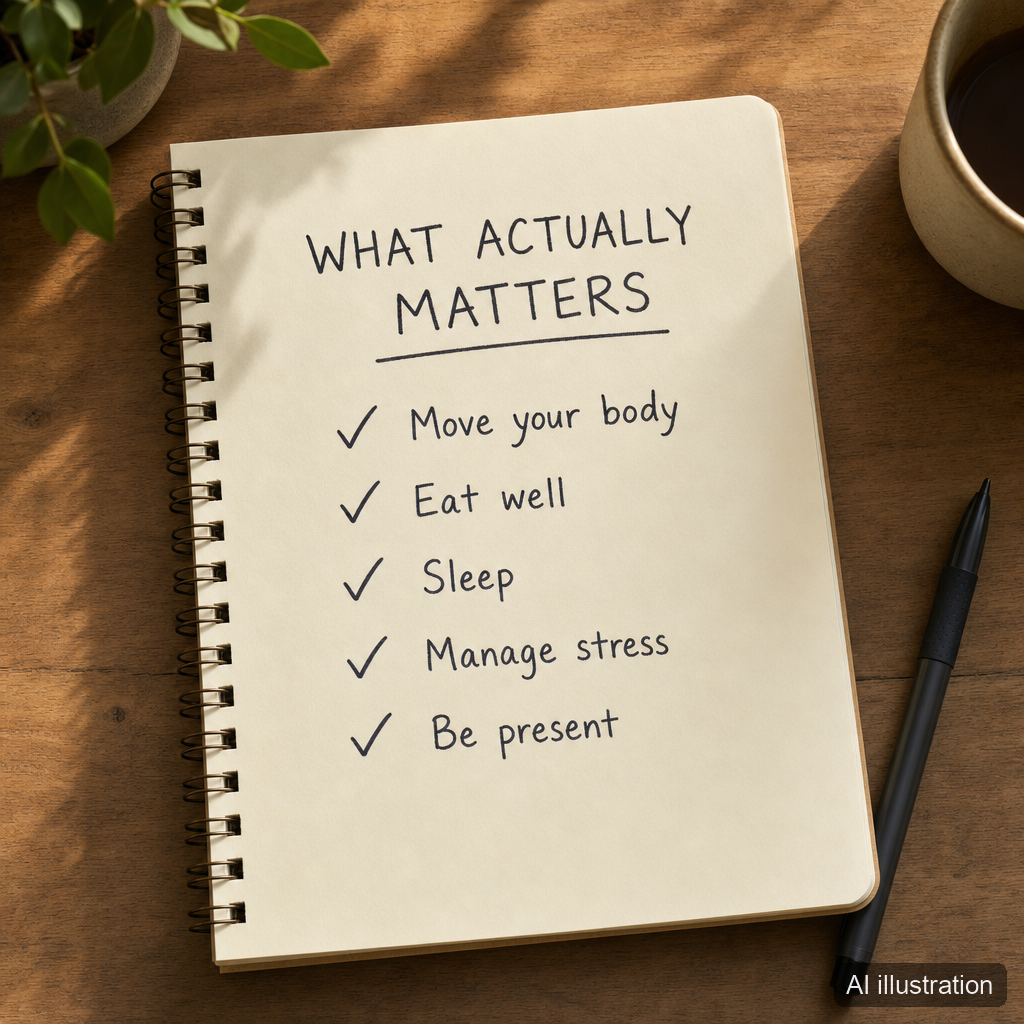
Naming the feeling correctly is most of the cure, and the right name for it is imposter syndrome. Imposter syndrome is the feeling of being a fraud despite real competence, and it comes from one specific error: comparing your insides to other people’s outsides. You know your every missed workout, your three a.m. wakeups, your bad weeks. You see their highlight reel. Of course you feel behind. You are matching your blooper tape against their trailer. In every other part of life you already know that feeling is not evidence. It is not evidence here either.

I am not going to train harder out of inadequacy, and I am not going to push my dose to chase a physique that an algorithm picked for me. I am also not going to quit something that is working and that I enjoy. I am going to keep lifting in the garage and rowing or riding on the weekends, because I like it and because the scan says it is working, and I am going to stop grading my real, good life against a leaderboard built from outliers and chemistry.
A target you build toward is a gift. A target that decides whether you are worth anything is a cage. The bar in that Pentagon gym was never the point. The point is whether you can still pick up your kids, carry the groceries, ride for an hour, and get up tomorrow and do it again. By that measure I am not losing. Neither, probably, are you.
About Gunnar
Gunnar is 53. He lost about 170 pounds, trains in a garage gym, and writes DadStrengthDaily from personal experience, citing primary sources where he can. He also moderates r/ProactiveHealth. He is not a doctor, and nothing here is medical advice. Talk to your own doctor before acting on anything, especially GLP-1s, TRT, blood pressure, sleep apnea, and cancer screening.