
I was shocked to hear about Kyle Busch this week. The NASCAR Cup Series champion died after severe pneumonia progressed to sepsis. His family released a brief statement and the wellness desks across the country pivoted to “what is sepsis” explainers within forty-eight hours. The interest is right. Most of us, including me until recently, do not actually understand what sepsis is.
The common shorthand is wrong. Sepsis is not “a bad infection.” Sepsis is what your immune system does when it tries to contain an infection and the response itself becomes the problem. The infection matters. The response matters more.
Once you understand that, the variety of entry points stops being surprising. Pneumonia in a world-class endurance athlete can trigger it. So can a UTI, a kidney stone, a skin abscess, a surgical site, an infected wound from a cat scratch, or a scrape that did not look like much at the time.
What sepsis actually is
Get the next one in your inbox
I write about longevity, training, and preventive health weekly — without the guru worship. Free, no spam, unsubscribe whenever.
The 2016 international consensus paper, Sepsis-3, defines sepsis as “life-threatening organ dysfunction caused by a dysregulated host response to infection.” Let’s look at that clinical mouthful. Your immune system tries to fight an infection, and the response gets so large that it starts shutting down your own organs. Blood pressure crashes. Oxygen drops. Kidneys, liver, and brain start to fail.
Dr. Jamin Brahmbhatt at Orlando Health used a good analogy this week on CNN.
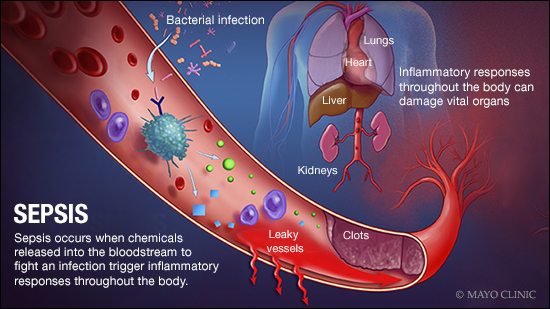
Sepsis is like a kitchen fire that triggers sprinklers throughout an entire building. The fire is in one room. The water damage is everywhere.
That is why the entry point can be modest and the outcome can still be fatal. The fire matters less than the sprinklers. For a body-system view of how this cascade looks, Mayo Clinic has a medical illustration showing how sepsis spreads through the body.
The numbers
About 1.7 million American adults get sepsis every year, according to the CDC. At least 350,000 die during hospitalization or are discharged to hospice. Sepsis contributes to more than one in three US hospital deaths. About one in five sepsis hospitalizations is cancer-related. These numbers do not show up in the public conversation the way cancer or heart disease do, but the death count is comparable.
The most concerning detail is the time scale. Sepsis can develop in hours. The actor Billy Porter has talked publicly about going septic from an obstructed kidney stone in minutes. Standard hospital protocol is now the “hour-one bundle.” IV fluids and broad-spectrum antibiotics within an hour of suspected sepsis. Every hour of delayed antibiotics meaningfully increases mortality.
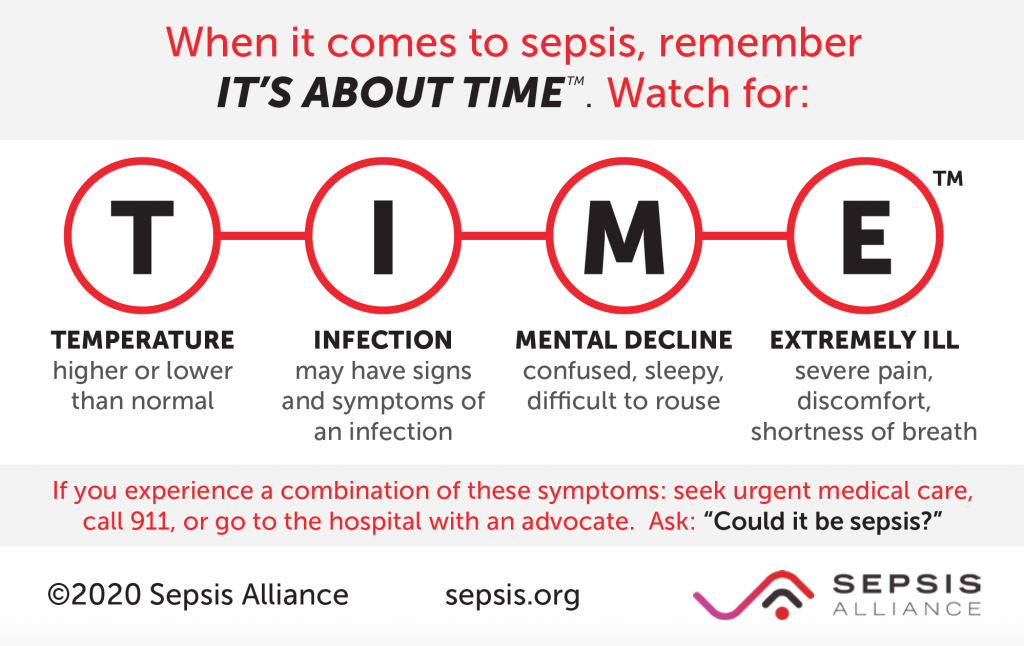
The TIME warning signs
The Sepsis Alliance teaches a memory tool called TIME for the warning signs in someone with an infection:
The hard part is that none of those signs are dramatic at first. Someone recovering from a UTI just seems extra tired. A kid post-surgery seems unusually confused. The change is incremental until it suddenly is not.
If someone with a known or suspected infection is breathing fast, getting confused, has a racing heart, or just seems much sicker than the underlying problem should warrant, that is not “they need rest.” That is an emergency room visit, that hour.
What I learned
Two things would have changed how I thought about ordinary infections.
The first is that you treat the body’s response, not just the bug. The antibiotics matter, but so does the IV fluid resuscitation, blood pressure support, and source control. Draining an abscess. Removing an obstructed kidney stone. Debriding an infected wound. The “they gave antibiotics, that should have been enough” assumption misses that sepsis treatment is its own discipline.
The second is post-sepsis syndrome. Up to half of survivors get fatigue, sleep problems, difficulty concentrating, anxiety, and a higher rate of repeat infections that can last months or years. The CDC also flags higher long-term risk for heart and kidney disease after surviving sepsis. The illness has a tail that does not show up in most news coverage.
What I would do
If I or someone I love had a known infection and started showing those TIME signs, I would not wait until morning. I would go to an emergency room and use the word “sepsis.” Triage takes sepsis seriously when it is named. Hospitals are set up to clock-start treatment when the team agrees. Mentioning the word is not catastrophizing. It is shorthand for “please move fast.”
Kyle Busch was a world-class endurance athlete and severe pneumonia killed him through sepsis. Billy Porter is a Tony-winning working actor and an obstructed kidney stone nearly killed him through sepsis. Two completely different doors, the same lethal middle. Knowing what is on the other side of the door is the part most people, including me until recently, get wrong.
About Gunnar
Gunnar is 53. He lost about 170 pounds, trains in a garage gym, and writes DadStrengthDaily from personal experience, citing primary sources where he can. He also moderates r/ProactiveHealth. He is not a doctor, and nothing here is medical advice. Talk to your own doctor before acting on anything, especially GLP-1s, TRT, blood pressure, sleep apnea, and cancer screening.