
Medicare covers one person, adds income surcharges based on your tax return from two years earlier, and in most states makes Medigap hard to buy after your first six months, so the planning starts a decade early.
Key Points
- Medicare has no family coverage, so a younger spouse needs her own. Enrolling before you leave your job can stretch your family’s COBRA from 18 months to as long as 36.
- HSA contributions stop with Medicare, and your income at 63 and 64 sets the surcharge on your first premiums.
- In most states, switching to Medigap later can mean being turned down on health. Massachusetts is one of four exceptions.
I’m 53 and plan to retire at 65. By then my wife Allison will be about 55 and our sons about 19 and 24, and Medicare will cover exactly one of us.
The expensive Medicare mistakes happen in the years before 65, and some of the decisions are due in your 50s. Most of them only make sense once you know what each part of Medicare does, so I’ll start there. We live near Boston, so I’ll also flag the Massachusetts rules.
Medicare in plain English
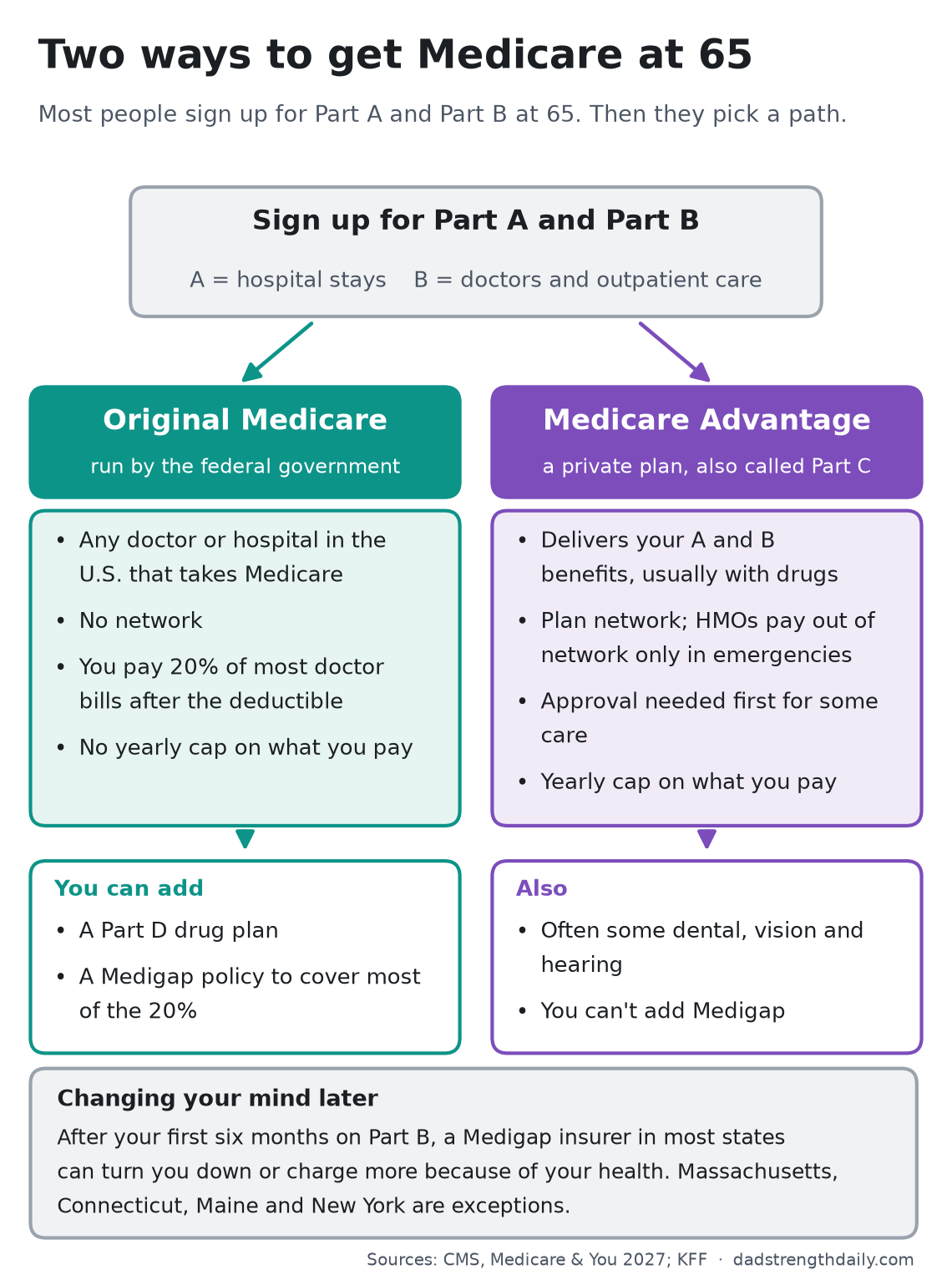
Medicare is the federal health insurance most Americans get at 65, and it comes in four lettered parts. Part A is hospital insurance and Part B is medical insurance: doctors, outpatient care, tests and many screenings. Together they’re called Original Medicare, and unless you choose something else, that’s what you get. Part D is drug coverage, sold by private insurers. Part C, better known as Medicare Advantage, is a private plan you can pick to deliver your Part A and B benefits instead of Original Medicare. You stay enrolled in A and B and still pay the Part B premium. The table covers Original Medicare and Part D; the chart after it shows where Medicare Advantage fits.
| Part | What it covers | What it costs in 2026 |
|---|---|---|
| A: hospital | Hospital stays, a limited stay in a nursing facility after one, hospice | Usually no premium. $1,736 deductible per hospital “benefit period” |
| B: medical | Doctor visits, outpatient care, tests, equipment like walkers, many screenings and vaccines | $202.90 a month, more at higher incomes. $283 deductible, then usually 20% of each bill |
| D: drugs | Prescription drugs, through a private plan | Premium depends on the plan. Your costs for covered drugs stop at $2,100 a year |
Dental, eye exams for glasses, hearing aids and non-medical long-term care mostly aren’t covered. Part D by law excludes weight-loss drugs, apart from a temporary $50-a-month GLP-1 program that runs through 2027.
So at 65 there are two ways to get Medicare. With Original Medicare you buy drug coverage and any Medigap policy separately. Medicare Advantage puts everything in one private plan, and you can’t add Medigap to it.
How Medicare compares with our employer plan
Today the four of us are on one family plan through my job. Medicare is different in two ways that matter for planning.
It covers one person. There is no spouse or family version of any part, including Medigap.
Original Medicare has no network. You can use any doctor or hospital in the U.S. that takes Medicare, usually without a referral, and it works the same in Florida as in Boston. Only about 1% of physicians who treat adults had formally opted out of Medicare in 2024, KFF found, though that doesn’t mean every doctor is taking new Medicare patients. Standard Medigap policies add no network of their own. Medicare Advantage brings networks back, much like an employer plan. An HMO generally pays only for in-network care, apart from emergencies and urgent care away from home, and a PPO pays for out-of-network care at a higher price.
| Employer plan (2026 average) | Original Medicare | Medicare Advantage | |
|---|---|---|---|
| Who it covers | Worker, spouse, children to 26 | One person | One person |
| Premium | Workers paid $7,471 a year toward family coverage | Part B, plus Part D and Medigap if you add them | Part B, plus the plan’s premium, sometimes $0 |
| Yearly cap | Almost always | None without Medigap | Yes, at most $9,250 in network, drugs not included |
| Network | PPOs pay more out of network; HMOs don’t pay | None: any provider that takes Medicare | HMO in network only; PPO pays more out of network |
| Approval before care | Varies by plan | Rarely needed | Needed for some services |
What happens to my wife’s insurance when I go on Medicare
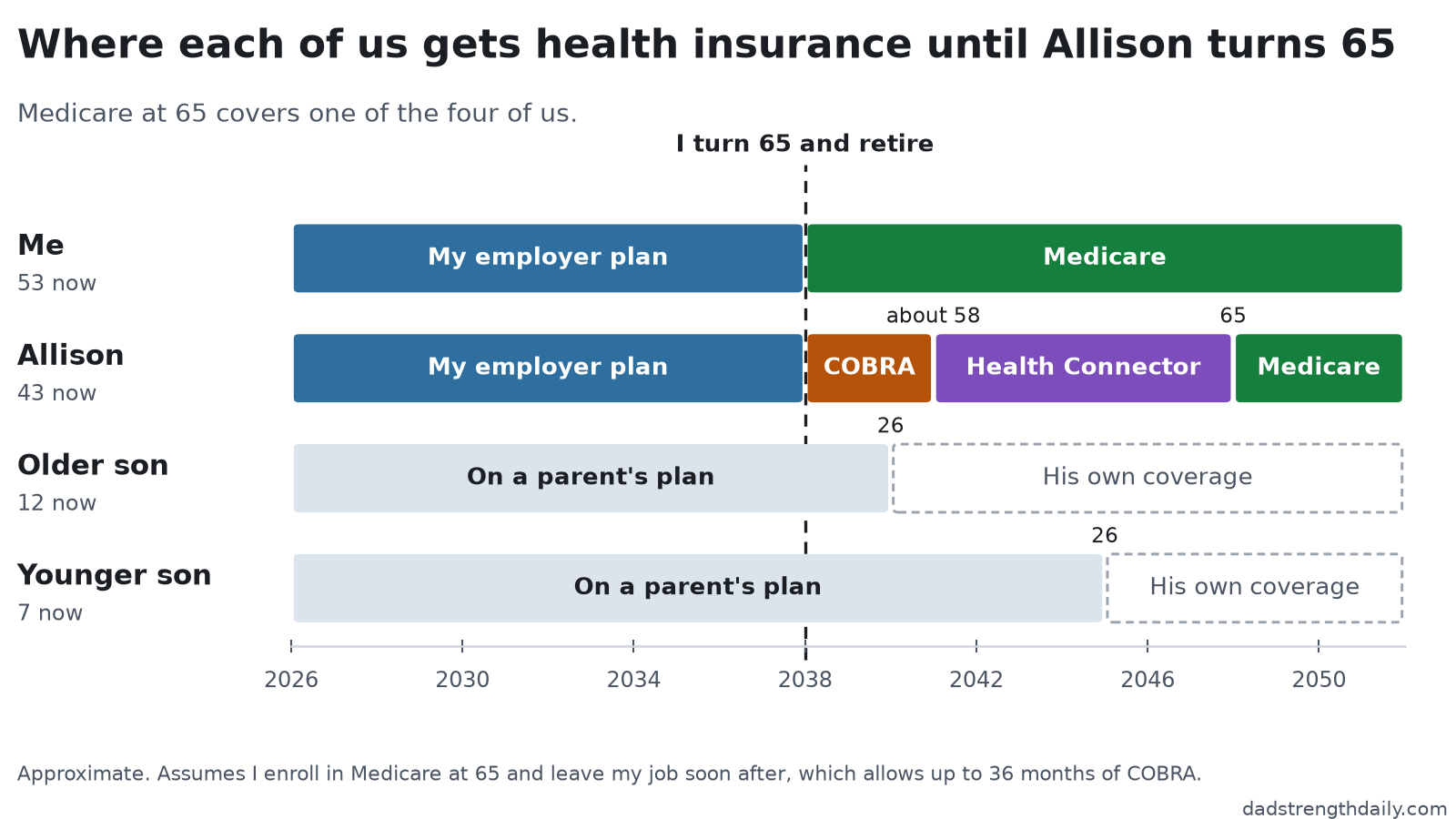
When I retire, Allison and the boys lose my employer’s plan. COBRA, which lets a family stay on that plan after the job ends, normally lasts 18 months. But if I enroll in Medicare first and leave the job less than 18 months later, Allison and the boys can keep COBRA until 36 months after my Medicare started. Leaving soon after Medicare starts is worth up to 18 extra months of coverage.
That coverage isn’t cheap. Federal law lets COBRA charge the full premium, including the part my employer pays now, plus 2%. For our family’s medical plan that comes to about $3,200 a month at this year’s rates, most of which I never see on my paystub. I don’t know yet what the rate would be for Allison and the boys without me, or exactly when their coverage would end. Those are questions for the plan administrator before I pick a retirement date.
Thirty-six months gets Allison to about 58, seven years short of her own Medicare. When COBRA runs out she has 60 days to enroll in a Marketplace plan, which in Massachusetts means the Health Connector. I lose any Marketplace subsidy once I’m on Medicare; Allison can still get one, depending on our income. Our older son turns 26, the age limit for a parent’s plan, about two years after I turn 65.
That subsidy is less generous than it was. The enhanced ACA premium tax credits lapsed at the start of 2026, so there is again no premium tax credit above 400% of the federal poverty level. For a married couple buying 2026 coverage that’s $84,600 a year, and more if the household includes dependents. Massachusetts cut the ceiling for its ConnectorCare program to the same 400% on January 1. I haven’t priced a Health Connector plan against COBRA yet, and I don’t know what the rules will be when Allison needs them.
Premium-free Part A takes about ten years of Medicare-taxed work, your own or your spouse’s, so Allison should get it at 65 either way. Part B she pays for herself.
The decisions that come due before 65
I don’t have a health savings account (HSA) yet, the tax-advantaged account that comes with a high-deductible plan. The IRS limit for 2026 is $8,750 for family coverage, and from age 55 each spouse can add a $1,000 catch-up to their own HSA. Mine starts the year I turn 55.
Once you’re on any part of Medicare you can’t contribute, so my last contribution is for the month before Part A starts. Anyone who signs up six or more months after turning 65 should stop six months before applying, because Part A is backdated up to six months. After I’m on Medicare, Allison can keep contributing to her own HSA if she’s on a family high-deductible plan and otherwise eligible. Once I’m 65, my balance can pay my Part B and Part D premiums, but not Medigap premiums.
Then there’s income. IRMAA, the surcharge on Part B and Part D premiums, is generally based on your modified adjusted gross income (MAGI) from two years before the premium year. For married couples filing jointly the joint return counts, though only the spouse on Medicare pays. Roth conversions and large taxable gains, such as a home sale above the exclusion, raise MAGI in a look-back year.
| 2024 income, married filing jointly | Part B per month in 2026 | Added to the Part D premium |
|---|---|---|
| $218,000 or less | $202.90 | Nothing |
| Above $218,000 to $274,000 | $284.10 | $14.50 |
| Above $274,000 to $342,000 | $405.80 | $37.50 |
| Above $342,000 to $410,000 | $527.50 | $60.40 |
| Above $410,000, under $750,000 | $649.20 | $83.30 |
| $750,000 or more | $689.90 | $91.00 |
For anyone retiring at 65 from a salaried job, the salary years at 63 and 64 set the surcharge for the first two years. Form SSA-44 asks Social Security to use the newer, lower income after a “life-changing event” such as retiring.
The last check is free: your earnings record, online with Social Security. I believe Allison has the work credits she needs for her own benefits, but I haven’t checked her record or her projected benefit yet.
Medigap or Medicare Advantage: the choice that’s hard to undo
Medigap is private insurance that pays most of what Original Medicare leaves to you, and almost everyone in Original Medicare has some extra coverage, 87% in 2023, 43% through Medigap. Nationally the most popular policy, Plan G, averaged $194 a month in 2025.
In most states, the risk is in buying Medigap later. You can buy any Medigap policy sold in your state without medical underwriting during the six months starting when you’re 65 and enrolled in Part B. After that, insurers in most states can turn you down or charge more based on health, apart from a few protections such as a 12-month trial right if you try Medicare Advantage first at 65. KFF Health News and NPR reported in 2024 on a retired veterinarian in Washington state who stayed in a Medicare Advantage plan after a melanoma diagnosis, though its network made specialist care hard, because he expected Medigap to turn him down.
Massachusetts, where I live, is an exception. It’s one of four states, with Connecticut, Maine and New York, that require Medigap insurers to sell to people 65 and older regardless of health at least once a year. Massachusetts guarantees a window every February and March, with coverage starting June 1, and state listings show several big insurers selling year-round. For me, the choice at 65 can be revisited.
Massachusetts also doesn’t sell Plan G or the other lettered plans. It has its own three: Core, which covers the basics such as the 20% coinsurance, Supplement 1A, which adds the hospital deductible and skilled nursing coinsurance, and Supplement 1, which is closed to anyone who became eligible after 2019. Supplement 1A is the closest to Plan G. It costs $240 a month at Fallon and $254 at Harvard Pilgrim in 2026, before any new-enrollee discount.
Switching back still takes planning. You leave Medicare Advantage in Medicare’s own windows, October 15 to December 7 or January through March, while a Medigap policy bought in the guaranteed February and March window doesn’t start until June 1, unless the insurer sells year-round.
My checklist at 53
- At my employer’s next open enrollment: compare the HSA-eligible plan with ours on premium, deductible and employer contribution, and open an HSA if it comes out ahead.
- This year: confirm both our earnings records.
- Before the tax year I turn 63: move any Roth conversions or large sales out of the look-back years.
- Before picking a retirement date: ask the plan administrator what COBRA would cost Allison and the boys, and price a Health Connector plan against it.
- The year before 65: ask SHINE, Massachusetts’s free Medicare counseling program (every state has one, called a SHIP), to check my enrollment order.
- At 65: enroll in Medicare, then leave the job, then file SSA-44.
In Massachusetts I can change my supplement choice in a later February. I get one chance at the order of Medicare and retirement, so that’s the decision I’m planning around.
Get the next one in your inbox
I write about GLP-1s, training, and preventive health once a week — what the evidence actually says, from someone using it. Free, no spam, unsubscribe whenever.
If this was useful, read next
- Our Family Health Plan Costs Nearly $38,000 a Year. It’s a Big Reason to Want a Good Job. — what the family plan Medicare doesn’t replace actually costs
- Wegovy, Zepbound and Foundayo on Medicare: $50 a Month Under the GLP-1 Bridge — how the temporary GLP-1 program works and who qualifies