
On October 28 HHS published a draft policy that would let licensed pharmacies make six peptides for patients with a prescription, under strict testing and reporting rules.
Key Points
- Not as an approved drug or a permanent change in the law. HHS calls the policy a draft, takes comments until November 13, and hasn’t said when pharmacies can start relying on it.
- Once it applies, HHS says it won’t act against state-licensed pharmacies that make BPC-157 and five other peptides for patients with a prescription, one peptide per product, from a tested, FDA-registered source.
- None of it is FDA approval. HHS’s case for BPC-157 rests on documented use, existing human studies and new lab results, not on a new trial showing it works.
The drug people keep talking about isn’t a new cancer drug, or even the latest weight-loss shot. It’s BPC-157, an unapproved peptide sold online as a fix for a bad shoulder or knee. On October 28 the Department of Health and Human Services published a policy that would let you get it from a state-licensed compounding pharmacy, with a prescription, once it applies.
The policy comes from Health Secretary Robert F. Kennedy Jr., who signed the notice, not from the FDA. It says HHS “does not intend to take enforcement action” against pharmacies and doctors that compound six peptides under certain conditions. That is enforcement discretion: the rule hasn’t changed, HHS just says it won’t enforce it here, and the notice adds that the policy is “not binding on HHS or the public.” It covers only compounding for individual patients under section 503A of the drug law, not the 503B outsourcing facilities that make larger batches.
The policy cites no new trial showing that BPC-157 heals anything. HHS argues that its use is “now documented and quantified,” that there are “multiple human studies,” and that a manufacturer has now supplied the lab results FDA reviewers said were missing. When I went through every human study FDA’s reviewers could find, I found five studies, about 80 people, and not one that tested an injury.
What the HHS peptide policy allows
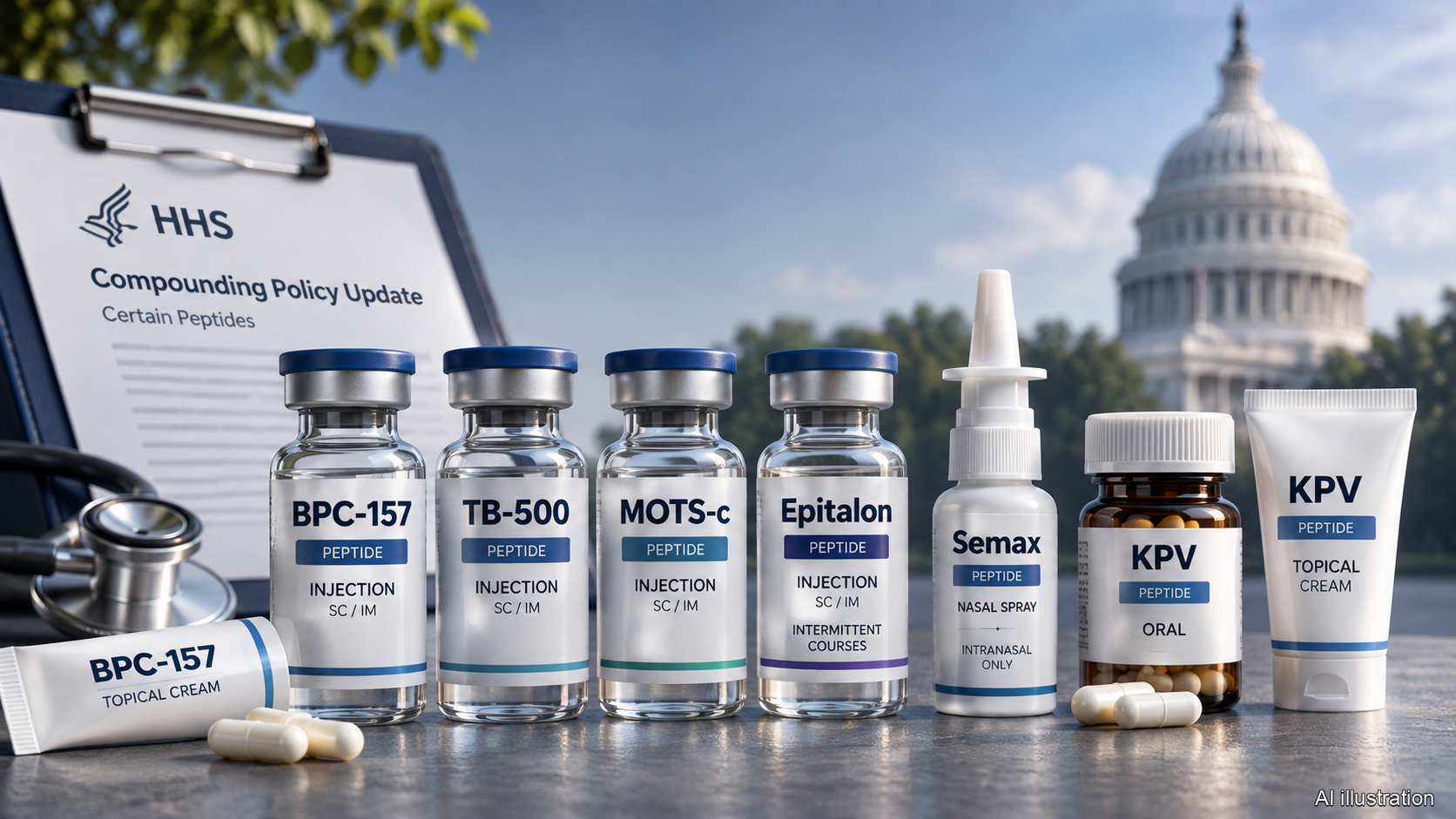
The six are the ones an FDA advisory panel voted for in July: BPC-157, TB-500, MOTS-c, epitalon, semax and KPV. Among the conditions the product you get has to meet:
- a prescription written for you, filled by a state-licensed pharmacy or a licensed physician
- one peptide per product, so no “Wolverine” blends of BPC-157 and TB-500
- the raw ingredient from an FDA-registered manufacturer that follows drug-plant manufacturing rules, named with its address on the certificate of analysis
- a certificate showing tests for identity, purity, potency and contaminants such as heavy metals, plus endotoxin and microbial tests for injectables
- if a device comes with the drug or holds it, only an FDA-cleared syringe, so no pens
- the label “This is a compounded drug product. Not for resale.”
- the pharmacy reports each product it makes, every serious adverse event (whether or not anyone thinks the drug caused it) and any quality problem to the FDA and to the states involved
Each peptide is also limited to certain forms and to one exact chemical form (an acetate salt for five, the free base for semax):
| Peptide | Allowed forms |
|---|---|
| BPC-157 | Injection under the skin or into muscle, oral, topical |
| TB-500 | Injection under the skin or into muscle |
| MOTS-c | Injection under the skin or into muscle |
| Epitalon | Injection under the skin or into muscle, in intermittent courses |
| Semax | Intranasal only |
| KPV | Topical or oral only |
Oral versions have one more requirement: the pharmacy has to document that the specific formulation is absorbed adequately in humans. I’d want to see that paperwork before trusting any BPC-157 pill.
Is BPC-157 legal now?
HHS calls it an interim enforcement policy, but the Federal Register notice calls it a draft and doesn’t say when pharmacies can start relying on it. Comments are open until 11:59 p.m. Eastern on Friday, November 13. The AP reported that the government will finalize it after the comment period, and the compounders’ trade group told the AP it still needs to know when the policy takes effect and how it fits with state pharmacy boards.
Neither telehealth company that has announced plans is shipping BPC-157 yet. Hims & Hers says BPC-157 and TB-500 will follow “when allowable,” and names no price. Superpower is taking BPC-157 preorders at $149 a month, including a clinician review and a blood panel, with a target ship date of late November. It doesn’t say how much BPC-157 a month buys. For comparison, Omegamino, a “research use only” store, lists a 10 mg vial at $50.99, labeled “Not for human consumption.”
Once it applies, the policy lasts until a final rule decides, peptide by peptide, whether each one goes on the permanent list. That could take years: lawyers at Hyman, Phelps & McNamara noted that in 15 years only six substances have moved off FDA’s interim compounding list that way. HHS can also withdraw all or part of it over a safety signal or quality problem. And the permanent answer could be no: before the policy came out, Bloomberg reported, citing unnamed sources, that officials had discussed letting the FDA propose a regulation recommending against adding certain peptides to the list, essentially leaving current restrictions in place.
The same lawyers call it “a big unknown” whether states will follow HHS, and Peter Lurie of the Center for Science in the Public Interest told the AP that the FDA doesn’t have the legal authority to enforce the pharmacy conditions.
What the policy doesn’t change
The policy states that “compounded drugs are not FDA-approved, which means FDA does not review their safety, effectiveness, or quality before they are marketed.”
If you compete in a drug-tested sport, nothing here changes your status either: USADA lists BPC-157 as prohibited under the World Anti-Doping Agency’s S0 category of non-approved substances.
According to the AP, FDA scientific staff had little input into the policy and opposed it. HHS first wanted a regulation and switched after FDA officials said their scientists would not support a rule deeming the peptides safe.
This policy doesn’t cover the stores selling vials labeled “for research use only.” It covers licensed pharmacies and doctors, and its stated goal is to “discourage the continued, widespread use” of those research-chemical peptides.
How to comment on the HHS peptide policy
Comments go through regulations.gov on docket HHS-OASH-2026-0496, by November 13. If I were commenting, I’d ask HHS and the FDA to publish the MedWatch reports filed under this policy, peptide by peptide.
If you’re going to inject BPC-157 anyway, I’d rather you wait for a licensed pharmacy operating under these conditions, and tell your doctor. Under them the pharmacy has to know who made the ingredient and what it tested at, and it has to report serious side effects and quality problems. The peptide bro selling “research use only” vials from a Chinese supplier answers for none of that. The pharmacy route still doesn’t tell you whether the peptide will help your shoulder, and it doesn’t answer the question I asked about my own aorta in June.
Get the next one in your inbox
I write about GLP-1s, training, and preventive health once a week — what the evidence actually says, from someone using it. Free, no spam, unsubscribe whenever.
If this was useful, read next
- BPC-157 Human Trials: 5 Studies, ~80 People, One Failed RCT — every human study HHS could point to, and why none of them tested an injury
- FDA-Approved Isn’t a Purity Guarantee. It’s an Accountability Guarantee. — what a 503A pharmacy answers for, compared with a 503B and the gray market
- I Checked 93 “Research Use Only” Peptide Stores — the market this policy is meant to pull people away from