
The Peptide Bro Industrial Complex, Part 3 of 3
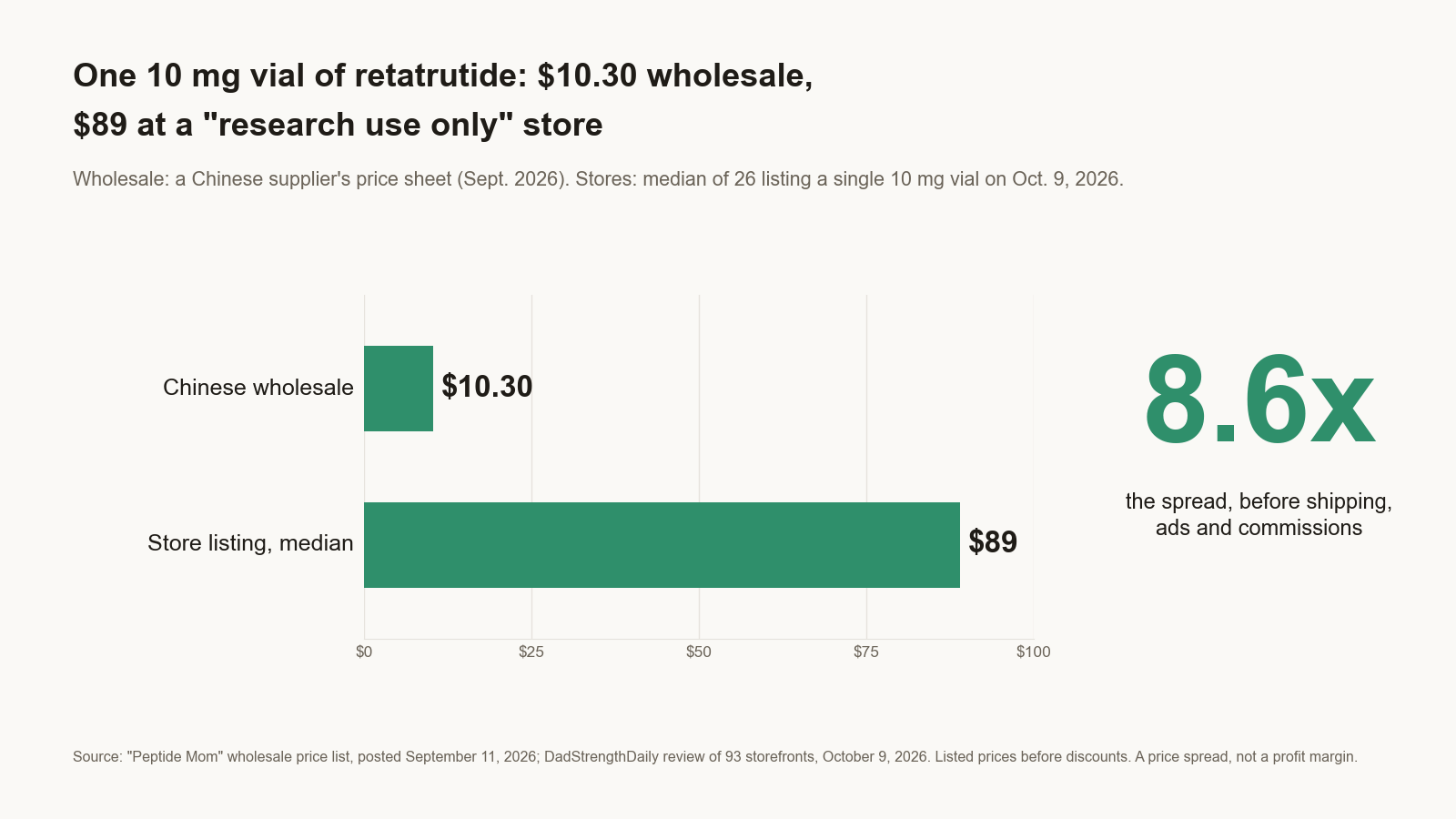
A research-peptide store is easy to start because every piece of it is for sale. A Chinese wholesaler’s price sheet lists 10 vials of 10 mg retatrutide for $103. On October 9, at the 26 stores in this series where I could read a price for a single 10 mg vial, the median was $89. Coaches on YouTube charge to help people launch a store, a U.S. fulfillment company offers white-label peptides, and affiliates promote the stores for a share of each sale.
I own Eli Lilly stock, and Lilly is suing several of the companies in this series. I take Zepbound and prescribed compounded testosterone. Part 1 counted what 93 stores publish, and Part 2 followed the 23 that had an FDA letter or an August Lilly lawsuit. This part is about the people who supply them and sell for them. I am quoting the coaching videos below but not linking them, for the same reason I do not link the stores.
Starting a store
Search YouTube for “starting peptide business” and most of the top results are people selling the answer. One channel is named “Aden Rao – RUO Peptide Business Consultant.” A documentary by The News Movement, Young, ripped, & rich: Inside the underground peptide economy, follows one of these coaches and reports that “participants pay Lino up to $12,500 to essentially launch their peptide companies for them using his Chinese supplier and networks, and after they get started, he takes a percentage of their revenue.” Earlier in the film, asked about the best month at his own peptide store, Lino says: “Around 140K that we took home.”
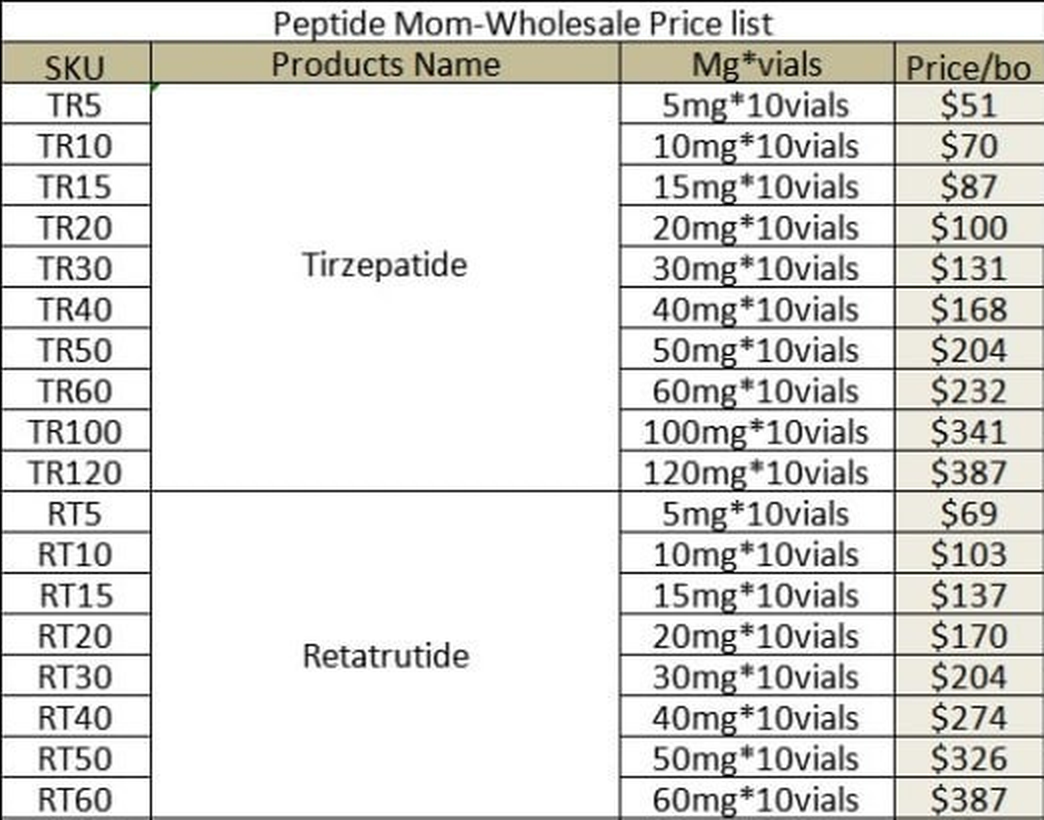
The wholesale price sheet I found in the Stoneville investigation, headed “Peptide Mom-Wholesale Price list,” prices every product by the box of 10 vials, and in the WhatsApp group where it was posted, a seller offered resellers drop-shipping (“We can handle drop shipping directly”). In a separate case, from December 2025 to March 2026, customs officers at one port, Cincinnati, intercepted about 5,000 prelabeled peptide parcels from “a shipper in China,” packed about 15 to a master carton and declared as something else. The Wall Street Journal reported on October 6 that the count had reached roughly 400 cartons and nearly 6,000 parcels. A U.S. third-party fulfillment company, RapidFulfillment, offers “White Label Peptides” and says most such businesses “can go live within 7 to 10 days.” The same page says the company “does not manufacture, market, distribute, or sell peptide products.”
There are lawyers for this too. A law firm advertises “Launch Your Peptides Business With Holt Law,” with flat-fee pricing. Its page tells clients that Category 2 peptides “may be sold only for research or laboratory use” and that selling one “as a supplement, injectable therapy, or wellness product for humans is unlawful even if the product is labeled cleanly.” An e-commerce platform’s guide to selling peptides, which steers its readers away from research peptides, is blunter: “The ‘research use only, not for human consumption’ label you see on these sites is a fig leaf, not a loophole.”
Get the next one in your inbox
I write about longevity, training, and preventive health weekly — without the guru worship. Free, no spam, unsubscribe whenever.
The money in the peptide business
Aden Rao, who runs that consulting channel and says he has his own store, tells prospective students “you might get it for six bucks. You might be able to sell for $60. That’s like a 10x markup.” In the video where he breaks down his costs, he puts some products at “six to seven X.” The wholesale sheet lists retatrutide at $10.30 a vial; the median store listing was $89 before discounts. I bought from none of the stores, so I can’t say the vials are equivalent.
The markup is not the profit. In that video Rao walks through a month he says brought in $382,000. By his account about 12 percent of revenue went to product, about 10 percent to shipping and fulfillment, about 10 percent to Google and Meta ads, about 5 percent to affiliates, whom he pays “on average a 25% commission,” about 3 percent to card processing and about 5 percent to miscellaneous costs. “Our net margin is 55%,” he says, adding that the money is shared with partners. He is selling a mentorship, and in a video posted 17 days earlier he presented the same $382,000 as one of his clients’ months, so these are a salesman’s numbers. The only revenue-and-cost figures I have from a prosecution are older and smaller: the Justice Department’s announcement of Adam Higdon’s 2013 guilty plea alleged that he paid Chinese suppliers $131,472.50 and sold the peptides for $397,662.
The broadest figure I have found for the market as a whole counts only cryptocurrency. The blockchain-analysis firm Chainalysis estimated in June that crypto sent to gray-market peptide vendors averaged about $200,000 a month before 2025 and reached $32 million in the first quarter of 2026, which is more than $10 million a month. Card payments are not in that number.
The labs
A certificate of analysis is the one document most of these stores offer as proof. When I checked in October, at least 35 of the 74 stores I could assess named a testing lab on their site or linked to one, and most of the rest said their products were third-party tested without naming a lab. Janoshik, a Czech company in Prague, is named at 12 or more. Its founder told the PepTok YouTube channel in a 2025 interview that “roughly 5%” of the samples the lab tests fail, meaning a sample “containing considerably different dosage of the peptide or it’s containing a different peptide or no peptide at all,” and that “roughly 3 to 5%” fail sterility. (I am quoting the video’s automatic captions. Its description, as it read in September 2026, says the interviewer is from Crush Research, one of the 93 stores in this series.) I found no ISO 17025 or other accreditation claim on Janoshik’s site, which does not show that the lab is unaccredited. A certificate reports on the sample someone sent the lab, not on what ships to a customer.
Freedom Diagnostics, named at 14 or more stores, the most of any lab, describes itself as based in Franklin, Tennessee and “Est. 2023.” A search of Tennessee’s business registry in September for names containing “freedom diagnostic” returned no records. A company can trade under a different legal name or be registered in another state, so that does not show it is unregistered. I found no accreditation claim on its site either.
Finnrick Analytics, based in Austin, publishes free test results. Its recruiting ad for a “Gray-Market Whisperer” says: “We fund the mission by supporting vendors who want to win, and offering premium options to the newly sovereign public.” Its vendor page offers vendors an optional $279-a-month premium service, a paid “Launch with Finnrick” program and paid private testing that is “Not published on Finnrick” unless the vendor adds its “Pulse” option. In the Launch program, the writer Krysia reported after interviewing Finnrick’s Raphaël Mazoyer in September, “the vendor is shown the findings and may either authorise or reject publication, but can’t alter the results.” On whether those paid results count toward a vendor’s rating, the two accounts conflict. Krysia reported that published Launch results “don’t contribute to Finnrick’s vendor ratings.” Finnrick’s vendor pages, as they read on October 10, answer “Are test results included in my Finnrick Ratings?” for the Launch program with “Yes.” I don’t know which describes current practice. Finnrick says it does “not ever accept payment to modify ratings or delete test results,” and I found nothing showing a result changed for payment.
The affiliates
The stores recruit salespeople in the open. On Reddit in late September I found 58 posts from 33 accounts recruiting affiliates for peptide brands, almost all since June 2026, and mostly on creator job boards like r/influencermarketing and the UGC subreddits rather than in peptide forums. Many are the same offer posted to several subreddits. At least 44 of the posts state a rate. Their median top commission is 20 percent, and they range from 10 to 40. A typical one, from August, offers “20% commission on every sale (including repeat purchases)” and adds: “Whether you have 200 followers or 200,000.”
The investigative journalist Scott Carney tested the model on purpose. A store called Iron Peptides, not one of the 93, offered him “a 25% commission” on “all revenue that you generate.” He sent its products to a lab and published what he found in a video that carried his own affiliate code, and said he would give the money away. On June 30 he wrote that “a payment… for $1048 from the CEO of Iron Peptides” had covered “the commissions generated from the first week of my video about peptides.” If he was paid the 25 percent he was offered, that is more than $4,000 in sales through his code in the first week of a video criticizing the company.
In my September captures, about half of the 93 stores showed signs of an affiliate program. I could identify the software at about 40 of those, and the most common was GoAffPro, at 19. At least twelve published a commission rate, from 10 to 30 percent. One of them is Royal Peptides, which got its FDA letter on August 24.
I started this series confused by how fast this business grew. The supply, the fulfillment, the lab testing and the salespeople for a store can all be bought, one seller puts his markup at six to ten times, and 19 of the 23 stores with an FDA letter or an August Lilly lawsuit were still online when I checked. I can’t tell from public pages who buys from these stores: laboratories, or people injecting the product.
If this was useful, read next
- Sam Sulek’s NewBioRx Sells “Research Only” Retatrutide — the one store I watched take its dosing site down
- How a Hacked Town Website Funneled Google Searches to Peptide Sellers — where the Peptide Mom price sheet came from
- Peptides Promise Everything. An FDA Panel Just Said Yes to Six of Seven. — what the evidence for the peptides themselves looks like