
The Peptide Bro Industrial Complex, Part 2 of 3
In May 2021 the FDA sent Umbrella, a research-peptide store in Tucson, a warning letter citing six SARM products (selective androgen receptor modulators, muscle-building compounds sold as research chemicals). Five years later all six pages still load, with prices.
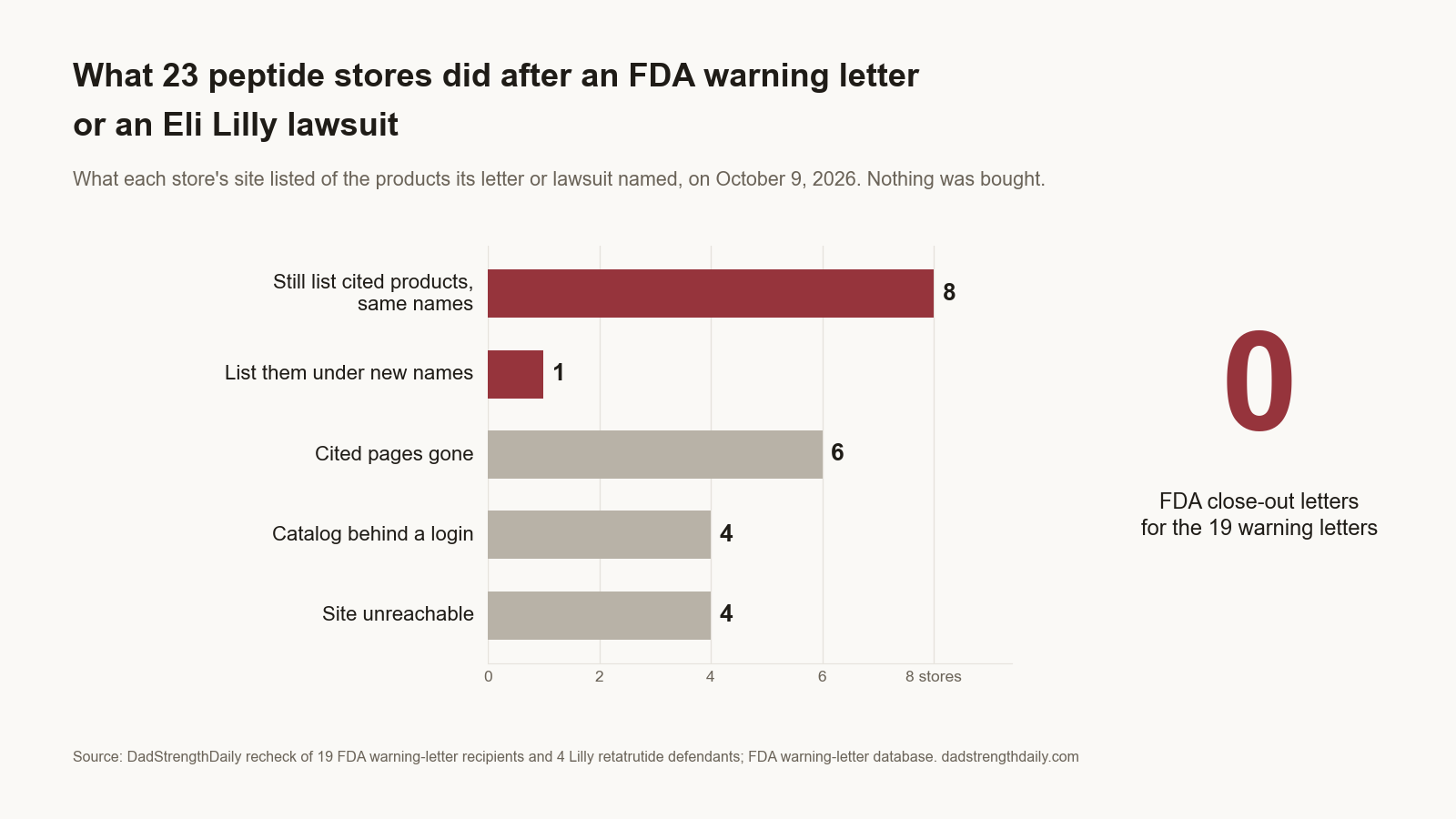
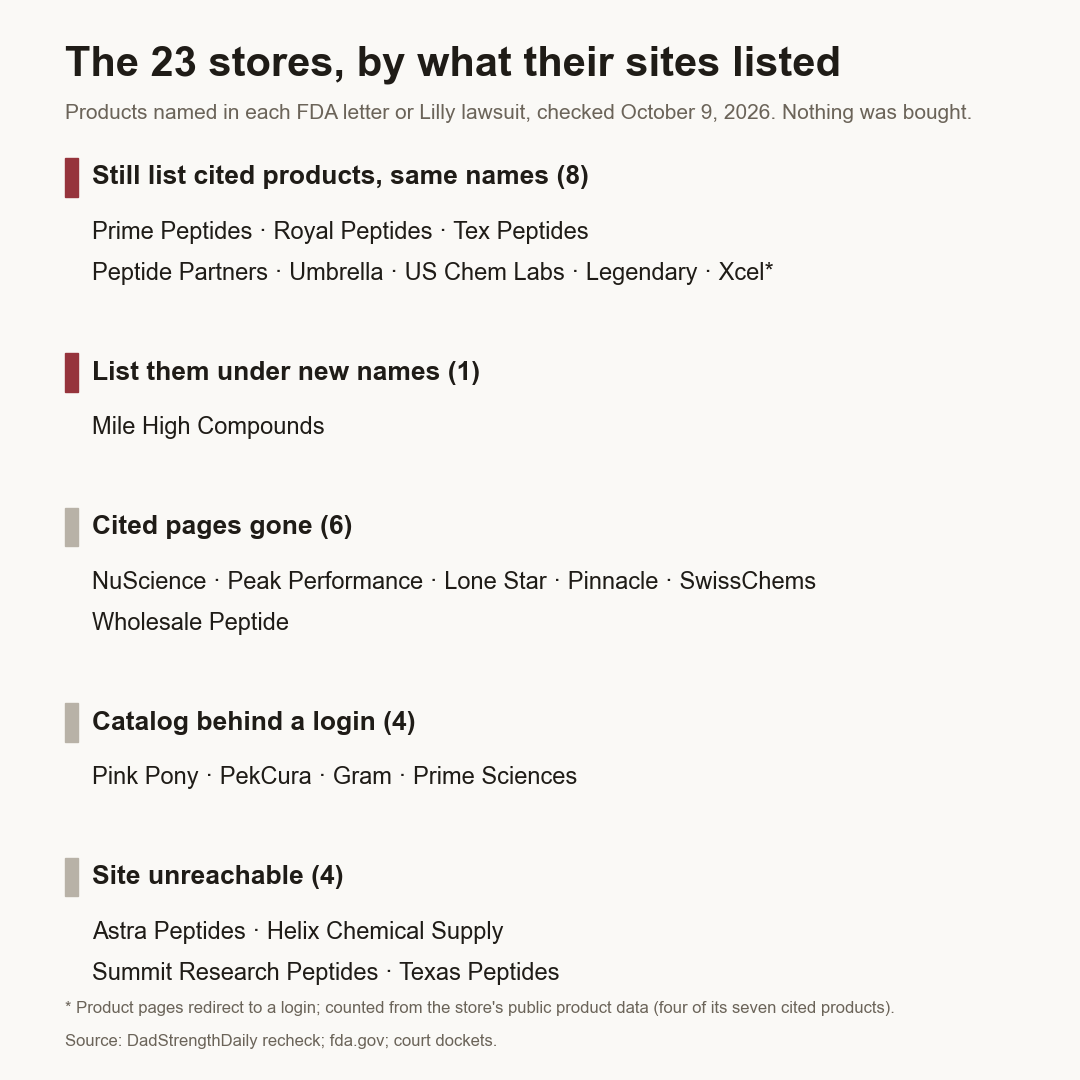
Umbrella is one of 23 stores, out of the 93 in Part 1, that had an FDA warning letter or were sued by Eli Lilly in August. On October 9, 2026, I went back to every one of them and checked each product the letter or lawsuit named. Nineteen of the 23 sites were online. Eight still listed products their letter or lawsuit named under the same names, one listed them under new names, six had taken down the pages they were cited for, four kept their catalog behind a login, and four sites were unreachable. I did not buy anything. I count a product as listed if its page loads or the store’s public product data names it.
I own Eli Lilly stock, and Lilly is the plaintiff in four of these cases. I take Zepbound and prescribed compounded testosterone.
What an FDA warning letter asks a peptide store for
An FDA warning letter sets out what the agency believes are violations, tells the company to address them and asks for a written response. It is not a fine or a court order. The August 24 letter to NuScience Peptides gives the company “fifteen (15) business days” to reply with “the specific steps you have taken to correct any violations,” and warns that failing to fix them “may result in regulatory or legal action without further notice including, without limitation, seizure and injunction.” All 19 letters set the same deadline and name seizure and injunction.
The public sign that the FDA considers a problem fixed is a close-out letter. According to the agency, one “may issue” after it has evaluated a company’s corrective actions, and “will not be issued based on representations that some action will or has been taken.” I searched the FDA’s warning-letter database for each of the 19 firms on the day of my recheck. It shows no close-out letter and no second letter for any of them. A missing close-out does not mean the FDA did nothing.
Get the next one in your inbox
I write about longevity, training, and preventive health weekly — without the guru worship. Free, no spam, unsubscribe whenever.
What the stores changed
Some stores changed very little. Tex Peptides got its letter on August 24 for, among other things, saying its retatrutide “may provide superior outcomes compared to GLP-1 or dual agonists alone.” Six of the seven products the letter cited were still listed under the same codes, among them “GLP-3 RT (20mg).” The seventh, bacteriostatic water, was not in the store’s product data. Peptide Partners and Royal Peptides each had all seven of their cited products listed. Prime Peptides’ two cited addresses return a 404, but both products are listed under the same names at new addresses.
One store changed the product names. Mile High Compounds’ March 31 letter, addressed to Max Radovanic, cited three GLP-1 products sold as “GLP-1 SM,” “GLP-2 TRZ” and “GLP-3 RT,” plus bacteriostatic water. The three cited addresses now redirect to products named “MHC-1 SM,” “MHC-2 TRZ” and “MHC-3 RT.” Where the letter cited bacteriostatic water, the store lists a “Reconstitution Solution” described as sterile water with 0.9% benzyl alcohol. Pink Pony, cited the same day, sends its product pages to a login screen. Its public product data lists “PinkPony-2TZ” and “PinkPony-3 RT,” which I take to be the two cited GLP-1 products under new names. Nothing I could read says so, which is why I count Pink Pony with the stores behind a login.
Four stores kept their catalog behind a login: Pink Pony, PekCura, Prime Sciences and Gram Peptides, whose page said “Existing clients must re-register and verify their account details before website access can be restored.” PekCura’s public product data names its products only by CAS number, and those numbers include the ones for semaglutide, tirzepatide and retatrutide. Two other stores ask for a login and still show products. Legendary’s home page says “An account is required to view products and pricing,” yet the same page showed “GLP3 (R),” the product name in Lilly’s complaint, at $60.00 to $145.00. Xcel’s product pages redirect to a login, but its public product data lists four of the seven products its December 2024 letter named. That data was incomplete, so I can’t say whether the other three are listed.
Six stores took down the pages they were cited for: NuScience, Peak Performance, Pinnacle, Wholesale Peptide, SwissChems and Lone Star. At NuScience, Peak Performance and SwissChems the cited products are also gone from the product data. For Pinnacle and Wholesale Peptide I could read no product data, so I can’t say the products are out of the catalog. At Lone Star, a Lilly defendant, the product category and the retatrutide dosage calculator the complaint cited are gone, and retatrutide is not among the seven compounds its shop page showed. Its certificate-of-analysis page still lists three retatrutide batches, marked in stock.
Older letters
US Chem Labs got its letter in February 2024 for semaglutide, tirzepatide and thymalin. The first two were still listed, thymalin was not, and the store also listed retatrutide.
Two of the older stores are gone. Helix Chemical Supply, which got its letter the same day as US Chem Labs, no longer has a site. Its domain was re-registered through a drop-catching service on August 11, 2026, and did not respond. Summit Research Peptides, cited in December 2024, has a domain that now leads to advertising and domain-parking pages. I did not look for successor stores.
Lilly’s lawsuits
Lilly filed six retatrutide suits on August 12. Four of the defendants are stores in my 93. The other two are a compounding pharmacy and a med spa, and Lilly dropped the suit against the med spa in September. The docket entries I can read show no answer from any of the four stores. Texas Peptides was served on August 17 and its answer was due September 8. The docket shows nothing from it since and no request from Lilly for a default, and its site says “This Deployment is paused by the owner.” Legendary hired lawyers and on October 2 asked the court to dismiss the case, arguing that Lilly cannot have lost sales to a drug it does not sell. I have seen no ruling.
In the Astra Peptides case Lilly is still trying to find out whom it is suing. It named Astra LLC because the store’s own terms and conditions named Astra LLC as the operator. Astra LLC told Lilly it is a transportation business with no connection to the store, and on September 2 Lilly dismissed it from the case, keeping the right to sue the company again. The store, which Lilly’s filing describes as run by someone “whose true legal identity is presently unknown,” is still a defendant, and on September 30 Lilly filed a motion “To Allow Pre-Service Discovery to Determine Defendant’s Identity.” The site now refuses connections.
On October 8 Lilly sued five more sellers, Bloomberg Law reported: American Peptides, LiveWell Peptides, Cenexa Labs, Medrein Health & Aesthetics and MedShape Weight Loss Clinic. By Bloomberg Law’s count that makes eleven retatrutide suits since August. None of the five is among the 23 stores above, though stores named American Peptides and Cenexa Labs are among the 93 in Part 1. I’ve read one of the complaints, the one against LiveWell. In it, Lilly says the address LiveWell gives for its “cGMP-certified facility” is an office high-rise in Dallas (¶11). The day after the suit was filed, LiveWell’s site did not load, and its domain record showed the status “clientHold,” which a registrar sets to stop a domain from working. A store named American Peptides still lists the drug at an address ending in /products/retatrutide. On September 20 that page was titled “RETATRUTIDE (RETA) – Research Peptide.” It is now titled “AP-TRA3™ Tri-Agonist Research Reference Peptide.” I don’t know when the title changed, so I can’t say whether it was before or after the lawsuit.
Eight weeks after Lilly’s first suits, two of the four stores it sued in August were online. None of the FDA’s 19 letters has a public close-out. Part 3 is about the money: the coaches who charge to help people start a store, the wholesalers, the testing labs and the affiliates paid by commission.
If this was useful, read next
- Sam Sulek’s NewBioRx Sells “Research Only” Retatrutide — the one store I watched take its dosing site down
- How a Hacked Town Website Funneled Google Searches to Peptide Sellers — the search-engine side of the same business
- Peptides Promise Everything. An FDA Panel Just Said Yes to Six of Seven. — what the evidence for the peptides themselves looks like