
The Peptide Bro Industrial Complex, Part 1 of 3
On March 30, 2022, the FDA sent Paradigm Peptides a warning letter, its second after one in December 2020. The company emailed back the same day: “These items are used for research only and do state such on each label and on our website in several places. We are not authorizing the use for human consumption on any level.” Paradigm kept selling until March 2024. Its owner, Matthew Kawa, later pleaded guilty to introducing unapproved new drugs into interstate commerce with intent to defraud and to illegally importing merchandise, and in July 2026 he was sentenced to 70 months in prison. The research-only claim was one part of that case, not the whole of it.
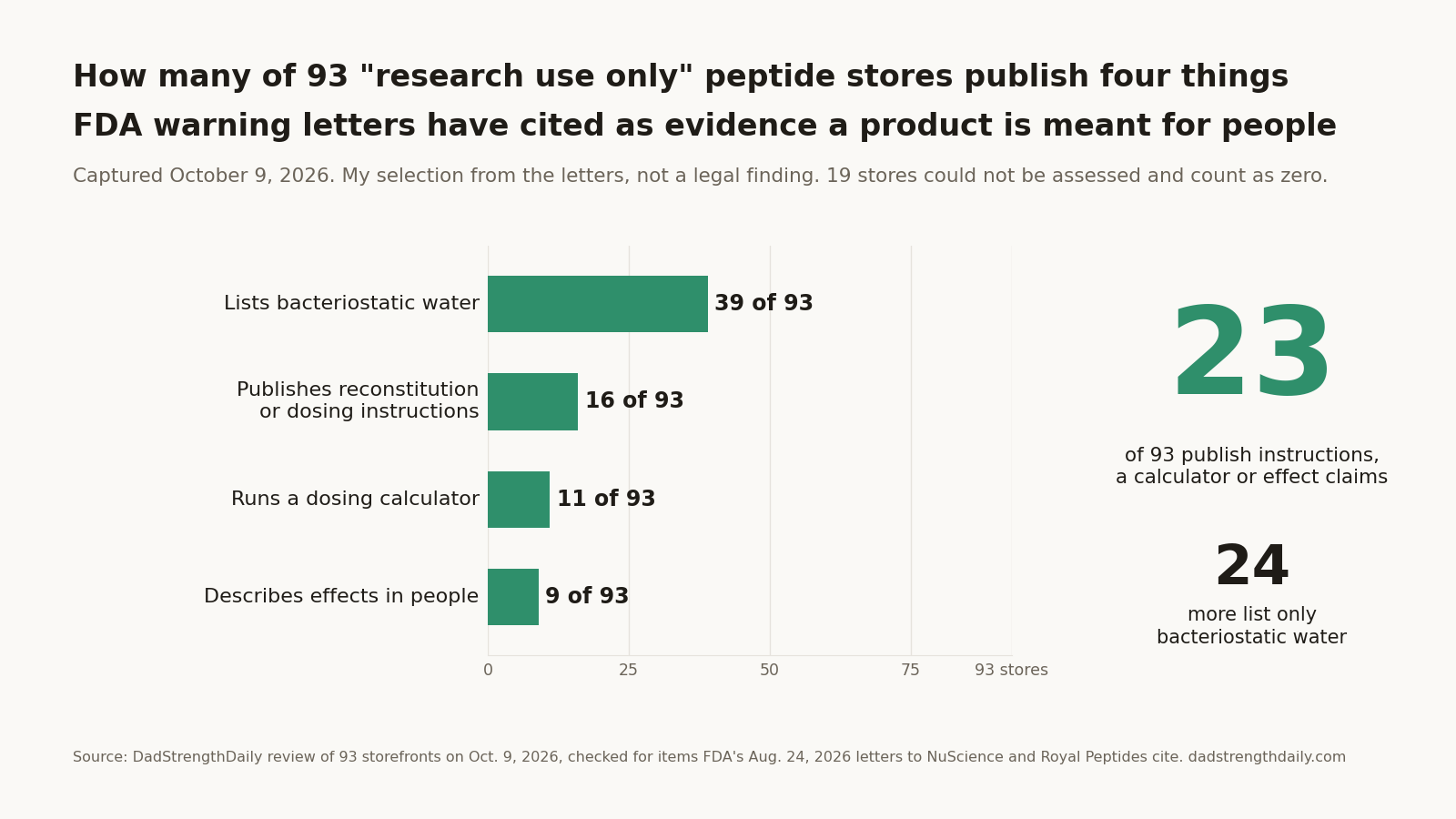
Stores still use the same disclaimer. On October 9, 2026, I checked 93 storefronts that list “research use only” peptides such as retatrutide and BPC-157, looking for four things FDA warning letters have cited as evidence that a product is meant for people. Twenty-three published mixing or dosing instructions, a dosing calculator, or copy describing what a compound does for people. Another 24 listed bacteriostatic water, the water used to dissolve a peptide powder for injection, and none of the other three.
I own Eli Lilly stock, and Lilly is suing several of the companies in this series. I take Zepbound and prescribed compounded testosterone.
This is the first of three posts on the business that has grown up in the US around selling weight-loss drugs like tirzepatide (Zepbound and Mounjaro) and retatrutide, plus hyped peptides like BPC-157 and TB-500, as research chemicals. I am actually intrigued by some of these peptides. However, I am confused by how fast this business has grown and who is behind it; it reminds me of the crypto boom, with its questionable practices, spotty enforcement and influencer money. After checking 93 stores, my explanation is that the risk is small and the money is good. The label did not protect the sellers who were prosecuted, but I found four such cases since 2013. Most of the stores that had a warning letter or a Lilly lawsuit by September were still online when I checked. This is not a buyer’s guide, and I do not link to any store, product or price.
The “research use only” label has been in court before
The charging document in Kawa’s case says Paradigm’s research-only email was false “because the Defendants knew that Paradigm’s products were being marketed and sold for human consumption.” It lists the label as the first of six deceptions. The others include forged certificates of analysis, misrepresented SARM ingredients (FDA testing found undeclared testosterone in some), and export parcels declared as “cosmetic samples.” The government puts Paradigm’s customers at more than 54,000 between 2019 and 2024.
He was not the first. In 2013 Adam Higdon pleaded guilty to mail fraud, misbranding and money laundering after selling peptides on websites that said “for research use only . . . not for human consumption.” In 2015 Gregory Tamborello of Precision Peptides in Florida pleaded guilty to selling misbranded drugs; each customer was asked to certify that they had read a disclaimer saying the products were “not intended for human ingestion.” And this July a federal judge in Michigan sentenced Brandon Piper to 21 months for conspiring to introduce misbranded drugs. The Justice Department said the drugs, which included semaglutide and tirzepatide, were sold on two websites that said they were “for research purposes only.”
Get the next one in your inbox
I write about longevity, training, and preventive health weekly — without the guru worship. Free, no spam, unsubscribe whenever.
What the FDA looks at when peptides are labeled “research use only”
Footnote 1 of the August 24 letter to NuScience Peptides reads:
Despite statements on your product labeling marketing your products “for laboratory, research, and analytical use” and “not intended for human or veterinary use,” evidence obtained from your website establishes that your products are intended to be drugs for human use. In addition to the cited drug claims, you market bacteriostatic water alongside a “peptide calculator,” a resource that provides the means to prepare an injectable drug for human administration.
FDA warning letter to NuScience Peptides LLC, August 24, 2026, footnote 1
The Royal Peptides letter of the same date adds a “peptide guide” to the water and the calculator. A JAMA news feature quotes Michael DiStefano, a pharmaceutical outcomes researcher at the University of Colorado, on sites that post a research-only disclaimer and then tell buyers how to use the product: “It’s really just some sort of legal cover.”
The FDA weighs a whole website, and these letters are not a checklist. To compare stores, I picked four things from them that anyone can see on a storefront:
- product copy describing what a compound does for people, such as fat loss or tissue healing (not copy framed only in animals or cells, and not molecular weight, sequence or purity)
- bacteriostatic water for sale (a “reconstitution solution” counts only if its listing calls it bacteriostatic water or says it contains benzyl alcohol)
- instructions for reconstituting or dosing (the letters say “peptide guide”)
- a dosing calculator
Counting them is my method, not a legal finding about any store. The letters cite the water too, but I report the water-only stores separately because I think listing it is weaker evidence than publishing dosing instructions.
Ninety-three stores, four signals
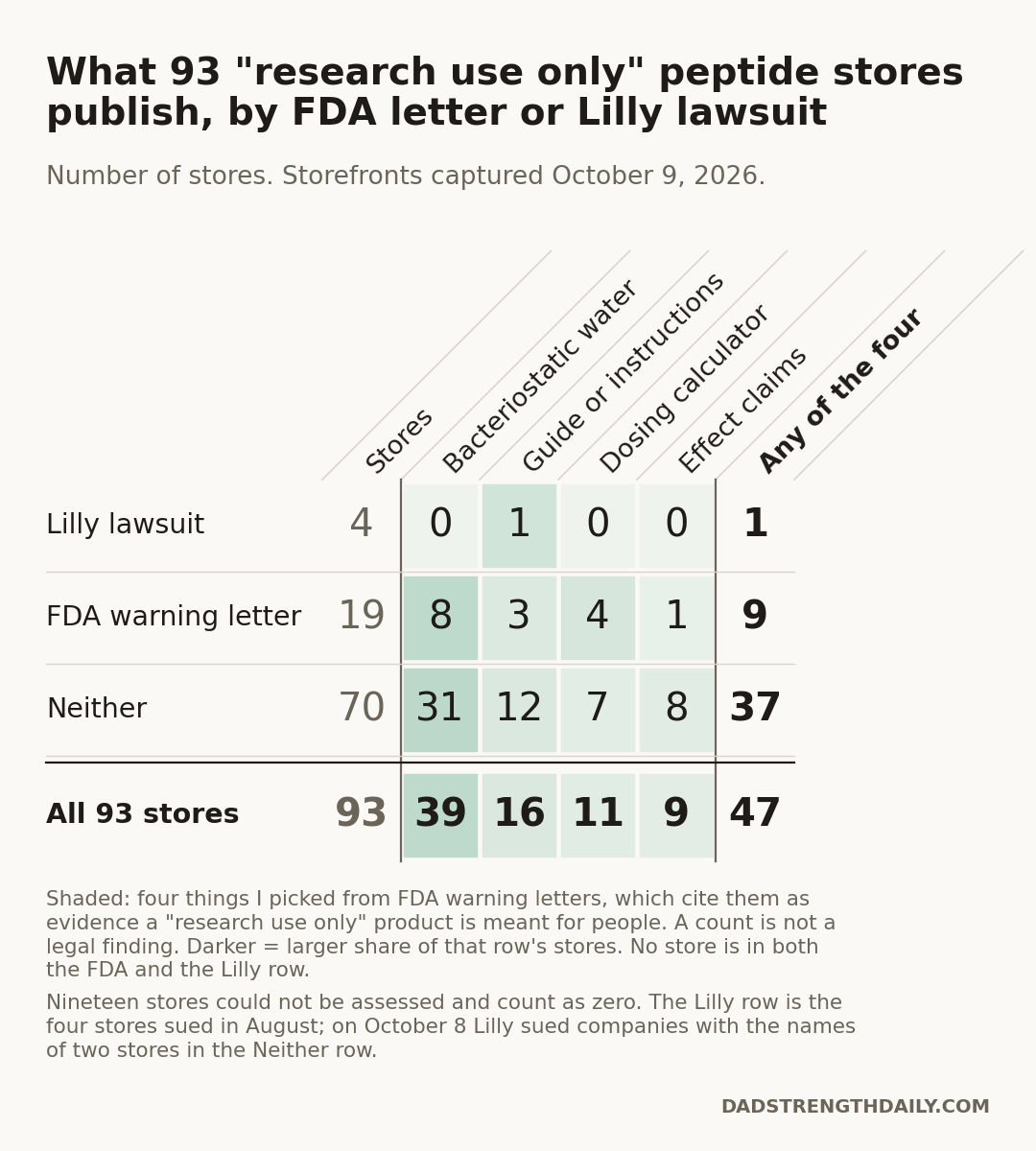
Forty-seven of the 93 show at least one of the four, and eight show three or more. Nine of the 19 warning-letter recipients show at least one, against 37 of the 70 stores that had neither a letter nor a lawsuit in September. Eight stores list bacteriostatic water and also run a dosing calculator, the pairing the FDA footnote describes.
Fifty of the 93 put something between a visitor and the catalog: 24 have a click-through gate asking for an age or a researcher confirmation, and 26 say an account is required to see products. One gate, at a store I am not naming because I found no FDA letter or lawsuit against it, asks the visitor to accept that they are “21+ and a qualified researcher purchasing solely for in vitro laboratory research.”
After the letters
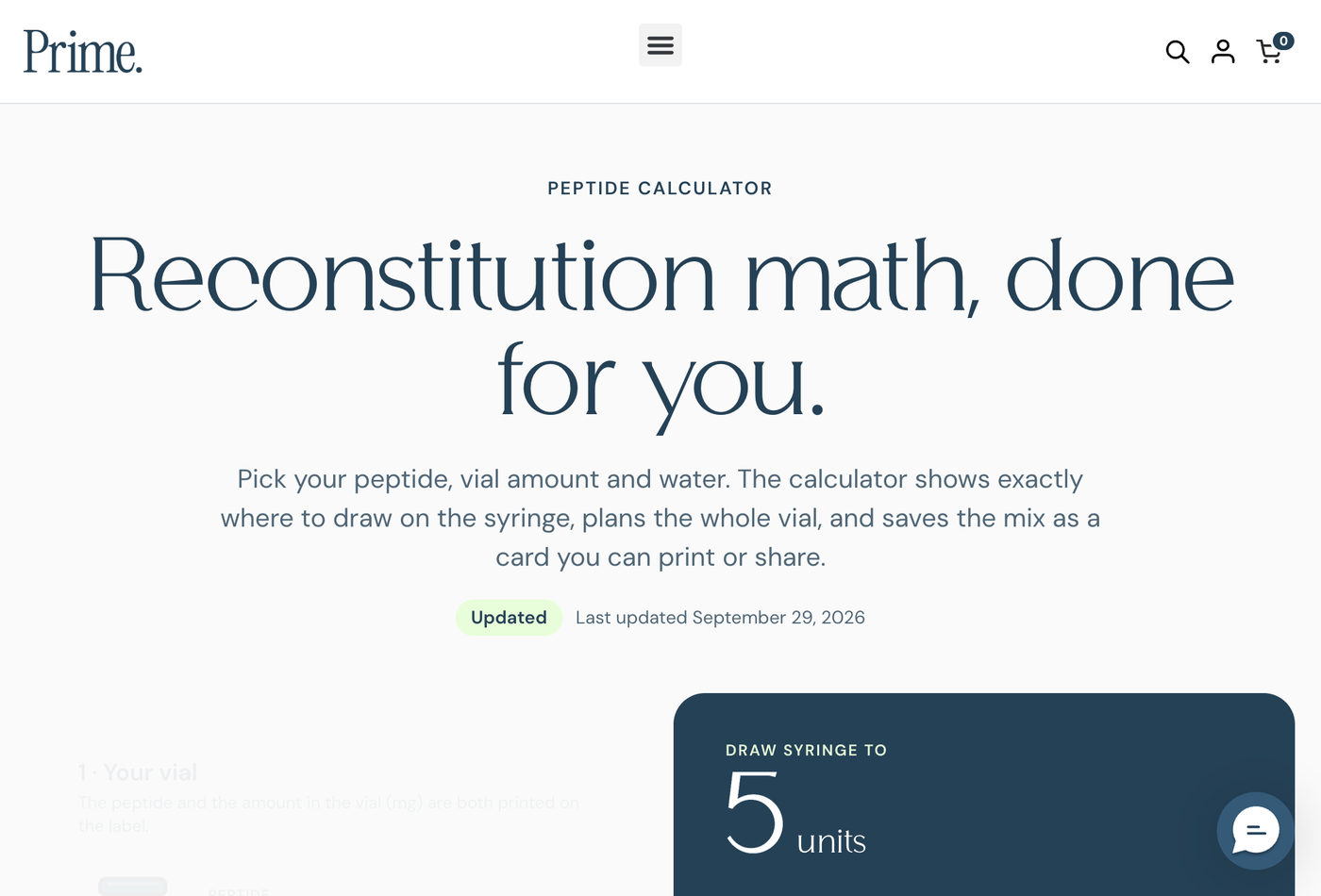
Twenty-three of the 93 had an FDA warning letter or a Lilly lawsuit by September. Prime Peptides received its letter in December 2024, addressed to Curtis Miller. When I checked in October, the store listed bacteriostatic water, a how-to page whose third step is “Draw 1 to 2 mL of bacteriostatic water into the syringe,” and a peptide calculator.
The oldest letter in the set went to Umbrella in Tucson in May 2021, for SARMs and kratom. In October the store showed all four signals. NuScience, whose August letter named its calculator, showed none, though it listed a 3 ml “Sterile Water.” Part 2 goes through what all 23 stores did after their letter or lawsuit.
How I counted
The 93 are the stores I found with an FDA warning letter or, as of September, a Lilly retatrutide lawsuit, plus the stores that three or more peptide-vendor directories list as U.S.-based, the ones on Google’s first page for a retatrutide product search, and a handful that two directories list and that are named at least 50 times across ten health subreddits I track. I could not confirm a U.S. base from every store’s own site. I counted web addresses, not companies; two pairs share a storefront or a brand, and counting each pair once leaves the 23 unchanged. Nineteen could not be assessed, twelve behind an account and seven unreachable, closed or blocked. They count as zero, so the totals could be higher. This is not a random sample, so the numbers describe these 93 stores on one day, not the market. The lawsuit group is as of September: Lilly sued five more sellers on October 8, and two of those names match stores I counted as having neither a letter nor a lawsuit. I did not buy or test anything. I am not publishing the captures, because a gallery of storefronts would point readers to the stores; a reporter or regulator who wants them can ask.
If this was useful, read next
- Sam Sulek’s NewBioRx Sells “Research Only” Retatrutide — the one store I watched take its dosing site down
- How a Hacked Town Website Funneled Google Searches to Peptide Sellers — the search-engine side of the same business
- Peptides Promise Everything. An FDA Panel Just Said Yes to Six of Seven. — what the evidence for the peptides themselves looks like