
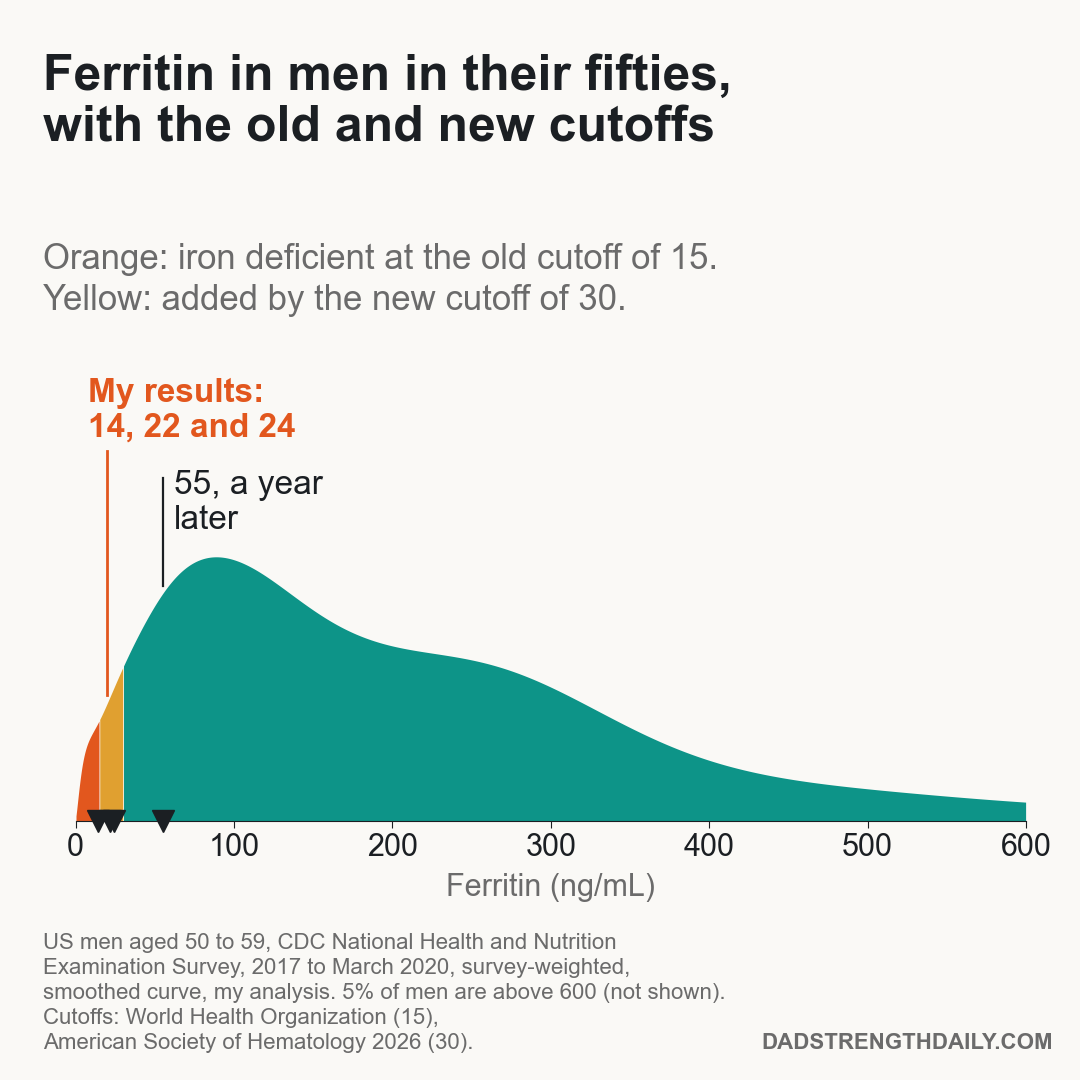
Ferritin is the blood test for how much iron you have in reserve. The World Health Organization cutoff for iron deficiency is 15 ng/mL. In late August the American Society of Hematology published a new guideline on diagnosing iron deficiency, and it suggests calling it at 30 or lower in adults who have no inflammation. That changes what counts as low ferritin in men. I had results of 14, 22 and 24 over nine months. Only the first counts as iron deficient under the WHO cutoff, and all three do under the new one.
What ferritin measures
Ferritin is the protein your body stores iron in, mostly in the liver, spleen and bone marrow. An adult carries 3 to 4 grams of iron, according to the National Institutes of Health. Most of it is in hemoglobin, the protein in red blood cells that carries oxygen, and much of the rest is held in reserve as ferritin.
When the body needs more iron than it takes in, it draws on the reserve first. Anemia comes later, once the stores are exhausted and hemoglobin starts to fall. So you can have low ferritin with a normal hemoglobin. Mine was 13.3 g/dL, inside the lab’s range, when my ferritin was 14.
Iron does more than build red blood cells. Cells also use it to produce energy and to make neurotransmitters. The symptoms and signs of low ferritin that the guideline lists include fatigue, worse concentration, restless legs, craving ice, hair loss and lower exercise tolerance.
What causes low ferritin in men
All of your iron comes from food or supplements. Meat, seafood and poultry contain heme iron, which the body absorbs better than the iron in plants and fortified flour. The body loses only small amounts of iron day to day, except through bleeding, because blood is where most of the iron is.
So ferritin falls when you eat too little iron, absorb too little or lose blood. The guideline’s risk factors include a vegetarian or vegan diet, long-term use of acid-reducing drugs, celiac disease, bariatric surgery, ulcers, inflammatory bowel disease, cancers of the gut and blood donation. Men have no monthly blood loss, so a low ferritin in a man needs an explanation.
Regular blood donation can leave you iron deficient. Each donated unit takes about 230 mg of iron. In a study of US blood donors, 16% of the men who had given three or more units in the past year had a ferritin under 12, against none of the men who were giving for the first time or the first time in two years. In a trial, two-thirds of donors who took no iron were still below their starting ferritin 24 weeks after one donation.
This matters if you take testosterone, which raises the red blood cell count. Some men on it donate regularly to bring their hematocrit (the share of blood made up of red cells) back down. In another study of US blood donors, the men who reported taking testosterone had about twice the odds of a ferritin under 12. That is an association, and it does not show that the donating caused it. Donating may not fix the hematocrit either. According to the abstract of a Canadian study I could not read in full, 12 of 27 repeat donors on testosterone still had a hemoglobin above the level at which guidelines there say to lower the dose or stop.
Is a ferritin under 30 low?
Under the new guideline, yes, and I think raising the cutoff was overdue. In the studies pooled for the guideline, a cutoff of 15 caught only 41% of the people who were iron deficient. A cutoff of 30 caught 67%, and the cost was more false alarms: 4% of people with enough iron were flagged, up from 1%. No trial has compared treating adults at 30 with waiting until 15, and the panel rates its evidence as low certainty.
The guideline suggests the same 30 for women who menstruate and in pregnancy. For men and non-menstruating women with symptoms or an ongoing risk factor, it says 50 or lower is appropriate. That cutoff caught 89% of the people who were iron deficient and wrongly flagged 14% of those with enough iron.
The higher number is not new either. The American Gastroenterological Association has recommended 45 over 15 since 2020 for people who are already anemic, and Labcorp was flagging anything under 30 on my report before this guideline came out. The guideline asks every lab to flag at the new cutoff. Yours may not yet.
For a man with no symptoms I think 30 is a reasonable cutoff. In the CDC’s national health survey, about 1 in 100 adult men of all ages is at 15 or lower and about 4 in 100 are at 30 or lower, rising to about 8 in 100 men aged 70 and over (my own survey-weighted count of 3,856 men in the 2017 to 2020 data). A single result is not exact. The guideline says a ferritin of 30 could read anywhere from 21 to 42 depending on the lab, and inflammation raises ferritin, so a result taken while you are ill is harder to interpret.
What to do about a low ferritin
A low ferritin with no obvious cause needs an explanation, and bleeding in the gut, including from colon cancer, is one cause your doctor will want to rule out. Peter Attia wrote this in 2024:
Low iron in an individual over the age of 50 should be assumed to be colon cancer until proven otherwise.
The case for looking is strongest once anemia is present. For men with iron-deficiency anemia, the American Gastroenterological Association recommends a scope from both ends, a colonoscopy and an upper endoscopy. Without anemia, how far to look is a judgment for you and your doctor. My own colonoscopy, shortly before my first low result, was clean. Your evaluation should depend on your own history, symptoms and bloodwork.
In my case the low ferritin was traced to some benign GI issues, and it took me about a year and two rounds of an iron supplement to get from 14 to 55. The guideline covers diagnosis only, so dose and retesting are between you and your doctor. Don’t start an iron supplement without discussing whether you need it with your doctor, because too much iron is harmful as well.
The diet advice I got was red meat and a cast iron skillet. Red meat makes sense: meat and seafood are the richest sources of heme iron. The evidence for iron cookware is less clear. In a 2021 review of iron cookware, food cooked in iron did pick up iron, but fewer than half of the studies in people found a significant rise in hemoglobin, and the participants were children, adolescents and women. I would not count on a skillet to fix a low ferritin in a man.
If your last ferritin was between 15 and 30 and nobody mentioned it, raise it at your next visit.
Get the free Bloodwork Decoder
I made the one-page cheat sheet I wish I’d had at my first physical: what every number on your labs actually means, what’s worth aiming for at 50, and what to ask your doctor. Subscribe free and I’ll send it straight to your inbox. No spam, nothing to sell.
If this was useful, read next
- How Long to Fast Before a Blood Test? For Most Tests, It Barely Matters — if you are about to book the draw, this is what fasting changes and what it doesn’t
- ApoB Test Cost: 13 Services Priced at Checkout — the same self-ordered labs sell ferritin, and this is what the draw fees add
- Check your bloodwork (regularly)! — the short 2025 post from the week I found out my iron was low