
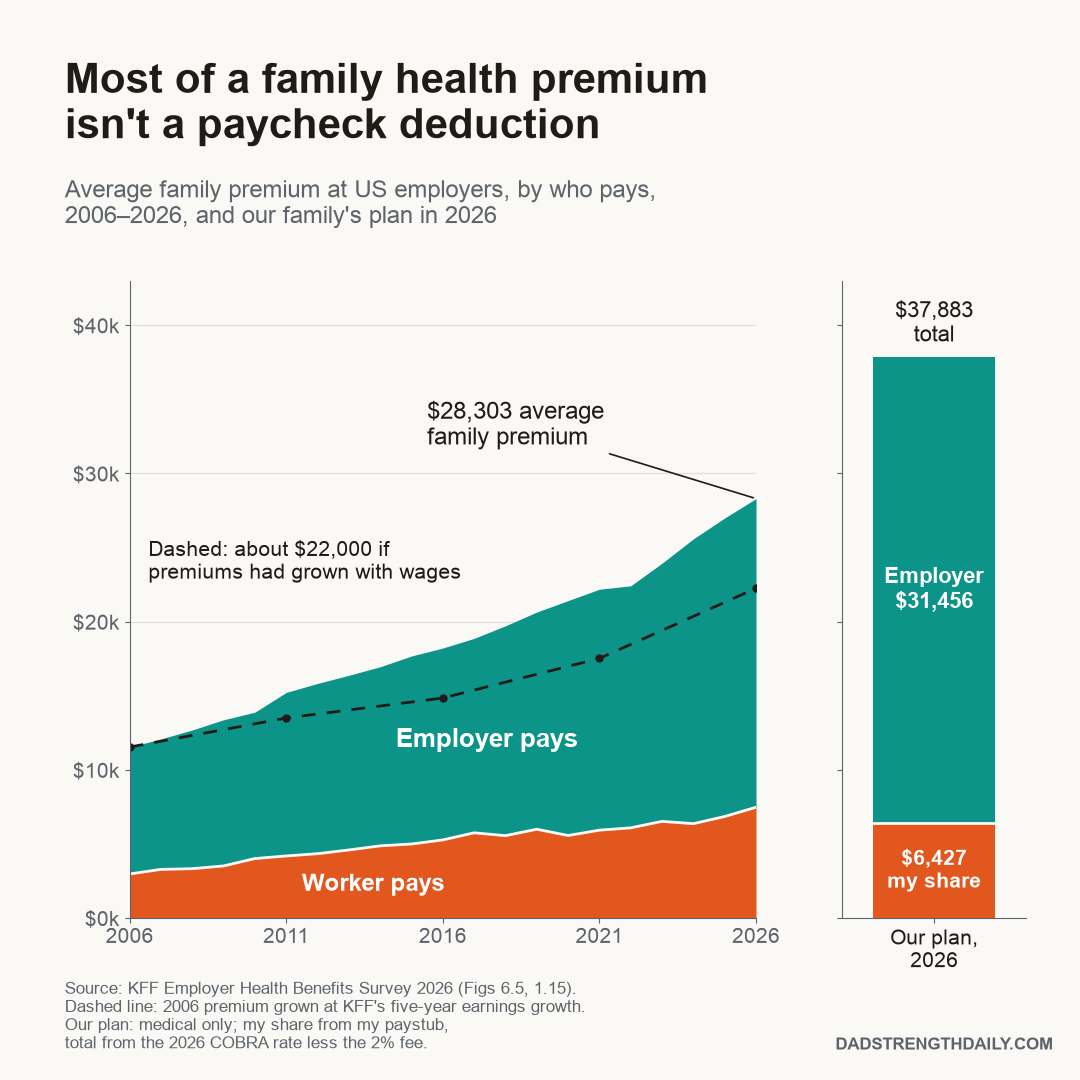
I used to look at the premium deduction on my paystub, $6,427 this year for my wife, our two boys and me, and think: that’s a lot, but I can afford it. Then I looked up what it would cost to keep the same medical plan if I left my job, and saw that the part I could not afford on my own is the part I never see. My employer pays almost five times my share, and the whole premium comes to nearly $38,000 a year.
I know I’m lucky to have it. The Commonwealth Fund’s survey released October 22 found that 11.2% of adults aged 19 to 64 were uninsured in mid-2026, up from 8.9% in 2024, after the enhanced ACA subsidies expired and the pandemic-era Medicaid enrollment protections ended. Most of the Medicaid cuts in the 2025 budget law don’t even start until January 2027. Those people have it far worse than I do. But even a good job with benefits doesn’t protect you from rising costs.
What the average family pays
The KFF 2026 Employer Health Benefits Survey puts the average family premium this year at $28,303, up 5% from $26,993. The average worker’s contribution to family coverage rose 9%, or $621, to $7,471, and employers paid the other $20,833. Wages rose 3.7% and inflation 2.7%.
The split between workers and employers barely moved. Workers now pay 27% of the family premium, against 26% last year, which KFF calls similar. A roughly stable percentage can still mean a bigger paycheck deduction as the total grows, and KFF says a shift toward higher worker contributions “could raise new affordability concerns.”
I won’t claim premiums have outpaced paychecks lately. KFF says that over the last five years family premiums grew at about the same rate as inflation and wages. Over twenty years it’s a different picture: the average family premium went from $11,535 in 2006 to $28,303 in 2026, about 2.45 times, while wages grew roughly 1.9 times.
The forecasts for 2027 are the worst in years. In a preliminary survey from Marsh, employers expect their health benefit cost per employee to rise 8.2% in 2027 after the changes they already plan, the highest increase since 2003, and 11% if they change nothing. A separate Marsh survey earlier this year found that about two-thirds of employers with 500 or more workers expect to raise the employee share of premiums. Much of the pressure comes from prices: STAT reported that commercial insurers pay hospitals more than double what Medicare pays for the same care.
Having insurance doesn’t make care affordable either. In the Commonwealth survey, 29% of working-age adults with employer coverage who were insured all year were underinsured, meaning their out-of-pocket costs or deductibles, not counting premiums, were high relative to their income. Among those with employer plans, 43% had avoided care because of cost over the past year and 31% were paying off medical bills.
Why a good job matters
Health insurance is a big part of what a job pays. The Congressional Budget Office counts employers’ payments for health insurance as “one form of compensation, along with wages, pension contributions, and other benefits.” For my family that part is large. The closest thing to a price tag I found is our COBRA rate, what it would cost to keep the same medical plan after leaving the job, which federal law generally caps at the plan’s cost plus 2%. Without the 2%, ours comes to about $37,900 a year. I pay $6,427 of that, and my employer pays about $31,500. That’s also the simplest way to find out how much your employer pays for your health insurance: ask HR for your plan’s COBRA rates, take off the 2% and subtract what comes out of your paycheck.
Which job you have makes a big difference. Nearly every firm with 200 or more workers offers health benefits to at least some of them, but KFF finds that only two-thirds of firms with 10 to 199 workers do. And where the smaller firms offer family coverage, their workers pay about $2,800 a year more toward it.
A hospital’s list price is the number on its master price list, the chargemaster. The federal price transparency rule calls it the “gross charge,” the charge “absent any discounts,” and makes hospitals post, next to it, the rates they have negotiated with each insurer and a cash price for people who pay themselves. For someone without insurance, the list price can be the number on the bill. It can sometimes be negotiated down, and nonprofit hospitals must charge patients who qualify for their financial assistance no more than what insured patients are billed, but it’s a frightening number to open.
On the statements from my insurer, the amount billed is always higher than the amount the plan allows. Earlier this year I had a minor in-network procedure to remove a cyst from my back. The provider billed $1,414. The plan allowed $468, about a third of that, and my insurer’s statement lists the other $946 as “amount saved,” which I don’t owe. For covered services, an in-network provider has to accept the allowed amount. HealthCare.gov puts it plainly: “A preferred provider may not balance bill you for covered services.” In many cases an out-of-network provider can bill you for the difference.
The other thing these statements show is how opaque the whole system is. I can’t follow most of them, and the prices are only one reason. My routine screening colonoscopy last year, done in network, produced claims from three providers: the gastroenterologist, the anesthesiologist, who shows up twice with separate claims for the same day, and the hospital. I owed nothing for any of it, as expected: HealthCare.gov says many plans must cover colorectal cancer screening for adults 45 to 75 at no cost, generally when an in-network provider does it. I still couldn’t tell you from the statements who was paid what. When a provider’s bill does say I owe something, I pay it.
Without a job that offers coverage, many families have to buy it themselves. Bloomberg profiled Ed Travalia, 56, who retired early and lives in Battle Ground, Washington, and pays nearly $32,000 a year for what Bloomberg calls the “most inexpensive, bare-bones” ACA plan for his family of four. His plan isn’t equivalent to mine, and he lives in a different state, but the order of magnitude is the same. Bloomberg says he has absorbed the premium increases himself.
I still see $6,427 on my paystub. What I could never pay on my own is the roughly $31,500 my employer adds, and that is one of the biggest reasons to want a good job.
Get the next one in your inbox
I write about GLP-1s, training, and preventive health once a week — what the evidence actually says, from someone using it. Free, no spam, unsubscribe whenever.
If this was useful, read next
- Bank of America Calls Your Health an Investment. Starbucks Calls It a Cost. — how employers decide what to cover when the bill keeps rising
- Health Is the New Luxury. The Biology Costs a Few Thousand Dollars. — what the add-on health spending outside insurance actually buys