
High Blood Pressure (aka. Hypertension) is known as the Silent Killer as it often goes undetected until it is too late. Many people have high blood pressure but are totally unaware of it since they have no noticeable symptoms. The fact that over the years the guidelines what constitutes “high” did not help.
Recently the American Heart Association and the American College of Cardiology have released updated guidelines on the definition and management of hypertension.
PBS has a good overview of the impact of the new guidelines.
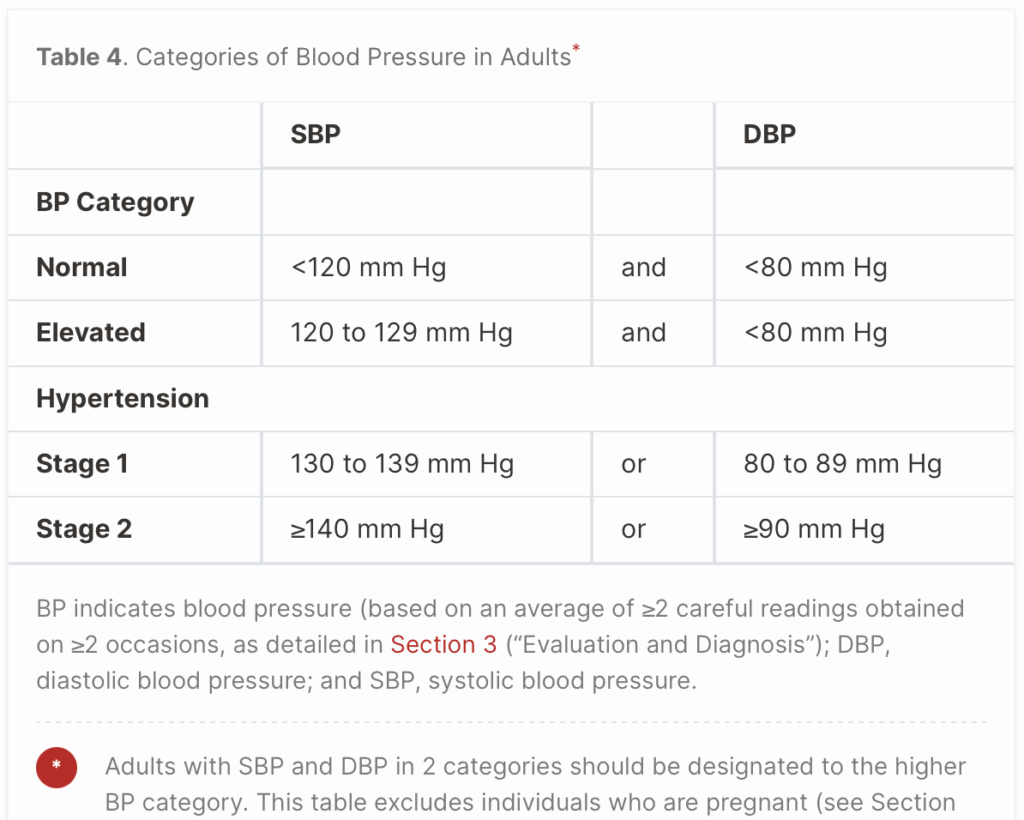
The new definitions for high blood pressure are best summarized by the table from the guidelines:
Is 116/86 high blood pressure?
Get the next one in your inbox
I write about longevity, training, and preventive health weekly — without the guru worship. Free, no spam, unsubscribe whenever.
I’ll answer this directly because it’s exactly where I landed on my own cuff: yes, 116/86 counts as Stage 1 under the AHA/ACC chart. My systolic (116) is technically normal, but my diastolic (86) puts me in Stage 1 on its own.
To be fully normal you need the systolic below 120 AND the diastolic below 80. Both, not either. If your two numbers land in different buckets, go with the worse one. Elevated is 120 to 129 systolic with diastolic still under 80. Stage 1 is 130 to 139 systolic or 80 to 89 diastolic. Stage 2 is 140 or above systolic or 90 or above diastolic.
The new hypertension stages, in plain numbers
Here’s the text version so you can check your numbers. When the two readings disagree, use the worse one.
| Category | Systolic (mmHg) | Diastolic (mmHg) | |
|---|---|---|---|
| Normal | less than 120 | AND | less than 80 |
| Elevated | 120 to 129 | AND | less than 80 |
| Stage 1 Hypertension | 130 to 139 | or | 80 to 89 |
| Stage 2 Hypertension | 140 or higher | or | 90 or higher |
| Hypertensive Crisis | 180 or higher | or | 120 or higher |
Quick sanity check on common readings men over 50 get on their home cuffs:
- 118/76: normal
- 122/78: elevated (systolic in the 120s)
- 116/86: Stage 1 (diastolic in the 80s)
- 132/82: Stage 1
- 145/88: Stage 2 (systolic at or above 140)
- 138/92: Stage 2 (diastolic at or above 90)
So, when I measured my Blood Pressure at 116/86 yesterday, I fall squarely into “Stage 1” Hypertension. This is the number that got my attention, and it’s why I started writing about blood pressure in the first place.
Stage 1 is also exactly the band where the medication question gets decided, and that decision runs on a risk calculator, not on the categories above. I wrote a full breakdown of who actually gets medication under the 2025 blood pressure guidelines, including the calculator you can run on yourself before your next appointment.
Alcohol and the new blood pressure guidelines
The guidelines also take a clearer stance on alcohol and sodium consumption. From the PBS article:
The new guidelines encourage patients to reduce or eliminate alcohol consumption entirely compared with the old guidelines. For people who do want to drink alcohol, the new guidelines recommend that men should drink no more than two drinks per day, and women should drink no more than one drink per day.
I am glad that the report is more straightforward about the need to eliminate alcohol. I have done that in my life a while ago and think everyone should do it as the effects of alcohol consumption on a societal level are devastating. I wish they didn’t actually give the numbers they provided. “two drinks per day” is still a lot in my opinion, especially if this ends up being “two drinks every day”! A new look at the cancer death data backs that instinct up — nearly all of the recent increase has landed on men my age.
Sodium, potassium salt substitutes, and the licorice warning
[The new guidelines] recommend that all adults – with or without hypertension – consume less than 2,300 milligrams of salt, or approximately 1 teaspoon, per day, and more ideally, less than 1,500 milligrams per day. [..] Patients may also consider potassium-based salt substitutes to further lower blood pressure.
I have been using this sodium-free Salt and this reduced sodium lite salt recently and been happy with them. Both seem to substitute potassium for sodium.
I was surprised about the hate on black licorice, but apparently it doesn’t just taste foul (in my opinion) but is also bad for you! The compound is glycyrrhizin and it can push your blood pressure up by a real amount if you eat the stuff regularly.
How to monitor your blood pressure at home
I think the critical first step for everyone is to make monitoring your blood pressure a regular routine, which is why I added it to my morning routine. Blood Pressure cuffs are cheap and effective. Do not wait for your annual physical to have your PCP tell you your blood pressure is too high. It’s super easy to measure it at home. Home is not the only place it gets done: I wrote about a program that put pharmacists in barbershops to check blood pressure. These days most cases of elevated blood pressure are very treatable via medication and lifestyle changes.
Two practical notes I wish I had known earlier:
- Sit quietly for 5 minutes before the reading. A reading right after a stressful email is not your real blood pressure.
- Take two or three readings a minute apart and use the average. Single readings vary by 5 to 10 points easily.
About Gunnar
Gunnar is 53. He lost about 170 pounds, trains in a garage gym, and writes DadStrengthDaily from personal experience, citing primary sources where he can. He also moderates r/ProactiveHealth. He is not a doctor, and nothing here is medical advice. Talk to your own doctor before acting on anything, especially GLP-1s, TRT, blood pressure, sleep apnea, and cancer screening.