
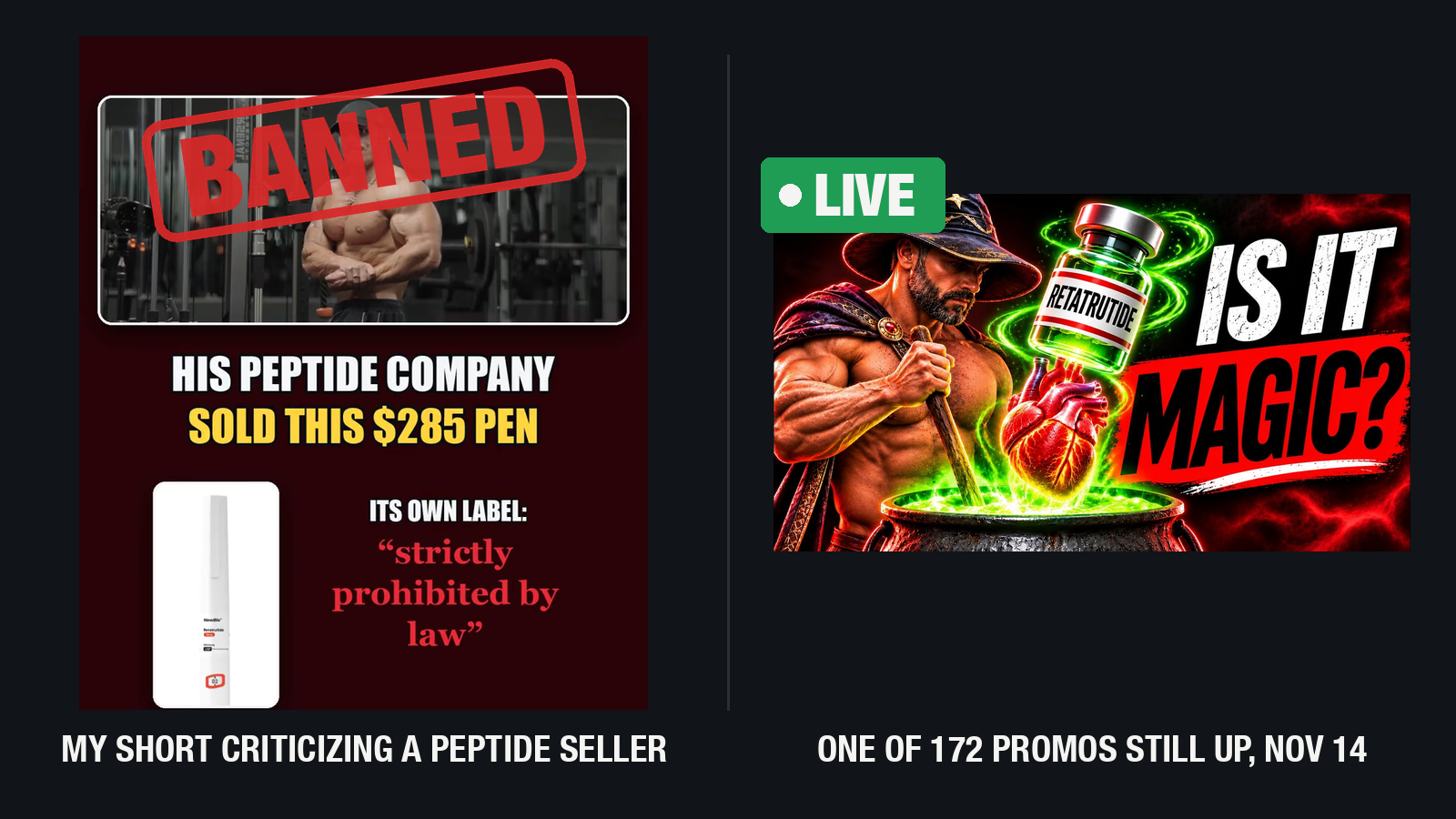
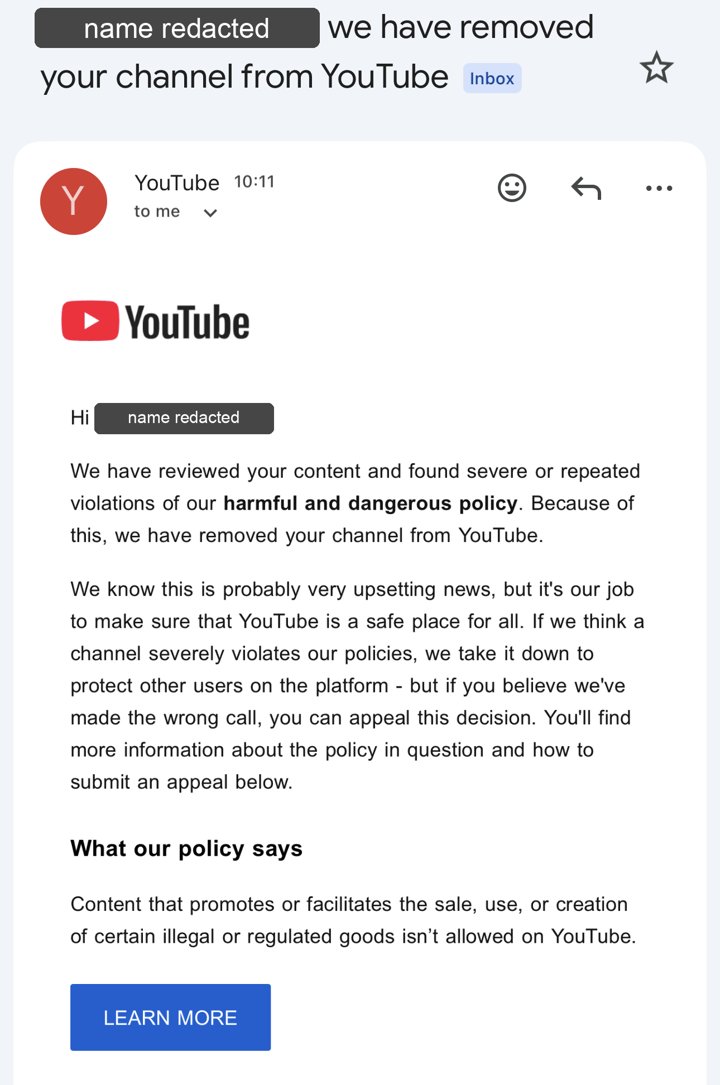
On November 10 YouTube terminated my channel, which had 4 subscribers, for “harmful or dangerous content,” under a rule that content that “promotes or facilitates the sale, use, or creation of certain illegal or regulated goods isn’t allowed.” It never said which video. The one it kept down, even during a brief reinstatement, was a Short criticizing NewBioRx, the peptide store that Sam Sulek, a bodybuilder with more than four million subscribers, says on camera he co-owns. The full story is in the termination post and the billing mess that followed.
Nov 10Channel terminated. No video named.
Nov 11Reinstated with one Short still removed, then terminated again. Appeal denied.
Nov 12Policy team review: “the original decision stands.”
The same week, a retatrutide video on a channel with 68,500 subscribers had 522,611 views. Retatrutide is Eli Lilly’s experimental weight-loss drug, approved nowhere. The description opens: “I’m 42. Four weeks ago I started retatrutide at the lowest possible dose.” Further down: “People ask me constantly where I get mine. I use Primal Peptides … Code SEAN10 gets you 10% off,” then the store’s link, marked as an affiliate link: “I earn a small commission.” On November 14 it was still up.
My reaction to the ban: I think this is an unfair (downright silly) interpretation, given the amount of straight-up commercial promotion of unapproved drugs that happens all over YouTube unchecked. That was an assertion, not evidence. So I had a look, and put everything I found on one page.
These are 172 YouTube videos, still public on November 14, that point viewers to a seller of unapproved peptides and promote taking them. Each card shows the thumbnail, the quotes, the code or link, and what the store sells.
See all 172 videos →uneven-enforcement.pages.devWhat the rule says
YouTube’s rule on illegal or regulated goods is short:
“Don’t post content on YouTube if it aims to directly sell, link to, or facilitate access to any of the regulated goods and services listed below. Making the sale of these items or facilitating the use of these services possible by posting links, email, phone number or other means to contact a provider directly is not allowed.”
“If you’re providing links or contact information such as phone numbers, emails, or other means of contact where hard drugs or certain poisonous substances can be purchased, or where pharmaceuticals can be purchased without a prescription, your channel may be terminated.”
It covers “clickable URLs, verbally directing users to other sites in video, as well as other forms.” Then comes the exception, with its limit:
“Sometimes, content that would otherwise violate this policy is allowed to stay on YouTube when it has Educational, Documentary, Scientific, or Artistic (EDSA) context. … This is not a pass to promote content intended to sell, create, or facilitate access to certain regulated goods and services.”
My reading is that critical reporting on a seller is what that exception was written for. The rule never uses the words peptide, “research use only,” unapproved, affiliate or discount code. Its hook is “pharmaceuticals … without a prescription,” and YouTube could read that more narrowly than I do: a store that labels its peptides “research use only,” a label meant for lab supplies, is not plainly a pharmacy, and a clinic that sees patients is not plainly selling without a prescription. Retatrutide, approved nowhere, is the hardest case to explain away.
What I looked for
The plainest kind of violation: someone selling a “research use only” drug, retatrutide included, or sending viewers to a seller with a link or an affiliate code, while making clear the drug is meant for people to take.
From November 12 to 14 I ran 111 searches for peptide terms, mostly through YouTube’s own Data API, and pulled every upload from two channels that kept turning up: about 9,400 videos in all. An automated first pass picked out about 1,190 candidates. An AI model (Claude) checked each against two rules that both had to hold: a seller (a code, affiliate link or store link for a research-peptide seller, a clinic that says it provides a named unapproved peptide, or the creator selling it himself) and human use (doses, injecting, “my stack,” results). A second, adversarial Claude review dropped anything borderline. A script confirmed every quote appears word for word in the video’s title, description, tags or captions, and every video is kept with its ID, capture date and quotes. I spot-checked at least 20 of them myself, and none failed.
What I found
On November 14, 172 of the 182 videos that passed were still public, on 110 channels, with 6.6 million views. In 26 videos, the quote I use as evidence of the seller, of human use, or both names retatrutide. Those 26 have 2.2 million views across 16 channels, and almost two-thirds of the views are on one clinic’s channel.
Across all 172, and with some in more than one group, 101 give a discount code (64 different codes), 37 carry an affiliate-tracking link, and 47 are clinics that say they provide a named unapproved peptide. Retatrutide comes up in 44, and 40 link to a store whose catalog lists it, mostly under a coded name.
Most come from small channels: the median channel has about 1,400 subscribers, and only one has over a million. Seventy-eight are Shorts, and about half were uploaded in the past year. The median video has about 4,400 views; 20 have more than 100,000.
They are easy to find. On average 3 in 100 of the videos a peptide search returned are on the list, and for one search it was 14 in 100. Both are floors, since only results flagged by the first automated pass were reviewed.
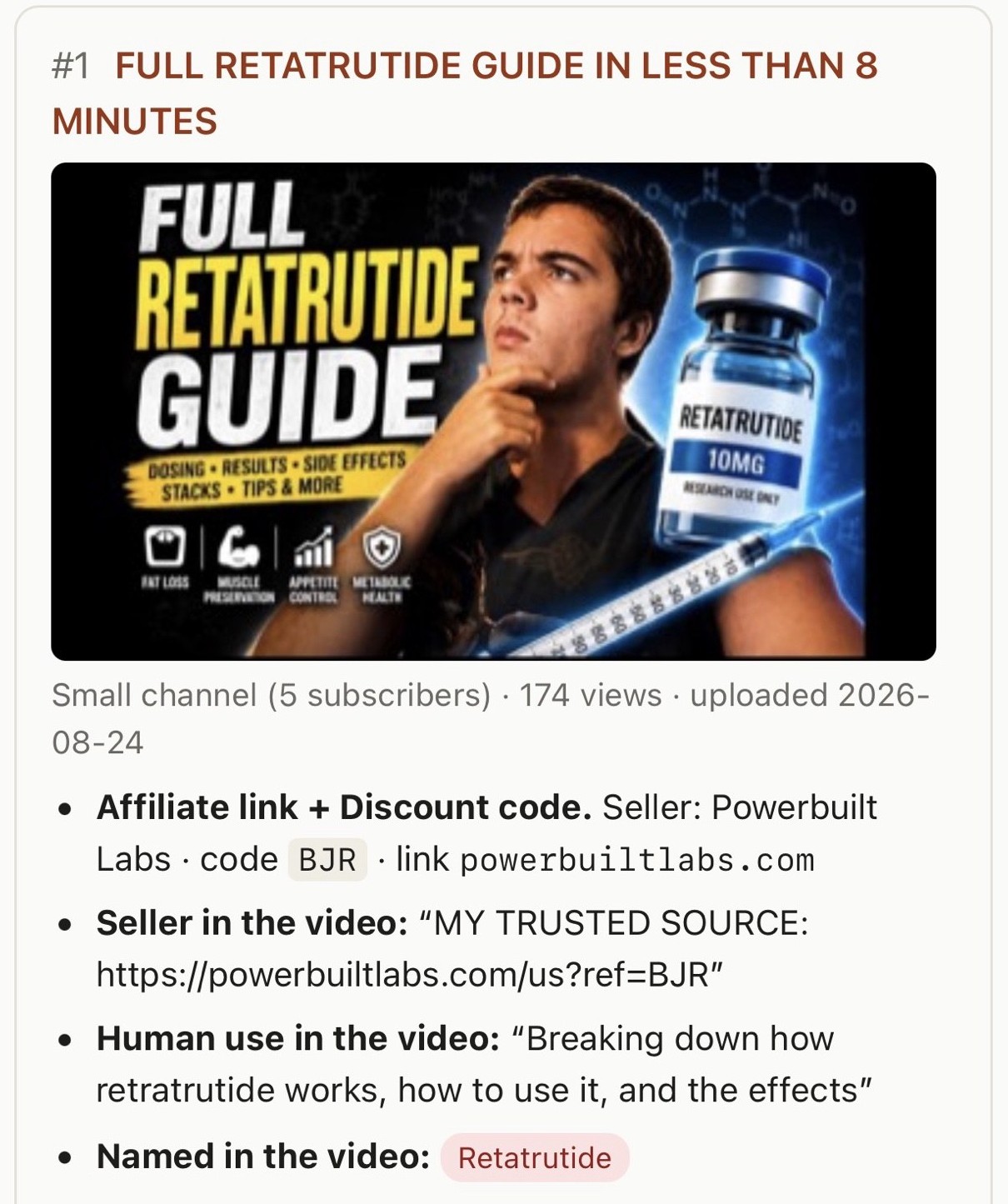
That card is the small end: a 5-subscriber retatrutide guide whose description reads “MY TRUSTED SOURCE” over a store link with the creator’s ref code. At the big end, besides the video at the top of this post, a telehealth clinic has two retatrutide videos at about half a million views each; one gives its dose steps and points viewers to a link to book a call.
My own Short, through the same checks
I ran the removed Short through both checks, as uploaded and with my channel name and this site hidden. Four runs, four times “does not qualify.” The reason on the blinded run: “Critical investigative report on a seller; warns against use, no code/link promoting purchase or human use.” The two checks are my criteria, not YouTube’s, so this shows my reading is consistent, not that YouTube was wrong.
The Short has no link or code and promotes no use. It shows the store’s address, a product page and a price as evidence, and points out that the seller’s own label says putting the drug into a human is “prohibited by law” (my write-up on the store).
YouTube does have a case. The Short says the store’s web address out loud, shows the product page and price, and repeats the seller’s injection steps while criticizing them. Only the documentary exception separates that from a violation, and the policy says the exception applies “sometimes.”
My guess is that my evidence got me flagged: product pages, prices, a cart with retatrutide and syringes, an injection guide under the brand’s logo. Enforcement that reacts to what is on screen catches that. A promoter who puts a code in the description and a dose in the voiceover shows none of it. I don’t think anyone at YouTube set out to remove a critic and leave the buying guides up. I think its process, automated and human, did not tell reporting on a seller from promoting one.
What YouTube publishes
YouTube’s enforcement report for April to June 2026 counts 11,159,676 videos removed, 98.6 percent of them first flagged by automation, with no line for regulated goods or drug sales. YouTube says its technology handles “clear policy violations” and that “for content that requires a deeper understanding of context and nuance, trained human reviewers evaluate the content and take action where appropriate.”
What this does not prove
My list is a numerator with no denominator: nobody outside YouTube knows how many comparable videos it has removed, so I am not claiming a rate. The searches sample what YouTube returns for peptide terms, not YouTube as a whole. Ten more videos that passed went down after capture, all from one channel, and the API does not say who removed them. I have not reported any of the 172, so I cannot say any was reviewed and kept. Nor should I have to: I found them with 111 searches, mostly through YouTube’s own Data API. YouTube invites viewers to report videos, but keeping its platform clear of drug sales is YouTube’s job, not theirs. A discount code does not prove the creator is paid. And I am a party to this: I lost a channel with 4 subscribers and I am annoyed about it.
What I am asking for
None of this needs a new policy. First, treat a discount code for an unapproved drug as the contact detail the rule already bans: a code given with a store’s name tells the viewer where to buy, which is what a link does. Eli Lilly, which has sued at least 11 retatrutide sellers since August, alleges in one complaint that a seller “partnered with social media influencers to provide affiliate links and discount codes.” That is an allegation, not a finding.
Second, when a flagged video looks like reporting or criticism, have a person weigh the documentary exception before the channel goes, not only on appeal.
Third, give regulated-goods removals their own line in the enforcement report, so anyone can set it against what a peptide search returns.
YouTube took down a critique that showed a seller’s own label saying human use is prohibited by law. The same week, a video with half a million views that says “I started retatrutide,” and gives a store, a discount code and an affiliate link, stayed up, one of 172 videos that point viewers to a seller and promote taking the drug. I can’t say how many like them YouTube has removed, or why it picked my Short. But when the critique comes down and the affiliate link stays up, the result is uneven, whatever the cause, and that part YouTube can fix.
On November 14 I sent these findings to YouTube’s press team and asked two questions: does it consider discount codes and affiliate links promoting research-use-only peptides for human use a violation of its regulated-goods policy, and how does it tell documentary criticism of a peptide seller from promotion when the criticism shows the seller’s products and website? I will add any response here.
Disclosure: I own Eli Lilly stock.
Get the next one in your inbox
I write about GLP-1s, training, and preventive health once a week — what the evidence actually says, from someone using it. Free, no spam, unsubscribe whenever.
If this was useful, read next
- I Criticize Peptide Sellers. YouTube Terminated My Channel Over “Regulated Goods.” — the notice, the appeal and the Short
- Sam Sulek’s NewBioRx Sells “Research Only” Retatrutide — the store the Short was criticizing
- Google Took My Money, Shut Off YouTube TV and Premium, and Won’t Let Me Cancel Online — what the termination did to my subscriptions