
Novartis’s pelacarsen cut Lp(a) by 78%. Lp(a), or lipoprotein(a), is a cholesterol particle whose level is mostly inherited. Yet major heart events were no less common than on placebo. Novartis is ending its heart and artery program; a heart-valve trial continues.
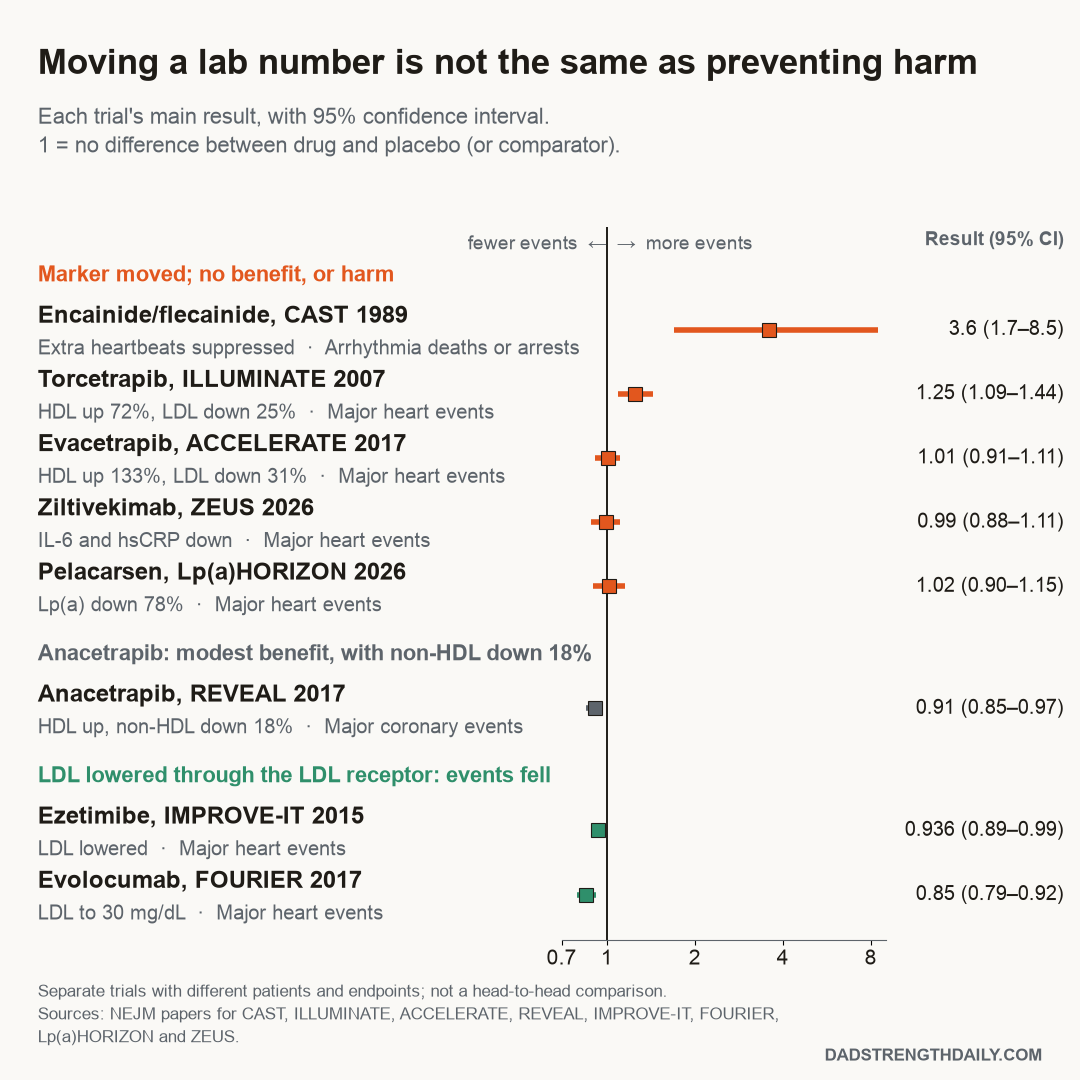
The Lp(a)HORIZON clinical trial, published in the New England Journal of Medicine, followed 8,350 people with high Lp(a) and artery disease for a median 4.7 years: 12.3% on the drug had a heart attack, stroke, urgent stent or bypass, or cardiovascular death, against 12.1% on placebo (hazard ratio 1.02; 95% confidence interval 0.90 to 1.15). Steven Nissen, who presented it, said it can’t speak to people without a prior event, or other Lp(a) drugs.
If a drug moves your lab number, why isn’t that proof it protects you? Because the number is only a stand-in, and a drug can move it without touching the disease, or while harming you.
Hitting the target and missing the patient
Lp(a) meets criteria for being a cause of artery disease, Donald Lloyd-Jones, a past American Heart Association president, said at the association’s meeting. “But we don’t have the most important criterion to establish causality, which is [that an] intervention to modify or abolish the risk factor results in a lower incidence of disease,” he added.
The textbook warning is CAST, a 1989 heart-rhythm drug trial. After a heart attack, extra heartbeats predicted sudden death, and CAST randomized only patients whose extra beats a drug had already suppressed. More of them died on encainide or flecainide than on placebo.
Torcetrapib raised HDL, the “good” cholesterol, sharply and lowered LDL by a quarter, but it also raised blood pressure, and more patients had major heart events and died (ILLUMINATE, NEJM 2007). The investigators pointed to an off-target effect, and later drugs in the class showed no excess deaths.
The ZEUS clinical trial, published the same day, tested Novo Nordisk’s ziltivekimab in 6,376 people with artery disease, kidney disease and a raised level of the inflammation marker hsCRP. It lowered hsCRP far more than placebo did, yet 17.6% had a major cardiovascular event, against 17.7% on placebo (hazard ratio 0.99, 0.88 to 1.11). Canakinumab, which blocks a different inflammatory signal, lowered hsCRP and did cut repeat heart events at its middle dose (CANTOS, NEJM 2017).
HDL: seven big trials, more than 120,000 patients
People with high HDL have fewer heart attacks, so drug companies spent years trying to raise it. Seven HDL-targeted outcomes trials randomized more than 120,000 patients, by my sum: four of CETP drugs (dal-OUTCOMES, ILLUMINATE, ACCELERATE and REVEAL), two of niacin (AIM-HIGH and HPS2-THRIVE) and one of an infusion of HDL’s main protein (AEGIS-II). Lilly’s evacetrapib more than doubled HDL and cut LDL by 31%, yet was stopped for lack of efficacy (ACCELERATE, NEJM 2017); its investigators noted that ApoB, which tracks the number of particles that can clog arteries, fell only about 20%.
The one modest win, anacetrapib, cut major coronary events by 9% (rate ratio 0.91, 0.85 to 0.97) and lowered non-HDL cholesterol by 18% (REVEAL, NEJM 2017); its investigators said the non-HDL drop would predict about that much. A large gene study agrees: some variants that raise HDL don’t lower heart attack risk, while LDL-raising variants raise it (Voight et al., Lancet 2012).
Why LDL held up, and the pill I take
LDL is the counterexample, and I have a stake in it. My LDL is 56 mg/dL and my ApoB 59 mg/dL, down from 96 in 2025. I got there with Zepbound and generic ezetimibe (Zetia), on top of losing about 170 pounds. I don’t take a statin.
In IMPROVE-IT, 18,144 people hospitalized with a heart attack or unstable chest pain got a statin with or without ezetimibe; ezetimibe lowered the seven-year event rate from 34.7% to 32.7% (hazard ratio 0.936, 0.89 to 0.99; NEJM 2015). That small benefit is the evidence behind my pill, though the trial added it to a statin right after a hospital stay, and I take it without one.
Across 26 statin trials with about 170,000 people, each 1 mmol/L (about 39 mg/dL) drop in LDL cut major vascular events by just over a fifth (CTT, Lancet 2010). Evolocumab, a PCSK9 injection, took LDL to a median of 30 mg/dL and cut heart attacks, strokes and related events (hazard ratio 0.85, 0.79 to 0.92; FOURIER, NEJM 2017), though it showed no effect on cardiovascular deaths in about two years.
Statins, ezetimibe and PCSK9 drugs work differently, but Lloyd-Jones pointed out that all three tend to raise the activity or number of LDL receptors, which pull LDL out of the blood. Drugs that lower LDL other ways have had “somewhat more variable” results, he said, as the CETP drugs show.
My reading, which isn’t new: a number holds up as a stand-in when genetics point the same way, when earlier drugs moving it by the same route have cut events, and when bigger drops bring bigger benefits. LDL lowered through the LDL receptor has all three. Lp(a) has strong genetic support, and its first outcomes trial, of one drug in people who already had artery disease, found no benefit.
Why failures make new drugs so expensive to develop
Only about 12% of drugs entering clinical trials are approved, the Congressional Budget Office estimates. Counting failures and the cost of capital, a 2024 model by Sertkaya and colleagues (JAMA Network Open) put the cost of each approved drug at $879 million in 2018 dollars, and before capital costs, failures account for about two-thirds of the spending. Failures don’t let a company charge more for a success: with a patent, it already charges what the market will bear, and the CBO says a drug’s sunk R&D costs “do not influence its price.” What failures change is which drugs get made, because a company starts a program only if expected sales can cover the ones that fail.
What it means for Lp(a), and for you
The investigators offer reasons pelacarsen might have failed. Background care was unusually good, with median LDL around 65 mg/dL. The trial ran under five years against a lifetime of high Lp(a), and 35% of patients stopped the drug, against 18% on placebo. But extended analyses in NEJM Evidence, which I’ve read only as an abstract, found no benefit in patients who stayed on it or in the half whose Lp(a) fell the most.
Three more Lp(a) drugs, Amgen’s olpasiran plus Lilly’s lepodisiran and muvalaplin, are in outcomes trials due to finish collecting data between 2028 and 2031. Nissen said a trial this neutral “doesn’t raise expectations for the other trials,” but added that “there have been pretty good examples where the first drug in a class failed for a variety of reasons.” Whether lowering Lp(a) prevents heart attacks is still open, and I won’t guess.
If you’ve never had your Lp(a) measured, ask your doctor to test it once. Mine came back at 12 nmol/L, which is low. The 2026 ACC/AHA cholesterol guideline recommends measuring it at least once in all adults, and Lloyd-Jones, who helped write it, said HORIZON doesn’t change that: a high result is a reason to consider starting or intensifying cholesterol-lowering treatment. I read that as a reason to review your overall heart risk with your doctor, which often means a lower LDL and ApoB target.
Before you buy a supplement or protocol sold as improving a marker, ask whether an outcomes trial has shown that moving that number prevents heart attacks. For LDL lowered by statins, ezetimibe or PCSK9 drugs, one has. For Lp(a), none has yet.
Get the free Bloodwork Decoder
I made the one-page cheat sheet I wish I’d had at my first physical: what every number on your labs actually means, what’s worth aiming for at 50, and what to ask your doctor. Subscribe free and I’ll send it straight to your inbox. No spam, nothing to sell.
If this was useful, read next
- The First Big Lp(a) Drug Trial Missed Its Main Goal — what the September topline said, and why it moved LDL back to the top of my list
- Lp(a) Test: The Number Most Doctors Miss — what the one-time test costs and what counts as high
- I Drove My Inflammation Number to Almost Zero — the same pattern with hsCRP: the marker fell, heart events didn’t