
One can cause rare liver injuries; the other can interfere with prescription drugs you already take.
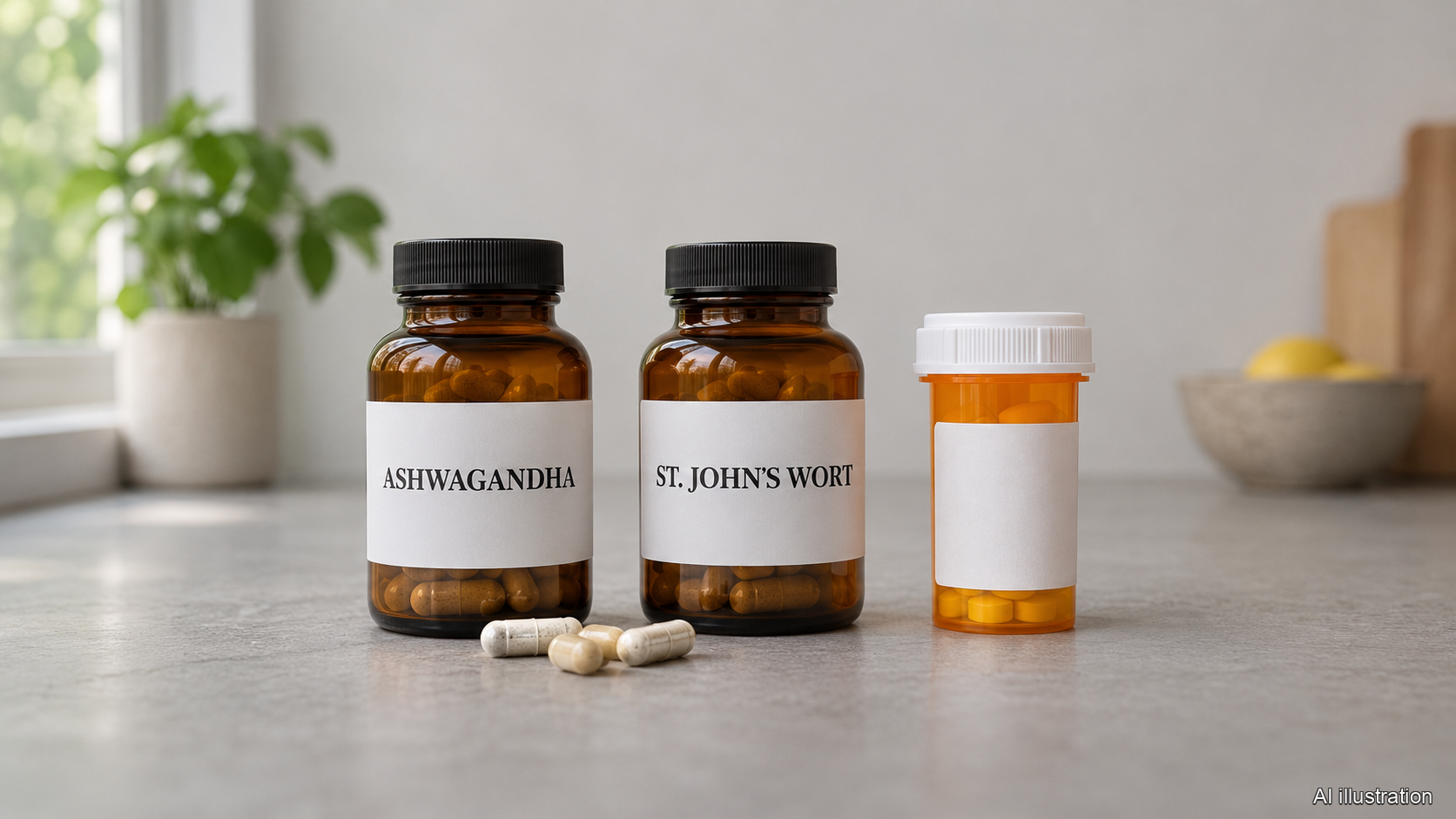
I took ashwagandha once, got a terrible headache, and threw the bottle out. One headache in one person proves nothing about the herb, although headache is among the reported effects in Germany’s risk assessment. The more serious ashwagandha side effects in the medical literature involve the liver.
A “natural” supplement can hurt you. Ashwagandha has been linked to rare, unpredictable liver injury; nobody knows how often it happens or what dose, if any, reliably avoids it. St. John’s wort does something predictable instead: it speeds up how fast your body clears many prescription drugs, enough to roughly halve the body’s total exposure to alprazolam (Xanax). Tell your doctor and pharmacist about every supplement you take.
How supplements are regulated, and the ones I cut from my own shelf, are in The Supplement Craze, in My House.
Ashwagandha liver injury is rare, and nobody knows the rate
Ashwagandha (Withania somnifera) is an herb from Ayurvedic medicine sold for stress and sleep. NIH’s LiverTox database says it “is considered generally safe,” and clinical trials have reported no rise in liver enzymes, yet “clinically apparent liver injury attributable to ashwagandha occurs although rarely.” The first case was reported in 2017, and more have followed. LiverTox grades it B, a “likely cause” of liver injury, on a scale where A is the most established.
The typical case, from LiverTox and five patients described by Björnsson and colleagues, starts 2 to 12 weeks after someone begins taking it, with jaundice (yellow skin and eyes) and itching. LiverTox says it usually clears within 1 to 4 months of stopping. In the Björnsson series, the products that were tested contained ashwagandha and no other known toxic compounds, though four of the five patients also took other supplements. A 2026 review of 26 published cases found that most people recovered after stopping; the severe cases needed intensive care or a liver transplant.
I wanted to know how often this happens, and nobody can say. No study has measured it, and case reports show the injury is possible without saying anything about frequency. It looks like an idiosyncratic reaction (one that hits a few people unpredictably), with no clear link to dose, which fits the Danish and German statements below that no safe intake level could be set.
People with liver disease had the worst ashwagandha outcomes
Philips and colleagues described 8 patients in India who took single-ingredient ashwagandha products. Five had existing chronic liver disease. Three arrived with sudden liver failure on top of that disease, and all three died. Testing of the products found no liver-toxic contaminants or added drugs, though one had trace metals. LiverTox says deaths and emergency transplants are rare and have been reported “particularly in patients with preexisting liver disease and cirrhosis” (scarring of the liver), and it advises avoiding ashwagandha with cirrhosis or advanced liver disease.
Denmark prohibits ashwagandha in food supplements, saying no safe intake level could be set. In September 2024, Germany’s Federal Institute for Risk Assessment (BfR) said children, pregnant and breastfeeding women, and people with liver disease should not take it, and that “the BfR and other European authorities advise against consuming food supplements containing ashwagandha.” Australia’s drug regulator updated its warning in July 2026, counting 11 possible liver-injury cases reported there and advising people with existing liver disorders to avoid it. I could find no ashwagandha-specific action by the US FDA. NIH’s ashwagandha page also warns of possible interactions with drugs for diabetes, blood pressure, thyroid, immune suppression, sedatives and seizures.
How St. John’s wort drug interactions weaken other medicines
St. John’s wort (Hypericum perforatum), sold for mood, is a different problem. LiverTox rates it E, “unlikely” to cause liver injury. The trouble is what it does to your other medicines.
In plain terms, St. John’s wort makes your body break down or pump out certain medicines faster, so less of the drug is left to do its job. As Nicolussi and colleagues explain, it switches on a sensor in liver and gut cells called PXR. That makes the cells produce more CYP3A4, an enzyme that breaks down drugs, and more P-glycoprotein, a pump that pushes drugs out of cells. CYP3A4 handles at least half of marketed medicines, by one estimate. More enzyme means a drug is cleared faster and its blood level drops. Grapefruit juice works the other way, blocking the same enzyme so some drug levels go up.
The effect scales with dose. In a 2024 study by Hohmann and colleagues, the estimated rate at which the body broke down a test drug, midazolam, about doubled at 300 mg of St. John’s wort a day, nearly quadrupled at 900 mg (a typical daily dose), and rose more than fivefold at 1,800 mg, which the authors call above the therapeutic dose. It also depends on a plant compound called hyperforin. According to one study’s abstract, a high-hyperforin extract cut midazolam exposure by 79% and a nearly hyperforin-free powder by 21%. Supplement labels rarely state hyperforin, so you usually cannot tell which kind you bought, and the low-hyperforin product still had an effect.
St. John’s wort halved Xanax exposure in healthy volunteers
| Drug | What St. John’s wort did | Study |
|---|---|---|
| Alprazolam (Xanax) | Total exposure over time roughly halved; half-life fell from 12.4 to 6.0 hours; peak level barely changed | JAMA 2003 (12 healthy volunteers, 14 days of the herb) |
| Simvastatin (Zocor) | Exposure to its active form roughly halved; pravastatin unaffected | 2001 study (healthy men, abstract only) |
| Warfarin, a blood thinner | Blood-thinning response (INR) over the following week down about a fifth | 2004 study (12 healthy men, single warfarin dose) |
| Digoxin, a heart drug | Exposure down 25% | 1999 study |
| Tacrolimus, a transplant drug | Median dose needed rose from 4.5 to 8.0 mg a day | 2003 study (10 kidney-transplant patients) |
Most of these were small studies that measured drug levels in the blood, not whether a patient’s condition got worse. Patients have been harmed, though. Two heart-transplant patients had acute rejection after St. John’s wort lowered their cyclosporine, an anti-rejection drug. In a small study of women on birth control pills, breakthrough bleeding happened in 7 of 12 while they took St. John’s wort versus 2 of 12 without it, and NIH lists birth control pills among the medicines St. John’s wort can weaken. Combined with an SSRI or a similar antidepressant it can cause serotonin syndrome, a dangerous overload of the brain chemical serotonin; the evidence is case reports, and NIH warns about the combination.
Your doctor and pharmacist need to see every bottle
A pharmacist cannot check an interaction against a product they do not know you take. Bring every supplement, or a photo of its label, to your doctor and your pharmacist, and ask about interactions directly if you take:
- warfarin or another blood thinner
- a statin or digoxin
- a transplant drug
- an antidepressant or a benzodiazepine (the drug class that includes Xanax)
- thyroid, diabetes or blood pressure medicine
Stopping St. John’s wort matters too. As its effect wears off, levels of the medicines it was lowering can rise again, and Australia’s drug regulator warns this can cause toxicity. Talk to your pharmacist or prescriber before starting or stopping it.
If you have liver disease, skip ashwagandha. The BfR says that about any liver disease, and LiverTox says to avoid it with cirrhosis or advanced liver disease. LiverTox and NIH’s herb pages are free places to look a product up. The liver warning signs after starting any supplement are yellow skin or eyes, itching, dark urine, unusual tiredness, nausea, and belly pain. If they appear, stop the product, call your doctor, and do not restart it.
Get the next one in your inbox
I write about GLP-1s, training, and preventive health once a week — what the evidence actually says, from someone using it. Free, no spam, unsubscribe whenever.
If this was useful, read next
- The Supplement Craze, in My House — how supplements reach the shelf without anyone checking them, and the bottles I threw out
- Does Creatine Damage Your Kidneys? — the supplement I still take, and why the kidney scare doesn’t hold up
- What the New Research Says About NAD+ — another popular supplement, read the same way: what the human trials actually show