
A new Neurology study in absolute numbers: at 40 to 54, the risk is about 1 in 800 a year.
I am 53, the same age as Sen. Chris Murphy, the Connecticut Democrat who felt numbness in his arm at his son’s hockey game on Oct. 31, called 911, and turned out to have a “small hemorrhagic stroke,” a small bleed deep in the brain. He left the hospital on Nov. 6 for several weeks of rehab, and his doctors expect a full recovery (New York Times). The cause hasn’t been reported, and I won’t guess.
A study in Neurology reports that stroke before 55 rose between the 1990s and 2020. The rise is real, but most of it happened by about 2005. The numbers come from hospitals in one region around Cincinnati, not the whole country. Other countries are mixed: Oxfordshire in England saw a similar rise, while Norway and Denmark saw none in midlife. At 40 to 54 the 2020 rate works out to about 1 in 800 a year. The risk factor tied to the most strokes at our age is blood pressure, and you can measure it at home.
Stroke before 55 in the Cincinnati study: about 1 in 800 a year at 40 to 54
Fisher and colleagues counted hospitalized first-ever strokes in five counties around Cincinnati and northern Kentucky (about 1.4 million people; the study covers only White and Black residents) in six snapshots from 1993/94 to 2020. At ages 20 to 54 the rate went from 33.90 to 62.18 strokes per 100,000 people per year. The increase was statistically significant, though narrowly (p = 0.04). At 55 and older it fell.
For ages 40 to 54, the band a 50-year-old sits in, the rate went from 72.05 to 124.74 per 100,000 a year. That is a 73% rise, or about 53 extra strokes per 100,000 people a year; in 1993/94 the rate worked out to about 1 in 1,400.
The 1 in 800 is an average across an age band in one regional registry, so it is nobody’s personal risk. Risk generally rises with age, even inside the band, and varies hugely with blood pressure, smoking, diabetes and A-fib (atrial fibrillation, an irregular heart rhythm).
The increase was driven largely by ischemic stroke (a clot blocking an artery to the brain, the common kind), the only type with a statistically significant rise. Bleeding inside the brain, the kind Murphy had, went from 6.6 to 10.1 per 100,000 a year, a change that wasn’t statistically significant.
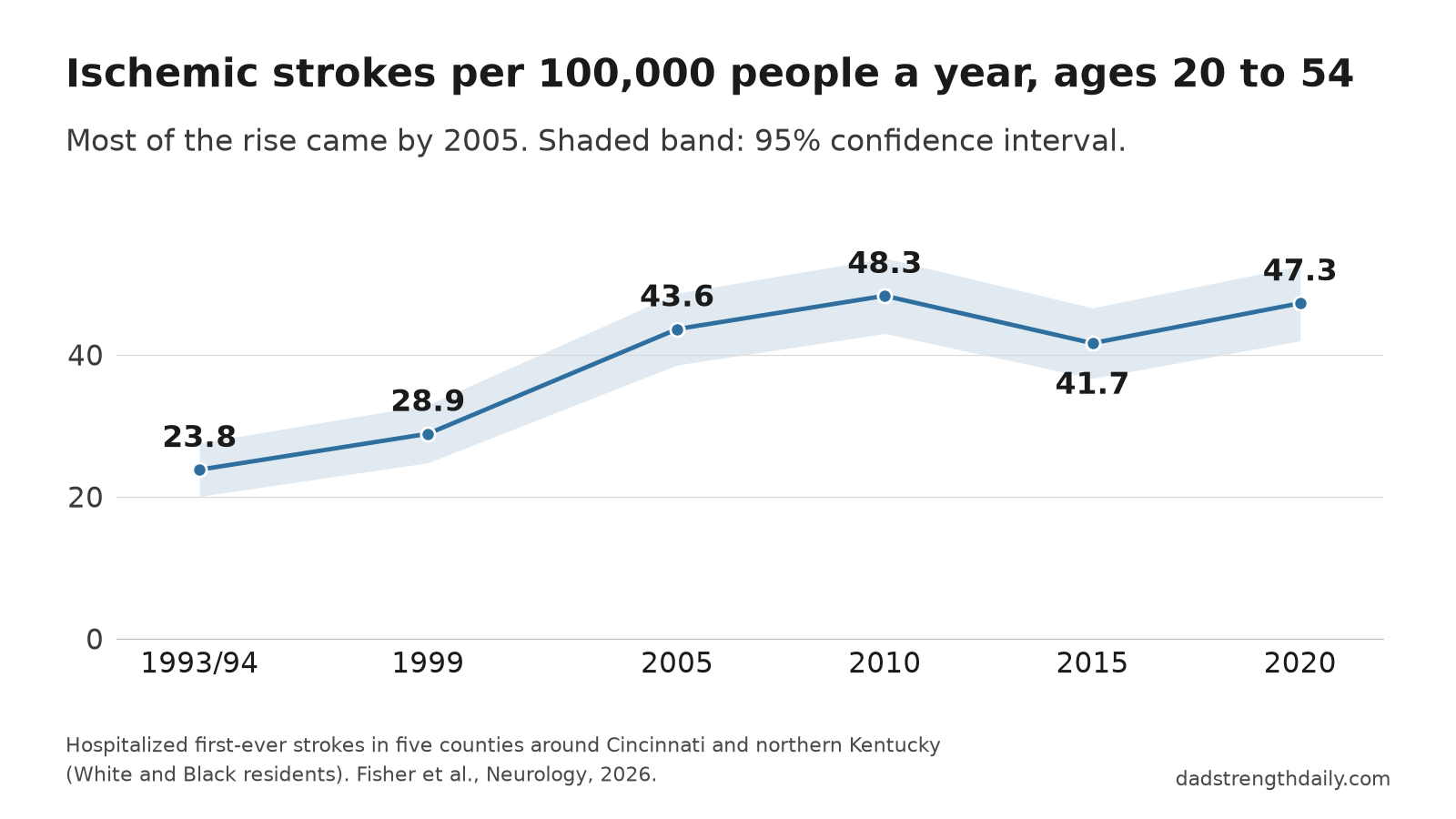
The chart at the top shows only the ischemic rate, for everyone 20 to 54; the 1 in 800 above counts all stroke types at 40 to 54. Looking at the chart, most of the ischemic rise happened by 2005, and the later snapshots bounce around at that higher level. That is my reading of the picture; no statistical test in the paper checks it, and the authors don’t describe it that way.
The study can’t say why strokes rose
Among young stroke patients, the share with high blood pressure went from 47.3% to 60.3%, diabetes and A-fib became more common, and reported marijuana use went from 0.9% to 30.6%, while smoking stayed roughly flat. These are percentages among people who already had a stroke. With no comparison group of people without stroke, the study cannot say which factors are responsible; the authors’ word is that the rise “coincides” with rising risk factors.
Better scanning is the other open question. MRI picks up small strokes more reliably than a CT scan, and it was used in 32.7% of young stroke cases in 1993/94 and 79.2% in 2020. The authors argue the rise is “not just a reflection of increased detection as a result of rising MRI use.” How much of it is detection has not been settled.
Oxfordshire saw a 67% rise; Norway and Denmark showed no comparable rise in midlife
In Oxfordshire, England, Li and colleagues found a 67% increase in stroke under 55 between 2002-2010 and 2010-2018, and a 15% decrease at 55 and older. In Norway, total stroke fell from 2001 to 2021, and ischemic stroke rose only in men 15 to 34 while staying flat at 35 to 54. In Denmark, ischemic stroke and bleeding inside the brain (intracerebral hemorrhage) were “steady” at ages 18 to 49 from 2005 to 2018. A meta-analysis of 50 studies in 20 countries found upward trends in young-adult stroke in 8 of 13 population-based studies, with incidence stable or trending down in the other 5.
High blood pressure is tied to about half of strokes at ages 40 to 65
INTERSTROKE, analyzed by age, compared about 13,500 stroke patients with a similar number of people without stroke in 32 countries. It estimated that about half of strokes at ages 40 to 65 could be attributed to high blood pressure, the largest share of any factor it measured, at every age. Physical inactivity came next, on a broad measure that counted most of the comparison group as inactive. The shares overlap, so you can’t add them together, and a study like this shows association rather than proving cause.
In a meta-analysis of blood pressure trials, each 10 mm Hg drop in systolic pressure (the top number) cut stroke risk by about 27% (a relative reduction). A later pooled analysis of 48 trials found 5 mm Hg lower meant about 10% fewer major cardiovascular events, even in people who started at normal or high-normal pressure. The 2025 AHA/ACC guideline sets an overall treatment goal of under 130/80 for adults, with some individual considerations; for lower-risk people at 130-139/80-89, lifestyle changes come first, then medication if 3 to 6 months of them don’t get you there. I went through the guideline here.
My mother had high blood pressure all her life, and I still ignored mine for years. It only got my attention when I finally bought a home blood pressure cuff, started measuring at home, and went on telmisartan, a blood pressure pill, to bring it down. I wrote about that in my post on barbershop blood pressure programs. Measuring at home gives you many readings instead of the few taken during occasional office visits. I also have an aortic aneurysm (a bulge in the main artery leaving the heart), which is one more reason I keep my blood pressure down.
Arm numbness is one of the BE FAST stroke signs
The standard memory aid is BE FAST:
- Balance: sudden loss of balance
- Eyes: sudden vision changes
- Face: one side drooping
- Arm: weakness or numbness (Murphy’s reported symptom)
- Speech: slurred or confused
- Time: call 911
Clot-busting drugs are used for certain ischemic strokes and work best early; bleeding strokes like Murphy’s are treated differently. The 2026 guideline uses a standard window of 4.5 hours from the start of symptoms for eligible patients, with later treatment possible for some, and earlier is better. Call 911 even if the symptoms go away.
Get the next one in your inbox
I write about GLP-1s, training, and preventive health once a week — what the evidence actually says, from someone using it. Free, no spam, unsubscribe whenever.
If this was useful, read next
- What a Barbershop Got Right About Blood Pressure — how I finally started measuring my own, and a program that dropped systolic pressure by 27 points
- The 2025 Blood Pressure Guidelines — who gets medication under the new rules, and the risk calculator that changed
- The panel that decides which of your screenings are free — the other preventive checks worth getting at 50, and why their coverage is at risk