
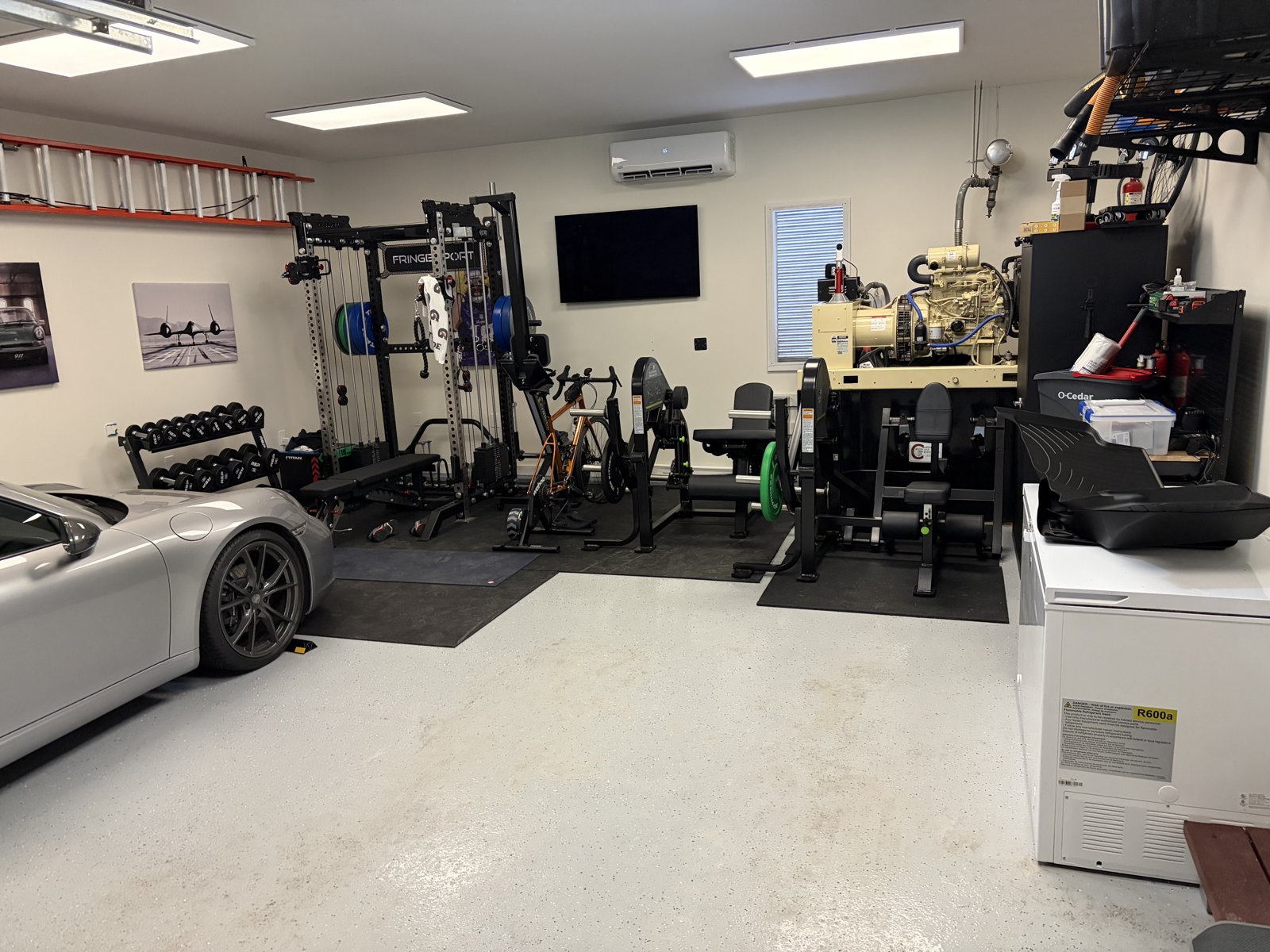
I started lifting weights at 50, after about thirty years of doing essentially nothing. No sport I’d kept up, no gym membership, no equipment gathering dust at home. For most of my adult life, exercise was something other people did.
What changed was weight loss on Zepbound. Early in my time on it, the same warning kept coming up: a meaningful share of what you drop on a GLP-1 can be muscle, not just fat, and the tool that protects muscle is resistance training. So I knew what I was supposed to do. The problem was that I didn’t really know what resistance training was. The phrase meant almost nothing to me.
What I did next was not a plan. It was a series of nervous guesses. This is the story of how I got from there to a program I follow five days a week, and the two things that actually turned it around: admitting that the gym scared me, and hiring a person to tell me what to do.
The dumbbells in my home office
Get the next one in your inbox
I write about longevity, training, and preventive health weekly — without the guru worship. Free, no spam, unsubscribe whenever.
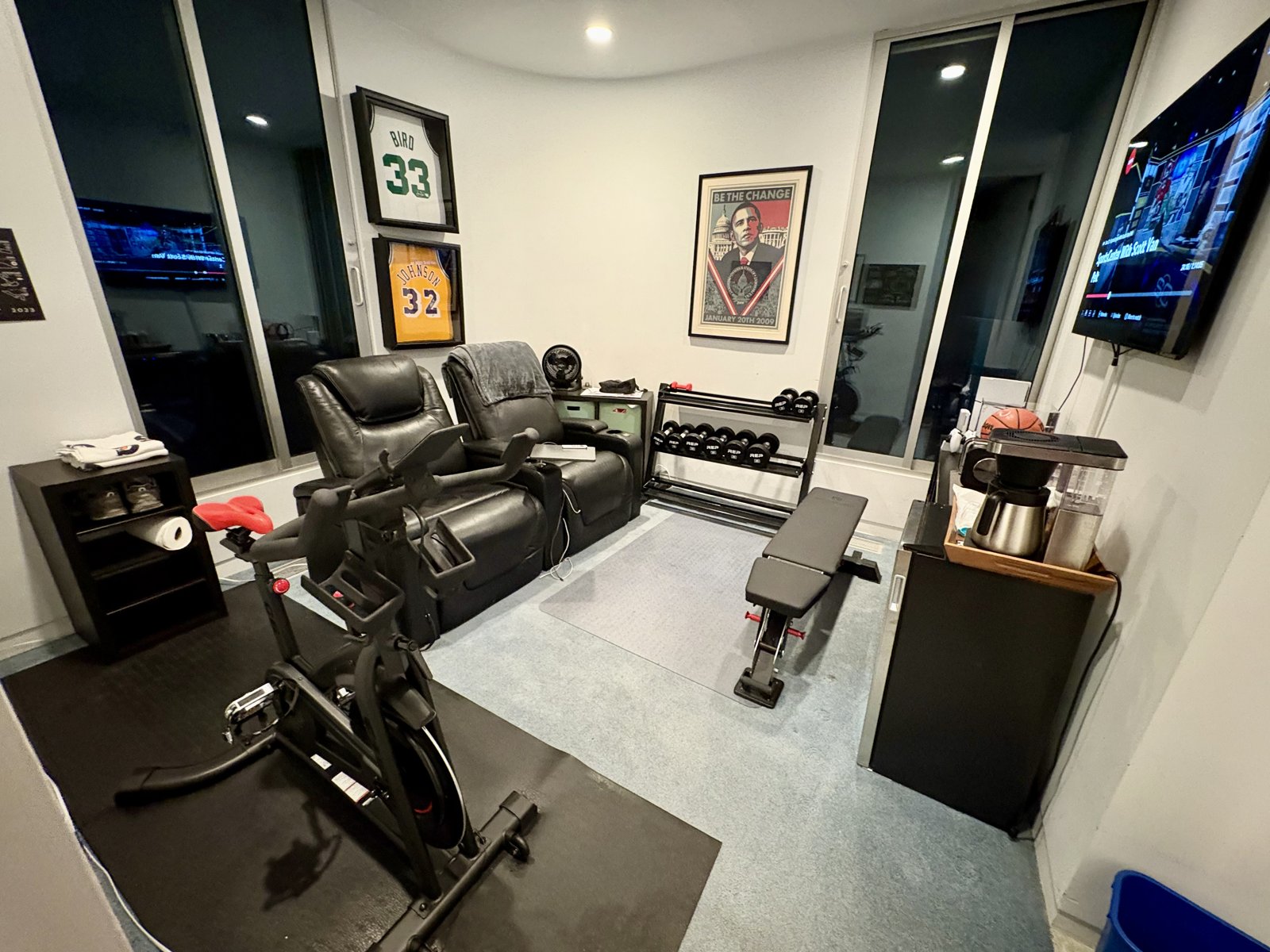
In December 2024, about a month into Zepbound, I bought some dumbbells and an adjustable bench and put them in the corner of my home office. That was the entire setup. I downloaded an app called Hevy to log my workouts, and I started watching YouTube to figure out what to do with the equipment now that I owned it.
I watched a lot of Renaissance Periodization. The RP guys are smart and thorough, which in hindsight was almost the problem. I was a rank beginner trying to drink from a firehose built for people who already lift. I’d half-absorb a video about training volume, then go into Hevy and build my own program that bore only a loose resemblance to anything I’d watched.
My workouts were mostly dumbbell curls and presses, because those were the movements I understood and wasn’t afraid of. I had no real schedule. I trained when I remembered to, did a few sets of the things I liked, logged it, and felt vaguely productive. Some weeks I lifted three times. Some weeks I didn’t lift at all. I was treating it like a hobby I dabbled in rather than a thing I did.
That phase wasn’t worthless, but it was close. The research is kind to beginners on this point. In the largest analysis we have, every version of resistance training, even modest ones, beat doing nothing for both strength and muscle (Currier et al., 2023). So my curls were doing something. But “better than nothing” is a low bar, and without any structure or progression, I had no way to tell whether I was getting stronger or just accumulating reps. I was busy. I was not progressing. And some part of me knew it, which is its own kind of discouraging.
The gym was the part that scared me
The obvious fix was a gym. A real gym has racks, barbells, machines, and people who know how to use all of it. Everyone I mentioned this to said the same thing: just go.
I could not make myself do it. The idea of walking into a commercial gym at 50, soft and untrained, and fumbling with equipment in front of people who clearly belonged there, was more than I wanted to take on. It looks small written down. It did not feel small. It was the single biggest thing standing between me and actually training, and it had nothing to do with sets or reps or any of the stuff I’d been watching on YouTube.
The fitness internet gets this part wrong. Almost all training advice is an argument about optimization: which split, which rep range, how close to failure you should push. For someone like me, that whole conversation was beside the point. I didn’t need the optimal program. I needed to start one and keep showing up. A perfect plan I’m too intimidated to follow is worth less than a mediocre one I actually do. The barrier to getting started, not the ceiling on results, is what decides whether a beginner ever gets anywhere. I was stuck at the barrier.
Hiring a coach was the actual unlock
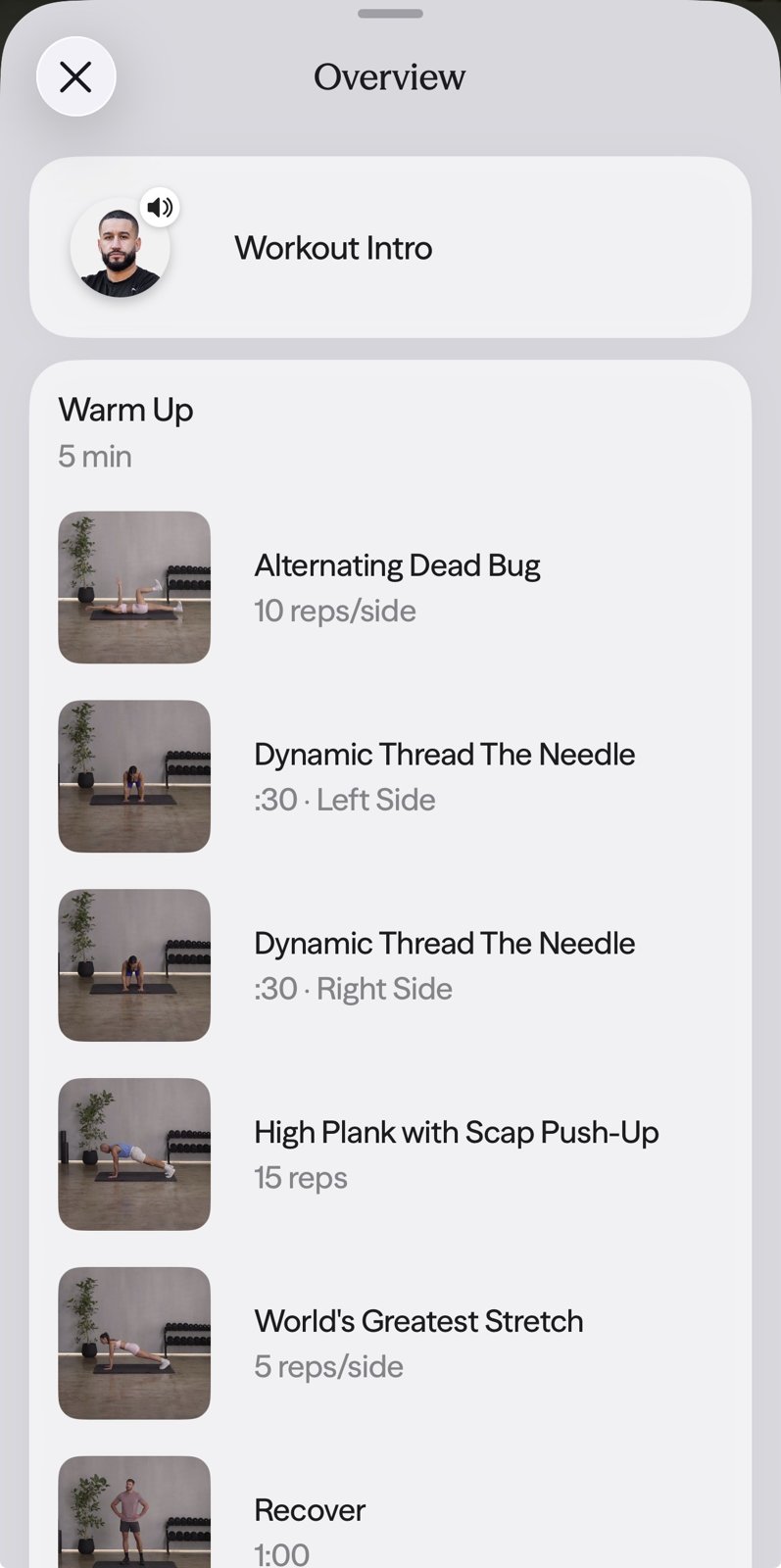
What finally moved me was not a program. It was a person.
I’d read a glowing review of an app called Future on Garage Gym Reviews, a site I trust because they actually test the equipment they write about. Future pairs you with a real human coach who builds your training remotely and checks in on you through the app. Hiring one was its own flavor of scary, in the way that admitting you need help usually is. But it was a smaller, more private scary than the gym.
I went through the coach profiles the way you’d interview anyone for a job that matters. I was trying to thread a needle. I didn’t want a bro whose entire personality was the bench press, and I didn’t want someone selling gentle movement when what I needed was to genuinely get stronger. I wanted a coach whose goals lined up with mine. I picked Jose, had an intro call, and he started programming for me through the app.
I have been with Jose since May 2025. He is still my coach, and the reason is almost embarrassingly simple: accountability. I am not a person an algorithm can coach. I know this about myself now. An AI app could hand me a flawless program and I would quietly stop opening it inside of three weeks. Knowing that a real person wrote my training, can see whether I did it, and will notice if I vanish is the entire mechanism that keeps me going. It is not willpower. I outsourced the willpower to the fact that Jose is watching.
There’s a second thing I didn’t expect to value as much as I do. I like handing off the thinking. I don’t want to design my own progression or decide when to push and when to pull back. Jose does that. I show up, do the work he assigned, send him a note when a movement feels wrong, and now and then get form feedback on a lift. The mental overhead of figuring it all out, the exact thing that had me inventing random programs in Hevy, is simply gone. For a busy guy in his fifties, removing that decision was worth more than any single training tweak.
And I never did join that gym. The coach made it unnecessary. I train in my garage now, on equipment I chose, following a plan built for me. The thing that scared me into stalling for months turned out to be something I could route around completely.
Two days a week is enough to start
Once Jose had me on a real program, I got curious about what the evidence actually says a beginner needs to do. Partly I wanted reassurance that I hadn’t wasted those first months, and partly I just wanted to understand the thing I was now spending five mornings a week on. The answer is far more forgiving than the fitness world makes it sound.
The best data we have is a 2023 analysis out of McMaster University that pooled 178 strength studies and 119 muscle-growth studies, covering thousands of people, and asked a plain question: how much do load, sets, and weekly frequency actually matter (Currier et al., 2023)? A few things in there matter most if you’re just starting.
Everything works. Every resistance training approach they examined beat doing nothing, for both strength and muscle. There is no version of lifting that fails to help an untrained person, which means your first job is not to find the right one. It’s to do any of them, consistently.
You also do not have to lift heavy to build muscle. Strength is where load matters most; the heaviest programs produced the biggest strength gains. But muscle size was strikingly insensitive to how heavy you went. What mattered for growth was doing multiple sets, not maxing out the weight. For a beginner afraid of loaded barbells, that is permission in scientific form: moderate weights you can manage for roughly eight to twelve reps build muscle perfectly well (Schoenfeld et al., 2021).
And twice a week does most of the job. Peter Attia’s team worked through the same dataset and made the point cleanly: a beginner using moderate loads, multiple sets, just two sessions a week captures roughly three-quarters of the strength you’d get from an all-out heavy program trained three times a week, plus essentially all of the muscle and all of the mobility benefit (Attia, 2026). You can chase the last quarter later, once training is a habit instead of a hurdle.
The one thing the researchers were firm about: do more than a single set per exercise. Single-set programs were the approach that consistently underperformed. Everything past that is more forgiving than it looks.
If I were starting next week, here’s the whole thing. Train two or three days a week, and on each of those days touch the four basic movement patterns: a push, which is a press of some kind, a pull, which is a row, a squat, and a hinge, which is picking something up off the floor with a flat back. Those four cover most of what a body needs, and you do not need a barbell to do any of them. I started with dumbbells. Machines count. Your own bodyweight counts. The equipment was never the point. The movements are.
For each pattern, do two or three sets of roughly eight to twelve reps. Pick a weight where the last couple of reps are genuinely hard but your form still holds, and stop a rep or two before the point where you’d actually fail. That margin, what coaches call leaving reps in reserve, is how you train hard without getting hurt or learning to dread it. Then, when a weight starts to feel easy, add a little: a few pounds, or a rep or two. That slow, almost boring upward creep is the entire secret behind the intimidating phrase “progressive overload,” and it’s the only thing that separates training from moving weight around. It is also, not coincidentally, why I keep having to buy heavier dumbbells.
That is a real program: a couple of sessions a week, the four basic movements, a weight that’s honestly hard, and a little more when it stops being hard. You could write it on an index card. The reason it matters that it’s this simple is the same reason it took me a coach to get moving, that the program you’ll actually do beats the optimal one you won’t. One caveat worth stating plainly: if you’ve got a history of injuries or a heart or joint issue, get cleared by your doctor first, and if you can swing it, a few sessions with a trainer to learn the basic movements is money well spent. It was for me.
People misread this part, so I’ll say it plainly. The forgiving math is specifically for beginners. Once you’ve trained for a while, the easy gains slow down, and load, proximity to failure, and how you structure progression start to matter a great deal more. That’s a real reason I keep a coach. But none of that is a reason to delay starting, and none of it is a prerequisite. You earn the right to fuss over optimization by first becoming a person who trains.
There’s one more reason the timing matters at 50 in particular. From around our mid-thirties we lose muscle and strength gradually, a process called sarcopenia, and it accelerates with age. Strength tends to fade even faster than muscle size does. Left alone, this is the quiet decline that becomes a cane, then a walker, then a fall that doesn’t heal, decades later. The loss is not mainly about looks or gym numbers. It tracks closely with the things that decide whether older people keep their independence, like how fast you can rise from a chair and whether a stumble turns into a broken hip (Currier et al., 2023). Grip strength, of all things, turns out to be one of the better simple predictors we have of how long a person will live (Leong et al., 2015). There’s a quieter stake, too. Muscle is a reserve, the protein bank your body draws down to get through a serious illness or a surgery, so the muscle I build in my fifties is partly insurance for a hospital stay in my seventies (Attia, 2026).
The encouraging part is that almost none of this is locked in. Muscle responds to training at any age. In the most striking demonstration of that, a group of frail nursing-home residents averaging ninety years old did eight weeks of weight training and walked away with their leg strength up an average of 174 percent, close to triple where they started (Fiatarone et al., 1990). If a ninety-year-old can nearly triple her strength, fifty is not too late for anything. Resistance training is the most direct tool we have to slow the slide, and often to claw back a good piece of it. Starting at 50 instead of 70 is one of the better decisions available to me, and the same door is open to you.
Where I am now, and what I’d tell you
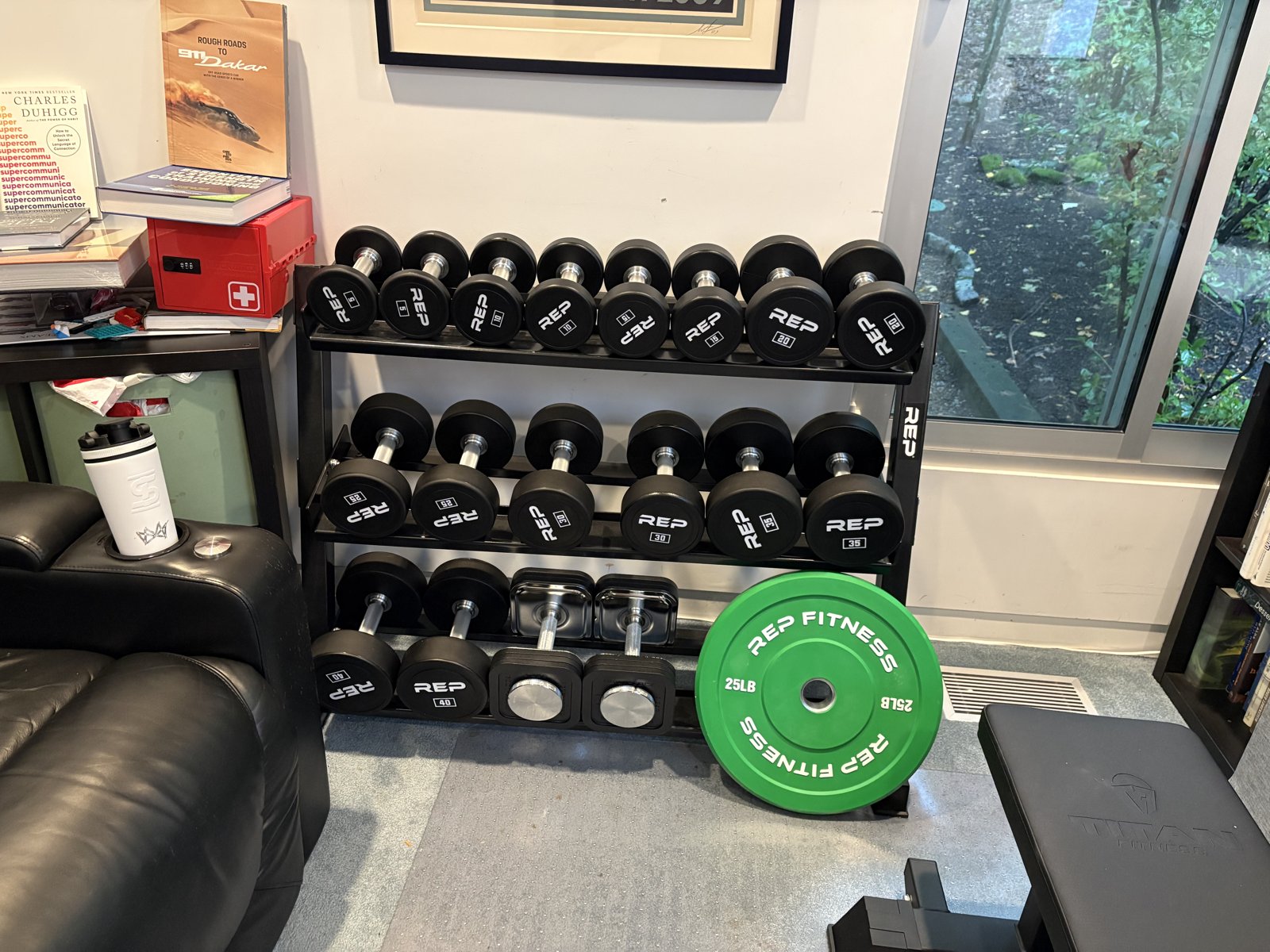
It’s been about a year and a half since those dumbbells landed in my office, and a little over a year with Jose. I train five days a week in my garage. Not because I’m chasing a number, but because it stopped being something I have to talk myself into. It’s just what I do on those mornings, the way I make coffee.
The contrast with where I started is almost funny. Those first sessions were me inventing things to do with a pair of dumbbells. Now Jose hands me a real week: two lower-body days built around barbell deadlifts and heavy leg work, two upper days of presses and rows, and one full-body conditioning day, each session opening with mobility work and closing with stretching. The barbell I was once too intimidated to touch in a public gym is now the center of most of my workouts, in my own garage. I don’t design any of it. I open the app and do what’s there.
The numbers backed up the feeling. After six months of consistent training, with enough protein and the other changes I’ve written about, a DEXA scan laid it out: I had added about 10 pounds of muscle while losing roughly 45 pounds of fat, and I did it while eating in a calorie deficit the entire time. Putting on muscle while dropping that much fat, in your fifties, on a diet, is not supposed to be the easy case. The lifting is the reason the weight I lost came off as fat and the weight I gained went on as muscle. I wrote that body-composition turnaround up on its own, because it surprised me as much as anyone.
My metabolism told a similar story. I had my resting metabolic rate measured directly, on a metabolic cart instead of guessed from a calculator, and it came back around 2,150 calories a day, roughly 10 percent higher than the formula predicted for a man my size. That cuts against the usual pattern. Losing a lot of weight normally drives resting metabolism down, as your body gets smaller and, too often, sheds muscle along with the fat. Mine is running high for my weight, and holding onto muscle is a big part of why a metabolism behaves that way. Resistance training is how you hold onto the muscle. The work showed up not just on a body scan, but in how many calories I burn doing nothing at all.
Here’s the gym version of progress, with one honest caveat: I don’t test one-rep maxes. Chasing a true max is a good way for a beginner to get hurt, and I’m training to still be useful at 70, not to win anything at 51. So these are working sets, weights I actually move for reps. My top barbell bench press is 150 pounds for 4, and my top sumo deadlift is 245 for 2. Those won’t turn heads in a serious gym. But for a guy who a year and a half ago didn’t know a deadlift from a doorknob, and who picked dumbbell curls precisely because the barbell intimidated him, they’re numbers I’m quietly proud of.
My favorite proof, though, isn’t on a scan or a barbell. I prefer individual fixed dumbbells to the adjustable kind, and because a full set of them is expensive, I made a deal with myself early on: I only buy the next pair up when I actually need it, when the weight I have stops being hard. I’m about to order the 60-pound pair. For a guy who started with the lightest dumbbells in the rack and didn’t know what “resistance” meant, that pending order is the most honest progress report I have.
If you’re where I was, a fifty-something who hasn’t trained in decades and feels faintly ridiculous even reading this, here is what I’d actually tell you.
The program is not your problem. You can get a good-enough one for free in an afternoon, or for the price of a coffee a day from someone like Jose. Your real problem is the same as mine was: starting, and then doing it again next week. So solve that problem first, and solve it honestly. For me the answer was a coach, because accountability to a real person is the only thing that has ever worked on me, and because I was glad to pay someone to do the thinking I didn’t want to do. For you it might be a training partner or a standing appointment you refuse to cancel. The mechanism matters less than picking one that fits who you actually are instead of who you wish you were.
You can also route around the thing that scares you. The gym terrified me, so I stopped pretending I’d ever walk into one and built what I needed at home instead. The obstacle I’d treated as the only entrance turned out to have a side door.
I waited until 50 to start, and I’d have been better off starting decades earlier. But the bar to begin is far lower than the noise makes it seem: two days a week and a weight you can actually lift is a genuine beginning. A year and a half ago I didn’t know what the word “resistance” meant. Now it’s the part of my day I’d give up last.
This was the beginning. The dose, the numbers, the recovery and most of what I got wrong afterwards are collected in one place.
About Gunnar
Gunnar is 53. He lost about 170 pounds, trains in a garage gym, and writes DadStrengthDaily from personal experience, citing primary sources where he can. He also moderates r/ProactiveHealth. He is not a doctor, and nothing here is medical advice. Talk to your own doctor before acting on anything, especially GLP-1s, TRT, blood pressure, sleep apnea, and cancer screening.