
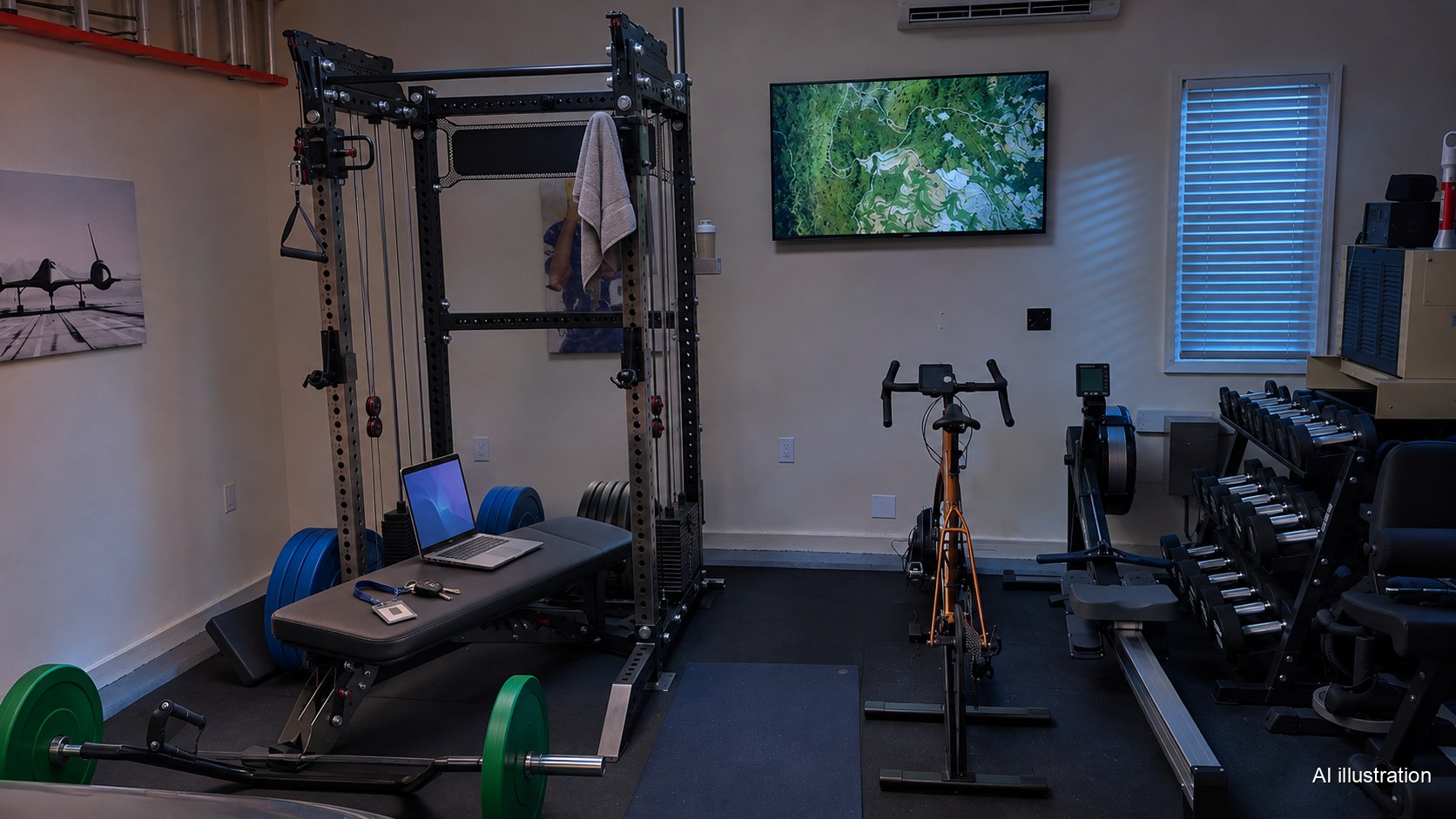
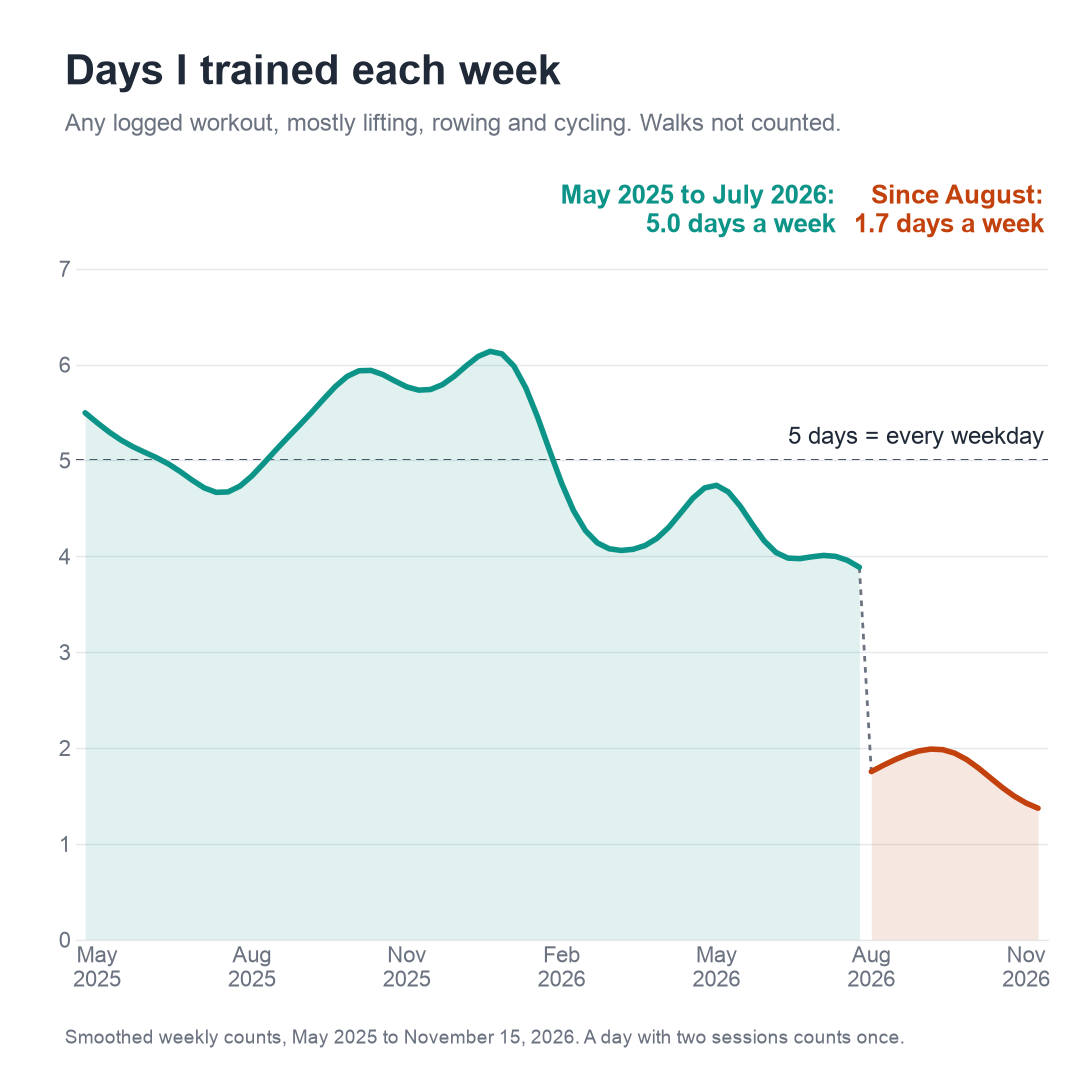
I trained every weekday morning for about fifteen months, in my garage, on a program my coach writes. Since August I have barely made it twice a week. Work got very busy, including nights and weekends, and one of our sons is going through a rough patch with attachment that takes a lot out of all of us. Many mornings I wake up stressed and depressed, and I don’t go down to the garage. I still get up at 5:45, but the hours before the office now go to work, before and after I take the kids to school.
What I’ve lost is my five-day habit and, for now, my reason to train. The strength and muscle are probably in better shape than it feels like, since the research suggests two hard sessions a week can preserve much of both.
What three months at twice a week actually costs
The most useful paper I found is a 2021 review by Spiering et al. in the Journal of Strength and Conditioning Research. It was written for exactly this situation, the periods “in which the time available for exercise is limited (e.g., personal, family, or business conflicts).”
Keeping strength takes very little. In the studies they reviewed, one session a week was enough to keep one-rep max strength (the heaviest weight you can lift once) for 8 to 32 weeks, as long as the load stayed the same. Endurance held for up to 15 weeks on two sessions a week.
Keeping muscle takes a bit more than keeping strength, and more again as you get older. For people around 60 to 75, the authors recommend two sessions a week with two to three sets per exercise to maintain muscle size. At 53, I’d rather go by that number than the one-session figure.
The condition on all of it is intensity. In an endurance study the review cites, people who kept training six days a week but cut the intensity by a third lost their gains in VO2max (the standard measure of aerobic fitness), and so did a group that cut it by two thirds. For lifting, the authors recommend maximal effort on the last rep of each set, or keeping the weights at least as heavy as usual. Their main conclusion is that intensity is the one thing to keep while cutting days and sets.
So far the weights on my main lifts haven’t dropped. That’s strength, though. It doesn’t tell me whether I’ve kept all the muscle. Another DEXA scan might give me a better idea. My body weight has been fluctuating more than usual.
The maintenance studies mostly used young or previously untrained volunteers, and the review’s authors say that too few studies of trained people met their criteria. Nobody has tested what happens to a trained 53-year-old who drops from five sessions to two, so I’m extrapolating.
The closest thing to a worst case for men our age is a 2020 study by Blocquiaux et al. in Experimental Gerontology. Thirty men aged 58 to 77 lifted for 12 weeks and then stopped completely for 12 weeks. They lost 5 to 15% of their strength and power, and fewer than eight weeks of retraining brought their one-rep max back to where it had been. They were new to lifting and quit outright, which is a bigger break than mine.
Why I lost the point
Stress is only part of it. For most of those fifteen months my reason to train was obvious: I was losing weight on Zepbound (tirzepatide), and I lifted so the weight coming off would be fat and not muscle. That job is done. I built some muscle along the way, but I’m no longer sure what I’m trying to achieve by building more. I’m not a bodybuilder, and I don’t particularly want to be one. Some mornings I genuinely don’t see the point.
The research in this post is the closest thing I have to an answer. Every paper above is about keeping what you built, not adding to it, and keeping it is the goal I have left. The evidence says it takes much less than building did.
Why stress wins the morning
A 2014 review by Stults-Kolehmainen and Sinha in Sports Medicine looked at 55 prospective studies of stress and physical activity. In about three out of four, stress predicted less activity. Studies of adults over 50 showed it more consistently, and the stressors included job strain and work–family conflict, which describes my last three months.
The same review found that habitually active people tend to exercise more under stress, and beginners less. Fifteen months of habit didn’t keep me at five days a week, but it does make coming back easier. I know the program, the garage is set up, and there is nothing new to learn.
How I’m getting back
My coach knows what’s going on, but the program hasn’t changed, so I’ve been making the cuts myself, mostly by doing shorter sessions. If you have a coach, ask for a short version of the program outright instead of improvising one the way I did.
In practice I keep the bench press, the trap bar deadlift and lots of dumbbell work, usually five sets each at my usual weights, and drop the rowing and bike at the end. Five sets is more than the two to three the review recommends for older adults to keep muscle, so if a session has to get shorter still, sets go before weight does. Dropping the rowing and bike means that while I seem to be keeping my lifting strength, I may be losing some aerobic fitness.
What I’m trying hardest to avoid is a whole week without training. In a 2010 habit study by Lally et al. in the European Journal of Social Psychology, missing one opportunity “did not materially affect the habit formation process.” The authors also note, citing earlier work, that missing a week’s worth of sessions reduces the likelihood of future performance. Those were young volunteers building new habits, not men coming back to an old one, but it is the best evidence I found on lapses.
The first time around, hiring a coach is what finally got me training every weekday (Fitness Journey Part 3). And when I started lifting, the research I cited said a modest dose gets most of the strength gains (How I Started Lifting at 50). That is also why short sessions are worth doing now.
I don’t know when I’ll manage five mornings a week again. Until then, two shorter sessions with the weights where they were should keep most of my strength and, if the research on older adults holds for me, most of the muscle.
Get the next one in your inbox
I write about GLP-1s, training, and preventive health once a week — what the evidence actually says, from someone using it. Free, no spam, unsubscribe whenever.
If this was useful, read next
- How I Started Lifting at 50 After 30 Years of Doing Nothing — the modest training dose that gets most of the strength gains
- Fitness Journey Part 3: Establishing an exercise habit — how I built the weekday habit in the first place
- The Morning Routine I Actually Follow at 53 — the full routine I’m working my way back to