
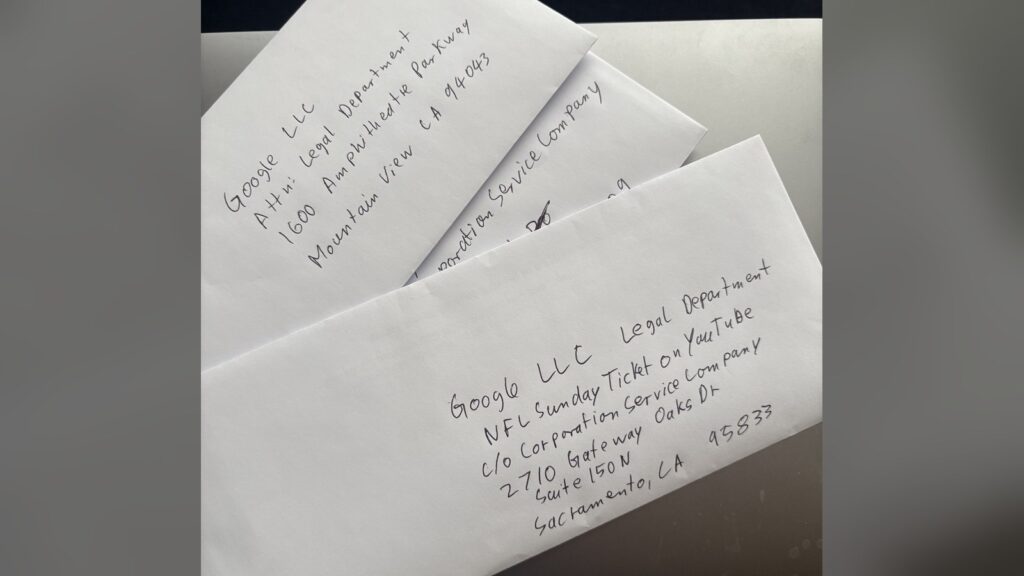
I mailed Google a demand letter under Massachusetts consumer-protection law on November 13. Six days later, a YouTube escalation support manager cancelled my YouTube TV and Premium and refunded $539.97: the October charges in full plus the whole NFL Sunday Ticket season. I had asked for $278.79.
What broke
On November 10, YouTube terminated my channel under its rules on regulated goods (I report on peptide sellers). My YouTube TV, Premium and NFL Sunday Ticket subscriptions were on the same Google account and stopped working that day.
I couldn’t cancel them online either (I wrote up each failed attempt). The “Manage subscription” links on Google’s payments page and a refund form from TeamYouTube on X all ended on a YouTube page saying “Your channel won’t be put back on YouTube at this time,” with no cancel button. When I asked YouTube TV’s chat about the error, the agent told me to unplug my TV.
The letter
Massachusetts’ consumer-protection law, Chapter 93A, requires a “written demand for relief” describing the unfair practice and your loss, then 30 days’ wait, before you can sue. If the company makes no reasonable written offer and then loses in court, it owes your actual damages, doubled or tripled if it acted willfully or knowingly or refused to settle in bad faith, plus attorney’s fees and costs.
I argued that Google’s setup broke a Massachusetts rule in force since September 2, 2025: if you signed up online, you must be able to cancel online, at least as easily. No court has ruled on whether it did. The FTC’s national “click to cancel” rule covered the same ground, but an appeals court threw it out in July 2025. The FTC started reconsidering the issue in March 2026 but hasn’t proposed a replacement rule.
The rule guarantees a way to cancel, not a refund. My demand for money rested on the loss: services I had paid for and could neither use nor cancel. I asked for the unused part of each service, prorated by day and by week: $278.79. The letter went by certified mail with return receipt ($11.02 each) to Google’s legal department in Mountain View, with a copy to its registered agent in Boston. A second letter went to the address in Google’s Sunday Ticket terms, which require a written “notice of the dispute” by certified mail and 60 days of trying to settle before arbitration. I’ve put a template of my letter after the results.
What came back
USPS delivered the Boston copy on November 16, and the Mountain View letter and the Sunday Ticket notice on the morning of November 19, California time. Between 7:26 and 7:30 that evening, Eastern time, YouTube sent four refund emails and two cancellations. Five minutes later a YouTube “Escalation Support Manager” wrote:
“We received your refund request for your subscription charges after you recently lost access to them due to an issue with your channel. … Since you lost access to your subscriptions, I have completely canceled them and ensured you will not be charged moving forward.”
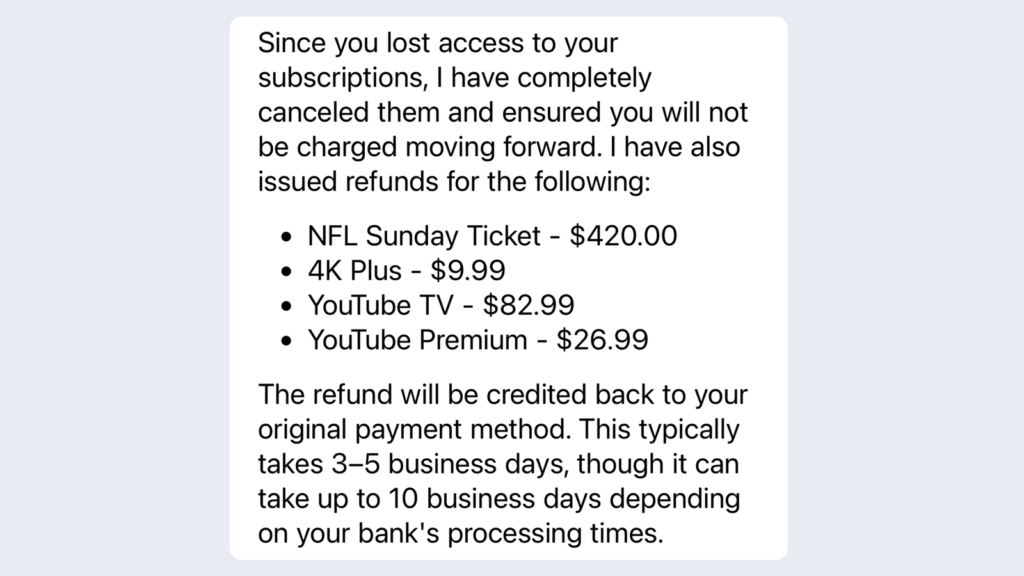
| I asked for | Google refunded | |
|---|---|---|
| YouTube Premium | $14.80 | $26.99 |
| YouTube TV with 4K | $53.99 | $92.98 |
| NFL Sunday Ticket with RedZone | $210.00 | $420.00 |
| Total | $278.79 | $539.97 |
That is more than Google’s terms promise. They call Sunday Ticket payments “non-refundable, in whole and/or in part,” and cancelling a monthly plan gets no refund for the rest of the month. Google refunded the whole season, including the nine weeks I’d watched. The credits were on my card the next morning.
The email calls it a “refund request” and doesn’t mention my letter or Massachusetts law, so I can’t prove the letter did it. My forms, chats and DMs from November 10 to 12 got me nothing. Two days after the refund, a “YouTube Legal Support Team” wrote that it only handles legal removal requests and couldn’t help with subscriptions. Attached was the registered agent’s intake notice: it logged my letter on November 16 as a “Demand Letter” with a 30-day answer deadline and sent it to Google’s legal department that day, three days before the refund.
Part of me wanted this to end in small claims court, but Google has paid back almost twice what I asked for, so I’m not taking this any further.
My 93A demand letter, as a template
Here is a template based on my 93A letter. Before you use it, check how you signed up and whether each subscription actually renews automatically, and change the claims to match what happened to you. I’m not a lawyer, and this isn’t legal advice.
Your name, address, the email on the Google account
Date
BY CERTIFIED MAIL, RETURN RECEIPT REQUESTED
Google LLC, Attn: Legal Department, 1600 Amphitheatre Parkway, Mountain View, CA 94043
Re: Demand for relief under M.G.L. c. 93A, § 9. YouTube Premium and YouTube TV, account email
This is a written demand for relief under Massachusetts General Laws chapter 93A, section 9. I am a Massachusetts resident and bought the subscriptions below online from my home in Massachusetts.
What I paid for. Each charge: amount, date, what it covers.
What happened. On date, I lost access to these services. What you see: the error message, on which devices.
I cannot cancel. These are automatically renewing subscriptions. I signed up online. I have tried to cancel online, and every route fails: each route, the date, and where it ended.
Why this is an unfair and deceptive practice. Under 940 CMR 38.05(3), it is an unfair and deceptive practice under M.G.L. c. 93A, § 2 to fail “to provide a simple mechanism for a consumer to cancel the Negative Option Feature and avoid being charged for the Product and immediately stop any recurring charges.” That mechanism “must be at least as easy to access and use as the method the consumer used to initiate the Negative Option Feature” (38.05(3)(a)), and for online sign-ups it must be available “through the same website or web-based application the consumer used to initiate” it (38.05(3)(b)1).
Injury. Each service, the unused days or weeks, the dollar amount. Total: $amount, plus any amount Google charges me after date.
Relief demanded. Within 30 days of the mailing or delivery of this letter, please: (1) cancel my subscriptions, effective immediately, and confirm the cancellation to me in writing; (2) refund $amount to my original payment method; (3) refund any later charge for these services and make no further charges.
Under c. 93A, § 9(3), Google has 30 days from the mailing or delivery of this demand to make a reasonable written offer of settlement. If Google does not, I intend to pursue my claim in court, where I may seek up to three times my actual damages, plus attorney’s fees and costs.
I have screenshots of each attempt to cancel and copies of the charges, and will provide them on request.
Signature
cc: Google LLC, c/o Corporation Service Company (Massachusetts resident agent), 84 State St., Boston, MA 02109
If you’re not in Massachusetts
Chapter 93A and the cancellation rule only apply in Massachusetts, and I haven’t checked other states’ laws. Next time an online cancel button fails me, I’m sending the letter first.
Get the next one in your inbox
I write about GLP-1s, training, and preventive health once a week — what the evidence actually says, from someone using it. Free, no spam, unsubscribe whenever.
If this was useful, read next
- Google Took My Money, Shut Off YouTube TV and Premium, and Won’t Let Me Cancel Online — Every cancel route I tried before the letter, with screenshots.
- I Criticize Peptide Sellers. YouTube Terminated My Channel Over “Regulated Goods.” — Why YouTube shut down my channel in the first place.
- YouTube Terminated My Channel After I Criticized a Peptide Seller. 172 Peptide Promos Are Still Up. — The peptide sales videos YouTube left up.