
Updated with the FDA’s September approval of Isembyld (apitegromab), the trial numbers behind it, the fracture and fertility safety data that came with the label, and where the drug can actually be prescribed.
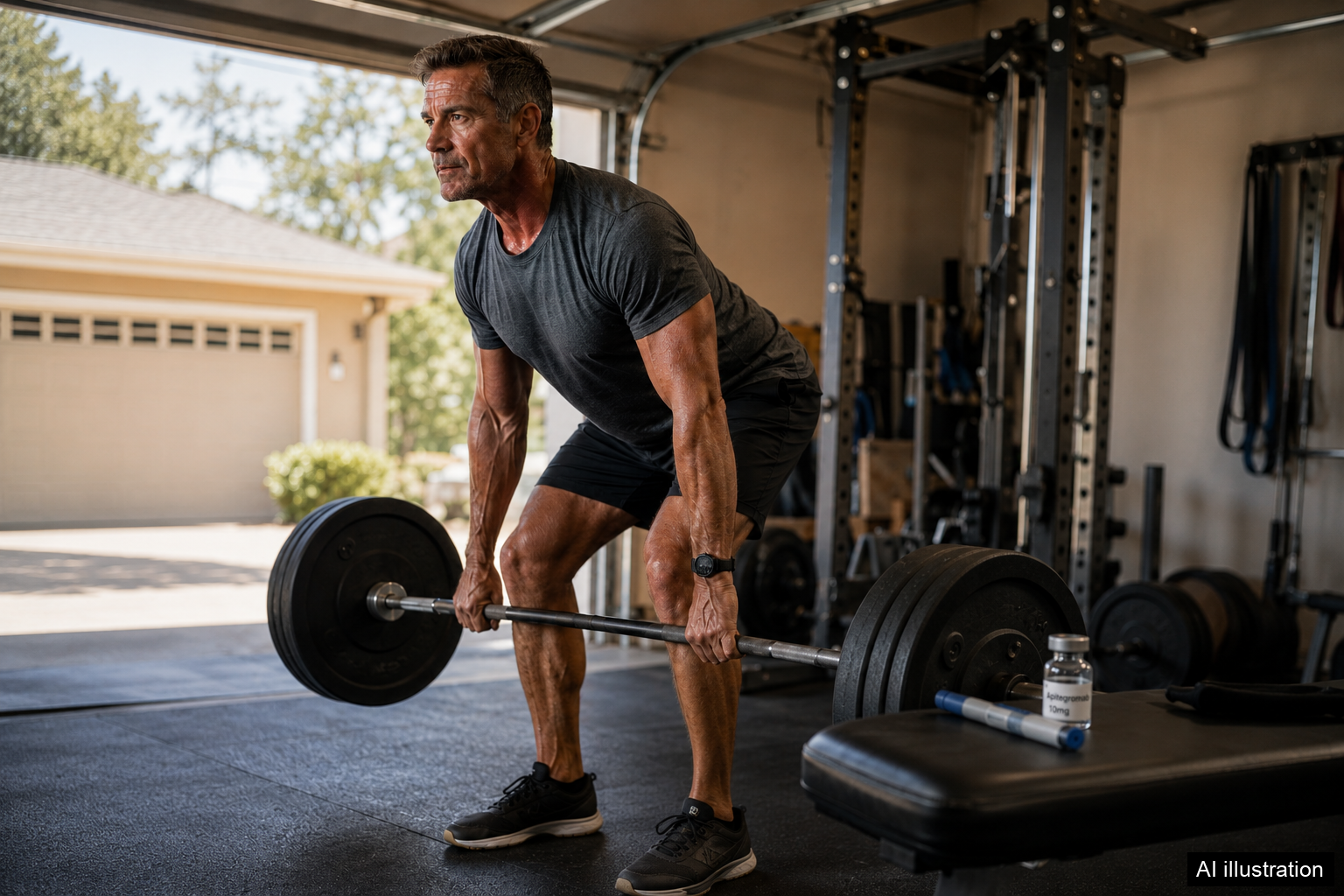
The tabloids are calling it the cure for “Ozempic butt.” But it saved lean mass on a scan, not strength, and the real fix is still protein and a barbell.
I take tirzepatide. I’ve also lost a lot of weight on it, and the one thing I worried about the whole way down was muscle, which is why holding on to it has its own section in my GLP-1 guide. Everybody on these drugs hears the warning eventually: a big chunk of what you lose isn’t fat. So when a new drug showed up in June pitched as the fix for exactly that, I read the paper.
The drug is apitegromab, and the study, published in Nature Medicine on June 8.
Same weight off, more lean mass kept
Get the next one in your inbox
I write about longevity, training, and preventive health weekly — without the guru worship. Free, no spam, unsubscribe whenever.
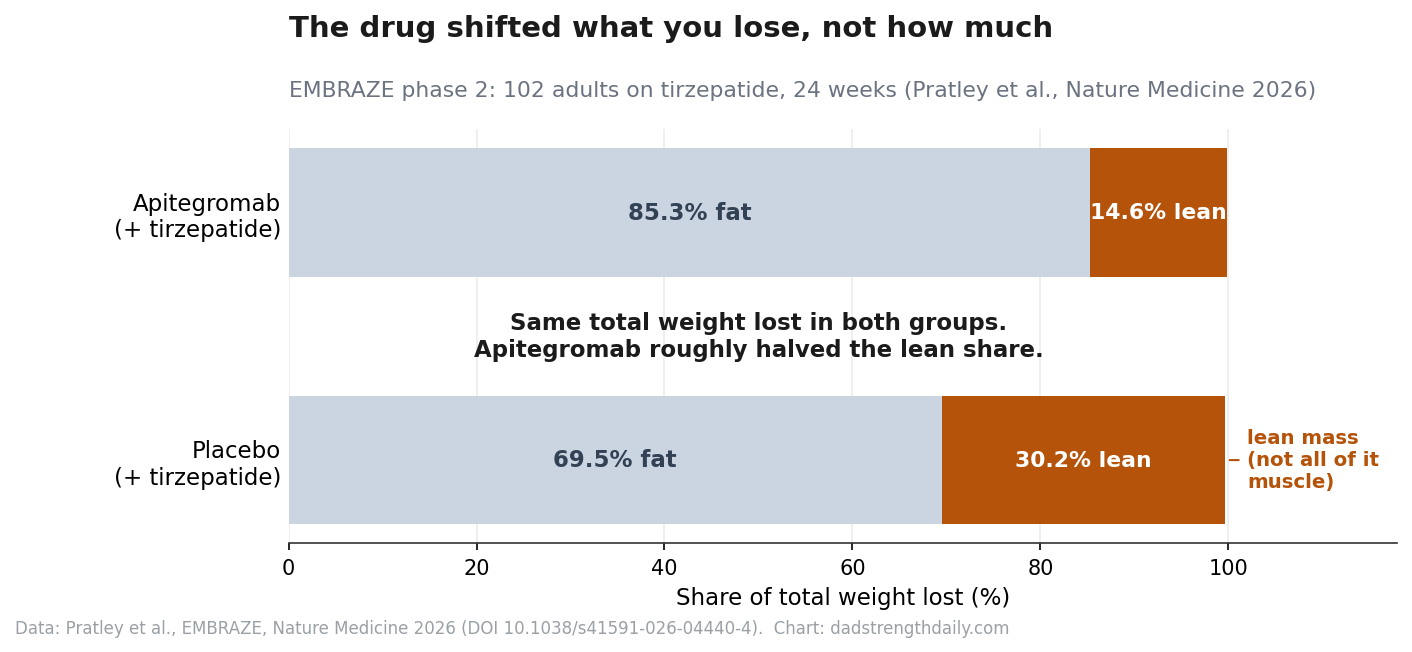
Researchers gave 102 adults tirzepatide, the drug in Mounjaro and Zepbound, and split them in two. Half also got apitegromab, an antibody that blocks myostatin, a protein that limits muscle growth. Half got a placebo alongside their tirzepatide. After six months, both groups had lost about the same total weight. But the apitegromab group held onto more lean mass. They lost 1.9 kg less of it than the placebo group, which works out to keeping a little over half of the lean tissue they’d otherwise have shed.
That’s a real result, and it’s exactly what a lot of people on these drugs worry about. If you’ve watched someone get thin and somehow frail at the same time, you understand why it matters. Roughly a quarter to 40 percent of the weight people lose on these drugs is lean mass, not fat, and muscle is a lot harder to put back than fat is.
Strength didn’t improve
What improved here was lean mass on a body scan. That is not the same thing as being stronger, and they looked. They tested muscle strength with a handheld gauge and counted how many times a person could stand up from a chair, and at both six and eight months there was no notable difference between the apitegromab group and the placebo group. It did not, in this study, show anyone getting measurably stronger. A 102-person, six-month trial might be too small to catch a real strength gain, but the honest read is they haven’t shown one yet.
That gap isn’t a quirk of one trial. Trials of other myostatin-blocking drugs have run into the same thing. You build muscle you can see on a scan, and the strength doesn’t reliably follow. An older review put the question right in its title: does muscle mass equal muscle strength? The answer, over and over, has been “not as much as you’d hope.” Bimagrumab, the best-known drug in this family, built mass without a clear strength benefit.
In fairness, apitegromab isn’t only a weight-loss drug. Its main job is treating spinal muscular atrophy, a genetic disease that wastes muscle in children, and there, on that disease’s movement tests, it genuinely helped kids move better. But a child whose muscles are failing from a motor-neuron disease is a very different situation from a fifty-year-old shedding pounds on a weekly shot, and the company cites the SMA results to argue the drug has broader promise. The weight-loss data, for now, shows a better body composition and no proven benefit to how people function.
The fat loss wasn’t actually greater on the drug either, despite how some of the coverage framed it. Both groups lost about the same amount of fat. What changed was that a bigger share of the apitegromab group’s loss came from fat instead of lean tissue. The study was small, ran six months, was about 84 percent women, and was paid for by the company that makes the drug. It’s a promising proof of concept, which is what the researchers themselves called it. It does not show a health or functional benefit. Naveed Sattar, a cardiometabolic specialist at Glasgow who wasn’t involved, told the Guardian it’s “too early to say whether this actually benefits people’s health or ability to move or function better.”
The other drugs, and what already works
Apitegromab isn’t alone. Eli Lilly’s bimagrumab does something stranger. On its own it actually builds lean mass, and paired with semaglutide in a trial called BELIEVE, people lost far less lean mass than on semaglutide alone while losing more fat. Regeneron has one in the works too. This is becoming a drug category, and the claims are ahead of the data. Mike Israetel, the bodybuilding scientist, sold these body-composition drugs as the era of enhancement in a video that drew about as much ridicule as applause. The pitch is easy: GLP-1 drugs created a muscle problem, here’s a drug to fix it. None of them has shown that the lean mass they save makes people stronger.
You’ll also hear that retatrutide, the triple-agonist also in development for weight loss, spares more muscle on its own. Nobody has run that head-to-head, and retatrutide’s own body-composition substudy put the lean-mass share of the weight lost right in the range of the other drugs. Nobody has shown that either.
Not everyone thinks the muscle loss is worth panicking about. The crew at Barbell Medicine, who are usually careful with this stuff, argue the worry is partly overblown: the lean mass a DEXA scan counts isn’t all muscle you can flex, since it also includes water, glycogen and organ tissue; a lighter body needs less of it to haul around; and the trials rarely show people actually getting weaker. I take the point. The loss is real, plenty of people on these medicines can feel it, and the industry sees a market. Some muscle loss when you drop fifty pounds is normal. Losing more than you had to, when protein and a few hard sets would have saved it, is the part to fix.
And we already know how to hold onto most of it while you lose weight: eat enough protein and do resistance training. Sattar, in the same breath where he called the drug early, said people on these medicines “should be supported to increase their physical activity,” because that “can help maintain muscle mass in a physiological way.”
I’m a single case, and one person proves nothing. I lost about 170 pounds on tirzepatide. A DEXA scan along the way showed I’d dropped 44 pounds of fat and added almost ten pounds of lean mass at the same time. I didn’t take a second drug. I ate a lot of protein and I trained, eventually with a coach five days a week. The drug quieted my appetite. I wrote up how to handle the protein side here.
If you’re older, losing weight fast, and physically unable to train, a drug that slows the muscle loss could turn out to matter, and longer trials will tell us whether the mass it saves becomes anything you can feel.
The approval is for SMA, not weight loss
Apitegromab has a name and an approval now. In September the FDA cleared it as Isembyld, the first myostatin inhibitor ever approved for anything, for spinal muscular atrophy in kids and adults 2 and up who can’t move or walk on their own, given alongside the drugs that already treat SMA. That’s a different population from the one this post is about, kids with a wasting genetic disease, not adults losing weight on tirzepatide, and the drug isn’t approved, priced, or marketed for the second group.
The trial that got it approved still didn’t answer the strength question. It measured a 66-point test of motor skills like sitting, standing and walking, not a strength test. Kids on the approved dose gained 2.2 points more than placebo on that scale over a year, and 34.2% of them hit a meaningful improvement on it against 13.5% on placebo. A higher dose, twice as much, was tested in the same trial and didn’t do any better, so the FDA only approved the lower one.
The approval documents also reported safety findings that weren’t visible in June. Five of the 53 kids on the approved dose broke a bone in the trial, against one of the 50 on placebo. In an ongoing follow-up study at that higher, unapproved dose, 22 patients have broken a bone, five of them serious femur fractures, some with no fall or obvious cause. Animal studies found bone damage at every dose tested, and the FDA’s label says no safe dose was ever found. The same animal data showed lower sperm counts and fertility problems at every dose tested too, which is why the label now warns the drug may affect fertility.
Can you buy apitegromab?
Not for this. It is a prescription biologic given by infusion, and the only legitimate route is a prescription for spinal muscular atrophy, handled through Scholar Rock’s own patient program. There is no prescription for keeping lean mass during weight loss, because that is not an approved use.
The name still turns up on supplier sites, listed by catalogue number and sold for laboratory use, labeled not for human use. That material is not the medicine. The fractures above turned up in a monitored trial, at a known dose, with a doctor watching. Buying lab-grade protein online means guessing at the dose and at what is in the vial.
Scholar Rock priced the drug at roughly $310,000 a year, an IV infusion for a rare pediatric disease, not a shot you add to a Zepbound pen. Eat the protein, lift the weights.
About Gunnar
Gunnar is 53. He lost about 170 pounds, trains in a garage gym, and writes DadStrengthDaily from personal experience, citing primary sources where he can. He also moderates r/ProactiveHealth. He is not a doctor, and nothing here is medical advice. Talk to your own doctor before acting on anything, especially GLP-1s, TRT, blood pressure, sleep apnea, and cancer screening.