
I aimed at 200 grams a day, averaged 164, and the DEXA still came back with 9.6 pounds more lean mass than I started with.
I published the first version of this post in August 2025 with three different protein targets in it. The body text said 1 gram per pound of target weight, which for me meant 200 grams a day. A few paragraphs later it said “my target of 180g.” The MacroFactor screenshot said my six-month average was 164. I also wrote that I am 6’4″. I am 6’3″. Both DEXA reports print 75.0 inches, so I have been rounding myself up for years.
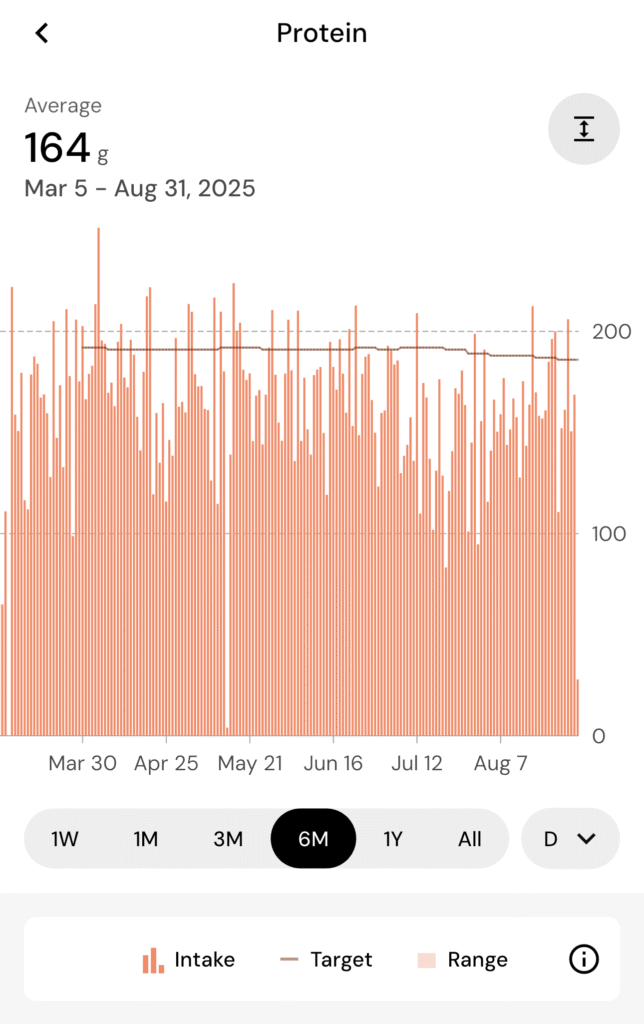
The honest version: between March 5 and August 31 of 2025 I averaged 164 grams a day, against a target line that started just under 200 and drifted down to about 185. I missed my own number by roughly 15 percent. If you came for a number: the defensible range runs from about 1.2 to 2.2 grams per kilogram a day depending on which authority you ask, and nobody has run the trial that would pick between them.
There is also an arithmetic trap in that 164. I logged those grams between March and August of 2025, when I was nowhere near the weight I am now: 373 pounds in October 2024, and still 245 at my first DEXA on 10 October 2025, six weeks after the logging window closed. At 245 pounds or more, 164 grams a day is 1.48 grams per kilogram or less, not the 1.72 it would be at my April 2026 weight. So what I actually ate sat inside the 1.2 to 1.5 grams per kilogram the most recent expert consensus endorses during weight loss, rather than above it. The number I hit, at the weight I hit it, is closer to what the evidence supports than the number I was recommending.
How much protein on Zepbound: two credible answers, 1.5 times apart
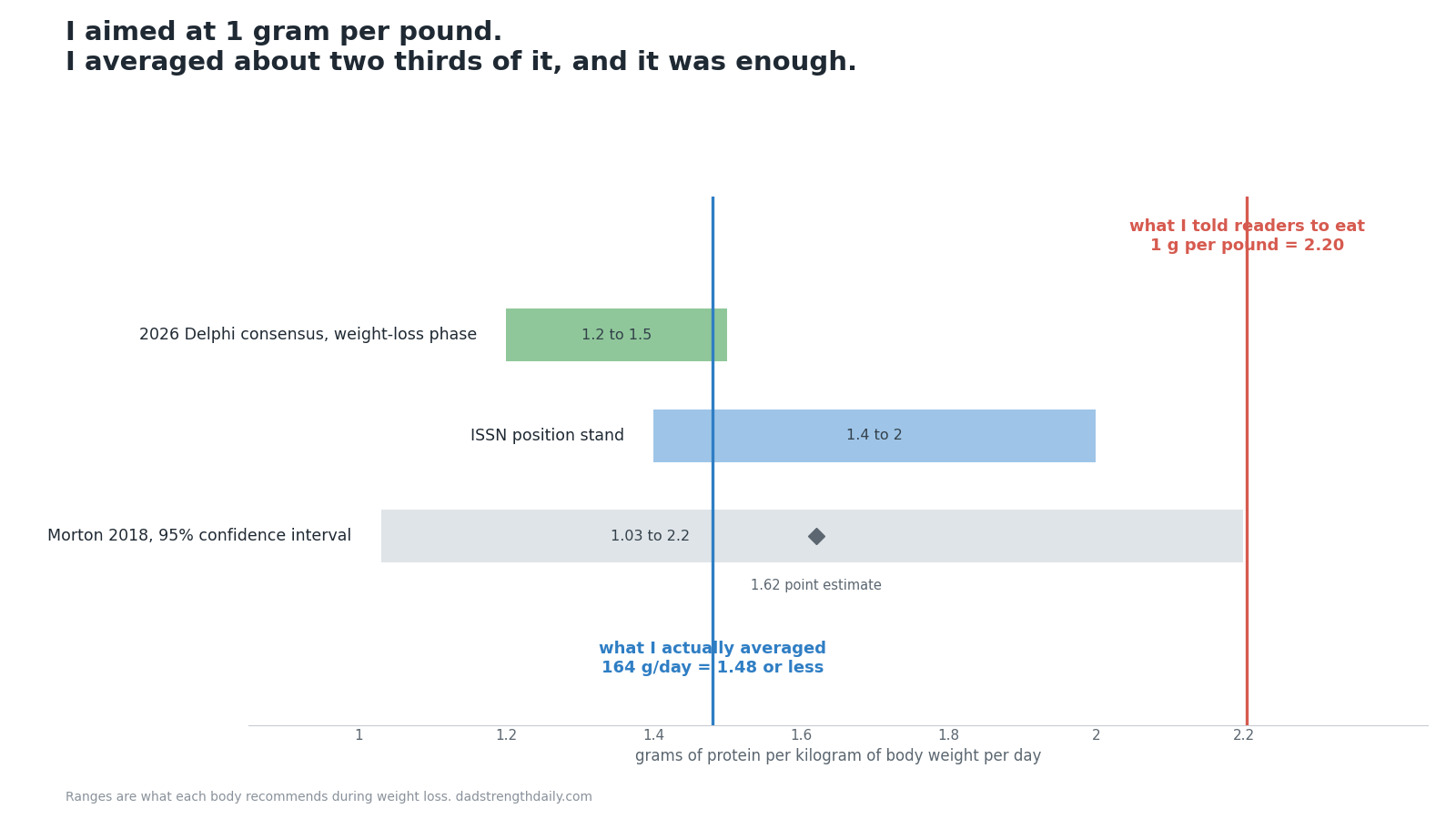
The “1 gram per pound” rule gets dismissed online as a bro number with no paper behind it. That is not fair. One gram per pound is 2.2 grams per kilogram, and 2.2 comes straight out of a real meta-analysis, which just means somebody pooled every trial they could find and ran the statistics on the combined pile.
Morton et al., British Journal of Sports Medicine (2018) pooled 49 randomized trials and 1,863 people lifting with extra protein, and found gains in fat-free mass plateauing at 1.62 g/kg/day. Nobody quotes the uncertainty around it. The 95% confidence interval ran from 1.03 to 2.20, and a confidence interval is just the range the true value is probably in given how noisy the data were. One that wide means the study pinned things down far less than the headline suggests. The authors also report that the fit producing 1.62 was not statistically significant (p=0.079), and their own advice was to recommend “~2.2 g protein/kg/d for those seeking to maximise resistance training-induced gains in FFM.”
So 1 gram per pound sits on the top edge of that interval and on what the authors themselves suggested. It is defensible. It is also well above what any medical body recommends on a GLP-1. Higher numbers exist and none come from GLP-1 users: the ISSN position stand runs to 2.0 grams per kilogram for people who train, and Longland et al. (2016) fed dieting young men 2.4 while they trained six days a week.
The most carefully graded guidance available is the international Delphi consensus published by Sievenpiper et al. in Obesity Pillars (2026), where a panel voted on 52 statements and published the agreement level for each. For the weight-loss phase, 87 percent endorsed 1.2 to 1.5 grams per kilogram of actual body weight, graded by the panel itself as expert opinion. At my weight that is 114 to 143 grams a day. My old target was 200.
| g/kg/day | g/lb/day | Grams/day at 210 lb | What it is |
|---|---|---|---|
| 0.80 | 0.36 | 76 | US RDA, and the Delphi floor once you are maintaining |
| 1.20 | 0.54 | 114 | Bottom of the 2026 Delphi range during weight loss |
| 1.50 | 0.68 | 143 | Top of the 2026 Delphi range, and the ceiling my own 164 grams sat under at the weight I was eating them |
| 1.62 | 0.73 | 154 | Morton’s plateau estimate |
| 1.72 | 0.78 | 164 | The 164 grams I averaged, priced at my April 2026 weight |
| 2.00 | 0.91 | 191 | Top of the ISSN range |
| 2.20 | 1.00 | 210 | Top of Morton’s confidence interval, and exactly 1 gram per pound |
| 2.40 | 1.09 | 229 | The high-protein arm in Longland et al. (2016) |
The two most recent expert documents also disagree about something more basic than the number, which is what you divide by. The Delphi panel says actual body weight. A joint advisory from four professional societies (Mozaffarian et al., Obesity Pillars, 2025) says actual weight “can significantly overestimate protein requirements” and that estimated fat-free mass is probably better. At 250 pounds and 35 percent body fat, that one choice moves your target by 50 grams a day. What I did was pick a third denominator that neither document endorses. One gram per pound of target weight held me to 200 grams a day, where the same rule against my actual weight then would have been 245. But 200 is still well above the 114 to 143 grams the Delphi panel gives me at the weight I am now. I picked the divisor that produced the biggest target, and I did not notice I was picking anything.
Nobody has run the protein trial on tirzepatide yet
I searched PubMed and ClinicalTrials.gov for a completed randomized trial testing any protein dose during semaglutide or tirzepatide therapy with a body-composition endpoint. As of August 2026, there is not one.
The first is LEAN-PREP (NCT06885736), still recruiting, protocol published by Alawadhi et al. in BMJ Open (2026). It will randomize 232 adults on semaglutide or tirzepatide into four groups for six months: control, home resistance training, protein supplementation, or both, with MRI of the quadriceps as the primary outcome. Its protein arm targets 1.6 g/kg/day, not 1 g/lb. A second trial, HUSTLE (NCT07700030), has not started recruiting.
So the most confidently repeated advice in the GLP-1 world, the thing my weight-loss advisor and my fitness coach both told me, is being tested for the first time right now. The Delphi panel says as much about its own recommendations: “there is still a significant lack of direct evidence to guide clinical practice, making consensus-based recommendations necessary.”
Does tirzepatide eat your muscle? Losing weight does most of it
I had this pointed the wrong way. I wrote the first version as if the drug were doing something specific and sinister to muscle that protein had to defend against.
Eisa and Barood pooled 20 randomized trials and 15,782 participants in Diabetes, Obesity and Metabolism (2026), using only studies with DXA or MRI. The share of weight lost that came off as lean mass was 25.4 percent on tirzepatide (95% CI 22.8 to 28.0) and 26.2 percent on lifestyle intervention alone (24.1 to 28.3), statistically indistinguishable at p=0.42. Semaglutide came out higher at 35.2 percent, so this is not perfectly clean. But the tirzepatide figure matches what happens to people losing the same weight with no drug, and the SURMOUNT-1 DXA substudy (Look et al., 2025) found the same split inside one trial, identical in the placebo arm.
The number in that meta-analysis that actually moves is the one for people who lifted. Lifestyle plus resistance training came in at 17.5 percent (14.2 to 20.8), about eight percentage points below the tirzepatide and lifestyle-alone arms, and it comes from training rather than from a macro.
Deller et al. (2026) found the same lever across 34 randomized trials on calorie restriction: adding exercise preserved an extra 0.87 kg of fat-free mass (95% CI 0.59 to 1.16), preventing 45.7 percent of the loss. The joint advisory puts it in one sentence: “increased protein intake alone is likely inadequate to support the preservation of muscle mass in the absence of structured resistance/strength training.”
Batsis et al., Annals of Internal Medicine (2026), reviewed 35 body-composition studies on these drugs and found that not one measured objective physical function. Nobody has checked whether any of this makes people weaker.
Can you only use 30 grams of protein per meal?
I left this hanging in the first version as an open argument. It is not open.
Trommelen and colleagues in van Loon’s lab, Cell Reports Medicine (2023), fed people either 25 or 100 grams of protein after resistance exercise and tracked it with four stable-isotope tracers. The 100-gram dose produced a larger anabolic response still running more than 12 hours later, with dose-dependent incorporation into actual muscle protein. They also measured the thing the myth depends on, and reported a “negligible impact on whole-body protein breakdown rates or amino acid oxidation rates.” Negligible is their word, and it is not the same word as zero: what it rules out is the idea that the extra protein simply gets burned off.
The 20-to-30 gram figure came from Moore et al. (2009), where the synthesis response to an isolated protein source saturated around 20 grams in young men. Fitness media turned an acute synthesis ceiling into an absorption limit. Those are different claims about different physiology.
At 53 it runs the other way for me anyway. Moore et al. (2015) pooled tracer studies in older versus younger men and put the per-meal plateau at 0.40 g/kg of body mass in the older group against 0.24 in the younger, roughly 38 grams in one sitting at my weight. The error bars are wide and that comparison landed at p=0.055, so read it as about 60 percent more per meal, not a precise dose. These are small studies measuring synthesis over hours rather than growth over months, and van Loon’s lab has taken dairy money. Clear enough that I stopped splitting my protein into six perfect servings.
What 164 grams a day looks like on an actual plate

Of 60 GLP-1 users with three-day food records in a 2025 study in the Journal of the International Society of Sports Nutrition, 43 percent reached 1.2 g/kg/day, 10 percent reached 1.6, and 5 percent reached 2.0. The men averaged 88 grams a day. Picking the target is the easy part. The eating is hard by design: tirzepatide cut intake at a single test meal by 525 calories in Martin et al., Nature Medicine (2025). You are being asked to eat more of the most filling macronutrient there is while on a drug built to make you not want to eat.
I also told you last time that everyone says to get it all from whole foods. The guidance documents say the opposite. The joint advisory recommends shakes and fortified products precisely because people on these drugs cannot eat enough, and says to put the protein in your mouth first, before anything else on the plate, because you may not finish.
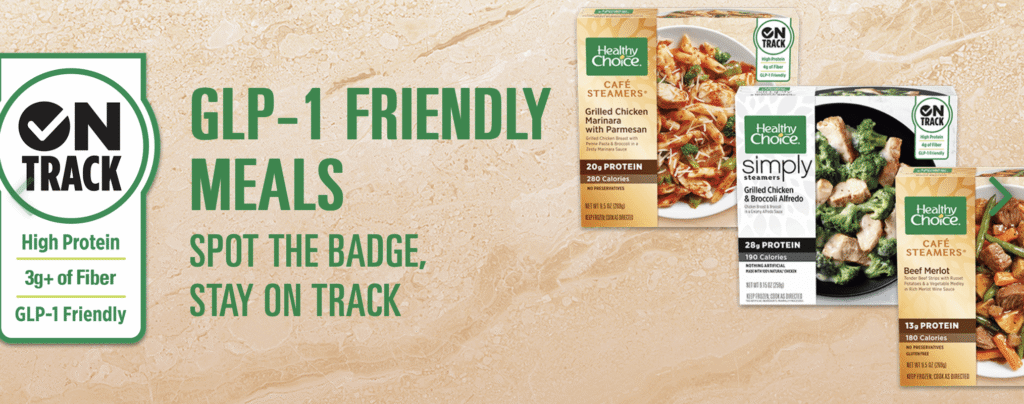
What works for me, unglamorously and on repeat: filet mignon, fast and genuinely good, 31 g for 180 calories. Chicken breast is the classic answer at 25 g for 130 calories and I still cannot make myself enjoy it. Ground turkey beats ground beef for me, 21 g at 170 calories for the 93 percent lean, and it goes with any vegetable in the house. Healthy Choice Cafe Steamers are my office lunch, and the Mexican-Style Street Corn one is 18 g for 240 calories at about three dollars. Fairlife shakes come in 26 g for 170 calories and 42 g for 230, and strawberry is the only flavor I still want a year in. On bars I have opinions: most are chewy glop, the influencer-hyped David bars gave me constipation and sulfur burps, and the Think! White Chocolate bars at 20 g for 230 calories are the ones I keep buying. Pure Protein Popped Crisps in hickory barbecue replaced the potato chips that helped make me obese and hypertensive, 12 g for 150 calories and 330 mg of sodium. The post-workout smoothie is a scoop of Optimum Nutrition vanilla whey, a cup of Oikos Triple Zero, a scoop of cocoa and two cups of frozen triple berry mix, 42 g for 385 calories with 14 g of fiber. Healthy Choice even put an “ON TRACK, GLP-1 Friendly” seal on the packaging, which is slightly ridiculous and also not wrong.
So did it work? Between my two DEXA scans, 10 October 2025 and 10 April 2026, I lost 44.3 pounds of fat and gained 9.6 pounds of lean mass, finishing at 15.6 percent body fat. Read it with the caveats, which matter more than the number does. DXA reports lean soft tissue, which includes water, organs and connective tissue, so it is not a muscle measurement. I lift five days a week, and everything above says that is the bigger lever. I am on physician-prescribed TRT at 120 mg a week, a well-documented driver of lean mass gain that nobody can pull back out of this number. And the logging in that screenshot ended before the first scan.
What I can honestly say is narrower than what I said the first time. I averaged 164 grams a day at a body weight north of 245 pounds, which is 1.48 grams per kilogram at the outside, comfortably under the 1 gram per pound I was telling people to eat, inside the consensus range for the weight-loss phase and just under Morton’s plateau, and nothing bad happened. If you are starting one of these drugs and you can only fix one thing this month, fix the lifting. The protein number is what everyone argues about online, and it is the smaller of the two levers.
I am not a doctor and none of this is medical advice. Talk to your own doctor before acting on any of it, especially about GLP-1s, TRT, and blood pressure.
I keep a running tracker of every GLP-1 and incretin drug, approved and still in the pipeline, with what each one targets, how far along it is, and what's coming next.
See the full GLP-1 Pipeline Tracker →Get the next one in your inbox
I cover the latest GLP-1 trials and access changes weekly. Free, no spam, unsubscribe whenever.