
I’ve been on a GLP-1 for a while now, and for the last couple of years the rule felt simple. If you wanted the kind of weight loss these drugs are famous for, you took a shot. The weekly injection was the price of admission.
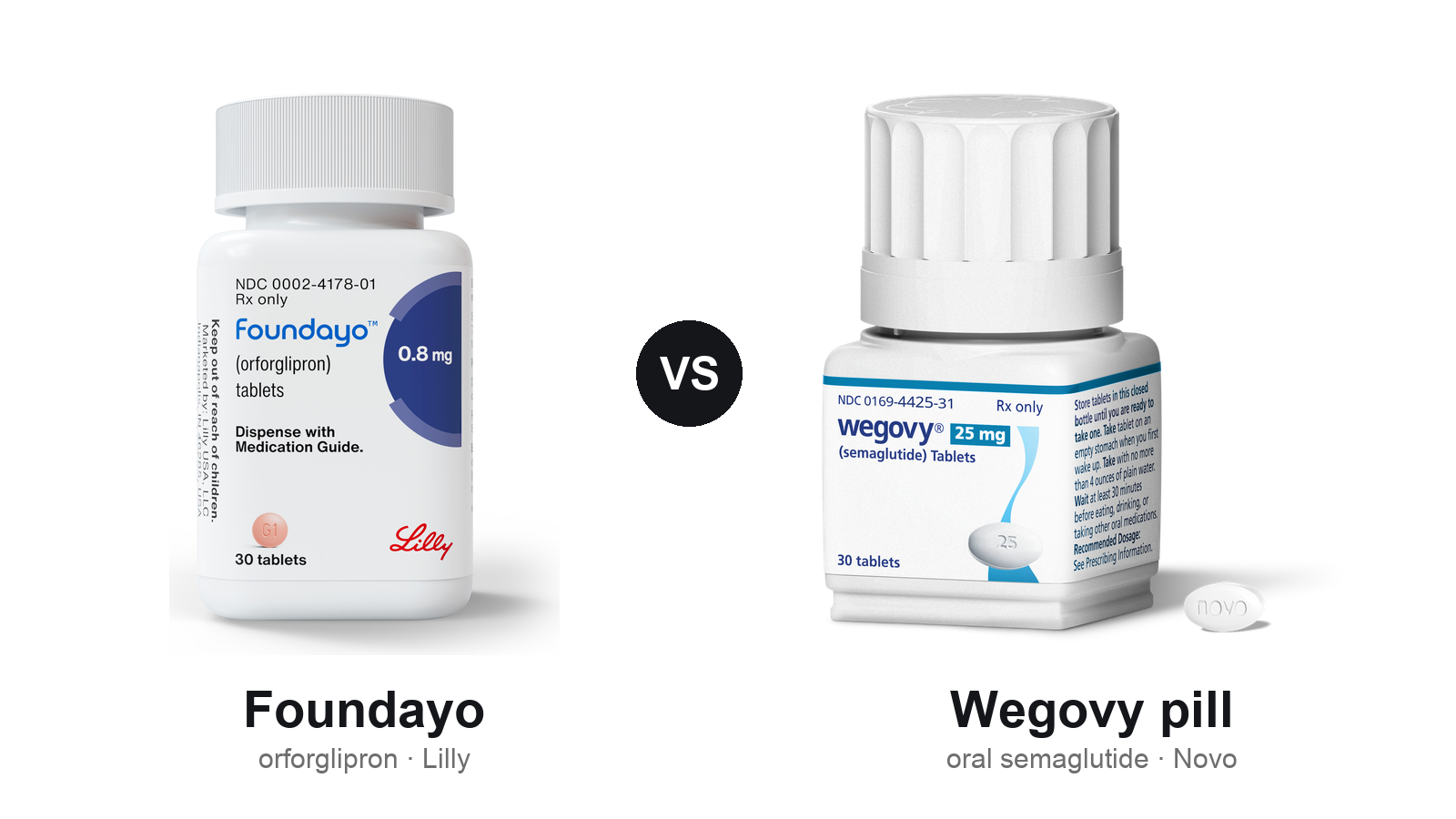
That rule just broke. Two GLP-1 pills are now FDA approved, both taken once a day: Eli Lilly’s Foundayo and Novo Nordisk’s Wegovy pill. No needle. So the real question is whether a pill can actually pull its weight against the shot, and which of the two is worth your attention.
I dug through the trial numbers and the pricing. Here’s what I found.
Update, August 16, 2026: Foundayo picked up its first approval outside the US. The UK’s regulator authorised it on August 10 for both weight management and type 2 diabetes, and called itself the first in Europe to approve the tablet. That diabetes indication is one Foundayo does not have from the FDA yet. Score one for the Lilly pill in this matchup, at least on paperwork.
Two pills, two genuinely different drugs
Get the free Bloodwork Decoder
I made the one-page cheat sheet I wish I’d had at my first physical: what every number on your labs actually means, what’s worth aiming for at 50, and what to ask your doctor. Subscribe free and I’ll send it straight to your inbox. No spam, nothing to sell.
It’s tempting to lump these together as “the GLP-1 pills.” They’re not the same kind of drug, and that difference drives almost everything below.
Foundayo is orforglipron, from Lilly. It’s a small molecule built by ordinary chemistry. Sounds like a footnote. It isn’t, and I’ll come back to it.
The Wegovy pill is oral semaglutide at a 25 mg dose, from Novo. Same molecule as the Wegovy shot and Ozempic, just packed into a tablet with an absorption helper called SNAC so enough of it survives your stomach. SNAC sounds exotic, but it is food-grade, has been in Rybelsus since 2019 with a solid safety record, and the only real caveat on the label is to skip it while breastfeeding.
Both are real and on the market. The Wegovy pill reached the US in early 2026, and Foundayo is right behind it.
The two pills, side by side
| Feature | Foundayo (orforglipron) | Wegovy pill (oral semaglutide 25 mg) |
|---|---|---|
| Maker | Eli Lilly | Novo Nordisk |
| Drug type | Non-peptide small molecule | Peptide (with an absorption helper) |
| Dosing protocol | Once daily, any time, no food or water rules | Once daily, empty stomach, small sip of water, then wait about 30 minutes before eating or drinking |
| Weight loss (its own trial) | About 11% at 72 weeks (ATTAIN-1, 36 mg) | About 16.6% if taken as directed, about 13.6% counting everyone (OASIS-4, 64 weeks) |
| On-label use | Obesity and weight management | Weight management plus cardiovascular risk reduction |
| Beyond weight loss | Largely untested. New molecule. | As semaglutide: proven heart benefit, plus research signals in knee arthritis pain and alcohol craving (studied with the injectable) |
| Manufacturing | Standard chemistry, roughly 30 to 50% cheaper to make, scales like any pill | Complex peptide process, the same one behind recent GLP-1 shortages |
| Cost and access | LillyDirect self-pay ~$149-299/mo; also on the Medicare GLP-1 bridge (~$50/mo if eligible) from Jul 1, 2026 | NovoCare self-pay ~$149-299/mo; also on the Medicare GLP-1 bridge (~$50/mo if eligible) from Jul 1, 2026 |
What the weight-loss numbers actually say
In its trial, Foundayo took off about 11% of body weight at the top dose over 72 weeks. The Wegovy pill managed about 16.6% in people who took it as directed, or about 13.6% counting everyone, including the ones who quit.
So the Wegovy pill wins on weight loss. It basically matches the injectable Wegovy, which is genuinely impressive for a tablet.
One catch the headlines skip past, though. Those numbers come from two separate trials, different patients, different lengths of time. Nobody has put Foundayo and the Wegovy pill head to head. The gap looks real, but it isn’t the clean apples-to-apples race it gets sold as, so don’t treat it like one.
And the injectables still beat both pills anyway. Tirzepatide, the Zepbound molecule, lands around 21%. These pills are the convenience option, not the most-weight-off option.
The daily routine is the real difference for most people
Foundayo has no food or water rules. Take it whenever works for you.
The Wegovy pill is fussier. Because semaglutide is a peptide, you take it on an empty stomach with a small sip of water, then wait about 30 minutes before you eat, drink, or swallow anything else. Every morning.
Sounds trivial until you do it for a year. The people who struggled with Rybelsus, the older oral semaglutide, mostly struggled with the routine, not the drug. If mornings are chaos in your house, that fine print matters more than a few percentage points.
Side effects: what the FDA labels actually list
Both pills are GLP-1s, so most of what you’ll feel is the same either way, and it’s mostly your gut. I pulled the two FDA labels and lined up their most common reactions, the ones that showed up in at least 5% of people in the trials, alongside the serious warnings. Here’s where they match and where they split.
The common stuff, shared by both. On either pill the frequent reactions are gastrointestinal: nausea, vomiting, and diarrhea, along with constipation, abdominal pain, indigestion, bloating, belching and gas, and reflux or heartburn. Headache and fatigue round out the list. For most people these run worst during the weeks you’re stepping up the dose, then ease off.
Where they differ. A handful of reactions cross that 5% line on one pill but not the other. The figures below are the trial rates from each drug’s label.
| Reaction | Foundayo | Wegovy pill |
|---|---|---|
| Hair loss | Up to about 5%, more often in women | About 3%* |
| Dizziness | About 4% | About 8% |
| Low blood sugar (if you have type 2 diabetes) | Under 5% | About 6% |
| Stomach-bug symptoms (gastroenteritis) | Not listed | About 6% |
| Skin tingling or burning (dysesthesia) | About 1% | About 5% |
*Semaglutide can thin your hair too. It runs about 6% on the high-dose 7.2 mg Wegovy shot, but only around 3% on the 25 mg pill, which keeps it just under the 5% mark for the tablet. Either way, hair loss on these drugs tracks with how fast you lose weight, not with the drug itself.
Serious risks and boxed warnings. These are rare, not everyday side effects, and here the two labels look almost identical. Both carry the same warnings for pancreatitis, gallbladder problems, and kidney injury from getting dehydrated, and both flag low blood sugar if you pair them with insulin or a sulfonylurea diabetes drug. Both can, rarely, trigger a serious allergic reaction, and both list anaphylaxis and angioedema in their post-marketing safety section. And both carry the same boxed warning, the most serious kind the FDA issues, about a rare thyroid tumor.
That thyroid warning is a class-wide precaution carried over from the older GLP-1s, and it’s worth knowing what sits behind it. In the animal studies, semaglutide actually caused those tumors in rodents. Orforglipron, the molecule in Foundayo, did not, and it isn’t even pharmacologically active in those animals. For both drugs, whether any of it means anything in humans is still unknown, which is why the warning reads the same on each.
Bottom line. Day to day, tolerability is in the same ballpark. The gut stuff dominates on either pill, the differences above are small, and none of it shifts the bigger picture from the rest of this comparison. The label describes the average trial patient, though, not you. How you react is your own, so work it through with your doctor, and you can report any side effect to the FDA at 1-800-FDA-1088.
Side effects above come from the current FDA prescribing information on DailyMed, accessed May 27, 2026: Foundayo (orforglipron), revised April 2026, and Wegovy (semaglutide injection and tablets), revised May 2026. “Most common” means a reaction reported in at least 5% of patients in the clinical trials.
The boring part that might matter most
Foundayo is a small molecule, made in a standard chemical reactor the way most ordinary pills are. The Wegovy pill is a peptide, and peptides take a complicated, multi-step process to make. It’s the same kind of process behind the GLP-1 shortages of the last few years, when demand for the shots ran way ahead of what anyone could produce.
So Foundayo is far easier and cheaper to mass-produce, by an estimated 30 to 50% over the peptide drugs. That buys two things. Supply gets steadier, since a pill you can run off in ordinary factories is much harder to run short of than an injectable peptide. And then there’s the part worth watching: price.
Cheaper to make means more room to discount, and that’s the structural difference most people miss. The injectables and the Wegovy pill are expensive to produce, so there’s a real floor under how low their price can go. Foundayo doesn’t have that floor. Lilly could cut its price hard and still make money, in a way Novo just can’t match on a peptide.
The catch is real, though. Lilly has already said out loud that it won’t price the pill below its own injections at launch, even though it costs less to make. So the savings aren’t hitting your wallet on day one. But the room is there, and that’s what makes this drug different. As the two pills fight on price, as volume grows, and eventually as patents age, Foundayo is the one with the most room to come down. If a GLP-1 ever gets genuinely affordable for regular people, the economics say it’ll be the small-molecule pill long before it’s anything you inject.
They stop being the same drug once you look past the scale
Weight loss is only part of the story, and past that point these two stop being the same drug.
The Wegovy pill is semaglutide, and semaglutide has years of evidence behind it. It’s approved to lower cardiovascular risk, and the molecule has shown real benefit for knee arthritis pain, plus early signals in cutting alcohol craving. Most of that work used the injectable, but it’s reasonable to assume the tablet behaves the same way. That’s not proof, but the track record itself is real.
Foundayo is a brand new molecule. It’s proven for weight and blood sugar, though so far only approved for weight loss, with a diabetes filing expected later in 2026. Almost nothing else has been studied yet. Don’t assume it inherits semaglutide’s heart protection, or anything else, just because they’re both called GLP-1s. That evidence doesn’t exist for it yet.
If part of why you’re taking one of these is your heart, that gap isn’t small.
What it costs, and how to actually get it
Both carry a cash list price around $1,000 to $1,500 a month, which almost nobody should actually pay.
Assuming insurance does not cover it for you, it depends whether you already have a prescriber. If a doctor’s already prescribing for you, go straight to the manufacturer self-pay programs. Lilly’s LillyDirect, for Foundayo, and Novo’s NovoCare, for the Wegovy pill, both sell directly at well under list, roughly $149 to $299 a month each, no insurance needed. Those are the cleanest cash routes when you’ve already got the prescription in hand.
If you need the prescription too, a telehealth service like Ro pairs you with a clinician who can evaluate you and, if it’s appropriate, write the script and ship the medication. That’s the route for people who don’t already have a doctor managing this, since it rolls the visit and the pharmacy into one step. Just know those services set their own pricing on top of the drug.
On Medicare, both join the GLP-1 bridge on July 1, 2026, which can bring eligible patients down to around $50 a month. That’s by far the cheapest door if you qualify.
And before you fill anything, check GoodRx for the current cash price at pharmacies near you. It’s the fastest way to see what you’d actually pay this week.
A big commercial-coverage change just landed
The biggest pricing news since this post went up is the CVS Caremark announcement on May 28, 2026. If you have employer insurance and your plan uses Caremark’s standard formulary, two things change soon. The new-drug hold on Foundayo ends June 1, 2026, so plans that already cover weight-loss GLP-1s can start filling it. And Zepbound returns as a preferred option on October 1, 2026, after Caremark had dropped it last year. Wegovy and the Wegovy pill keep their preferred spots too, so Lilly and Novo now sit side by side on this one.
That formulary sits behind about 25 to 30 million Americans with commercial coverage, and the wider Caremark book serves about 88 million. None of this is Medicare. Medicare has its own July 1 bridge schedule, and the two run on different rules.
The catch is your employer. Plans that adopt the Caremark template can still exclude weight-loss GLP-1s, and plenty do. Same idea applies to Foundayo, where the announcement says “where approved for coverage by plans,” which is the same opt-out in different words. So check your plan’s formulary or your benefits portal before you assume your script will go through.
So is the pill the move?
For me, already settled on the shot and a long way down that road, the case for switching is weak. The injection still takes off more, and there’s little reason to trade down in the middle of something that’s working.
The stronger case is for the person who hasn’t started yet, or who’s been staring at the needle as the one thing keeping them out. For a lot of people the best drug is just the one they’ll actually take, and a daily pill clears a hurdle a weekly shot never did.
The one thing I wouldn’t do is switch on the strength of a headline. These aren’t interchangeable, the price picture is still moving, and the right call depends on your own numbers, your heart history, and how much you trust yourself with a fussy morning routine. That’s a conversation with your doctor, not a coin flip.
The Wegovy pill drops more weight and carries semaglutide’s deeper track record. Foundayo is the easier one to live with day to day, and it may turn into the easier one to afford if its price ever follows the manufacturing cost down. Neither beats the shots on raw results. And the off-label extras you might be counting on, the heart data especially, belong to semaglutide, not to the new pill. Pick for the reason you’re actually taking it.
If you’re still sorting out coverage, my breakdown of the Medicare GLP-1 bridge walks through who qualifies before the July 1 deadline. And if you want to look further out, brenipatide vs tirzepatide covers what’s still coming. I’ll keep tracking these as they land.
I keep a running tracker of every GLP-1 and incretin drug, approved and still in the pipeline, with what each one targets, how far along it is, and what's coming next.
See the full GLP-1 Pipeline Tracker →About Gunnar
Gunnar is 53. He lost about 170 pounds, trains in a garage gym, and writes DadStrengthDaily from personal experience, citing primary sources where he can. He also moderates r/ProactiveHealth. He is not a doctor, and nothing here is medical advice. Talk to your own doctor before acting on anything, especially GLP-1s, TRT, blood pressure, sleep apnea, and cancer screening.