
Updated with what changed in Google’s ad library on November 24.
Update, November 24, 2026: Four of the 20 advertiser accounts have vanished from Google’s ad library, three of them among the 17 that kept advertising. Google hasn’t said whether it removed them. The other 14 showed ads on November 23.
Key points
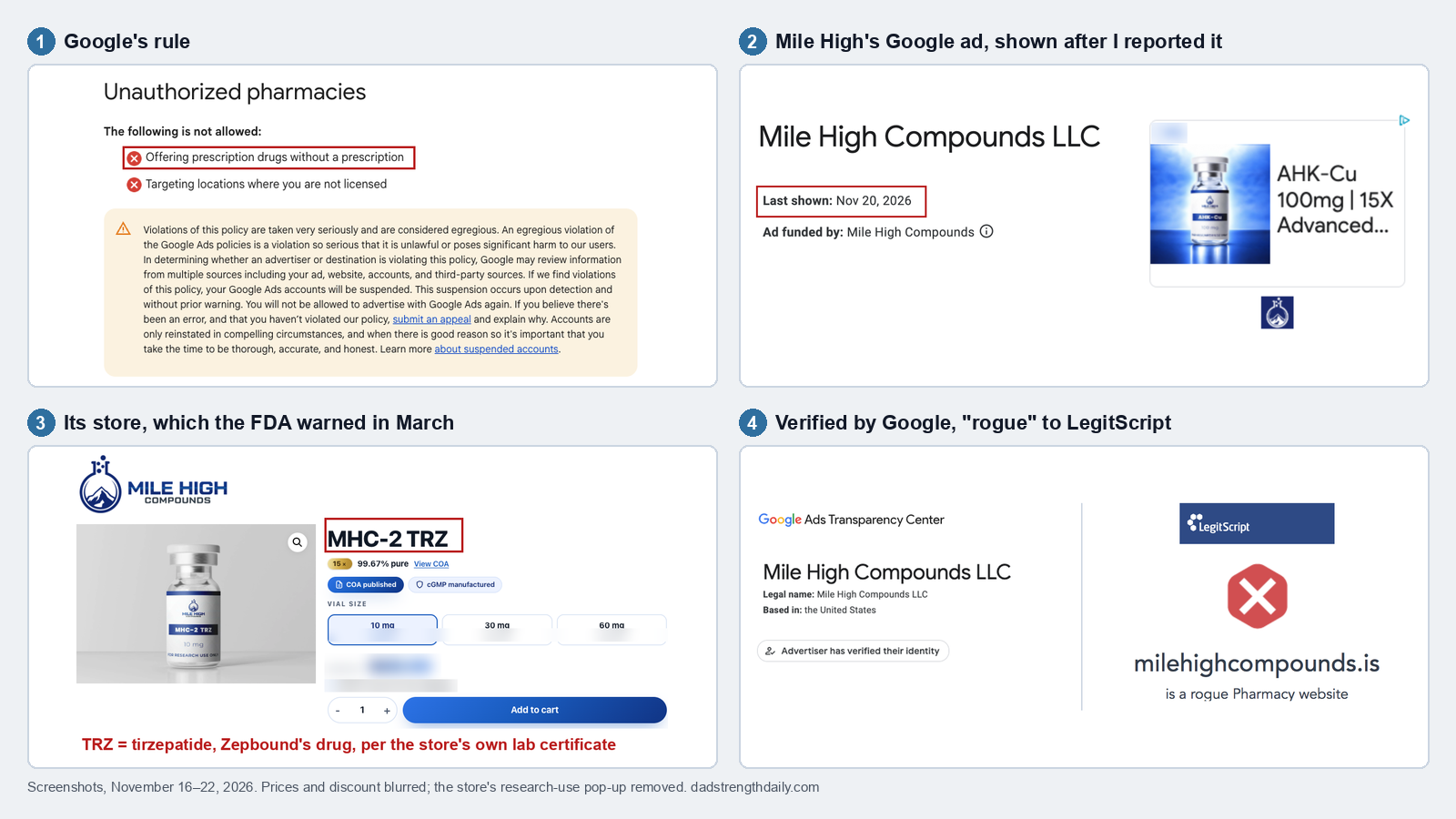
- Google calls “offering prescription drugs without a prescription” “egregious” and says it suspends violators without warning.
- I found 20 Google-verified advertisers whose stores sell the drugs in Zepbound, Ozempic and Egrifta without a prescription. The FDA has warned two of them; LegitScript lists six of the 15 stores I’ve looked up as “Rogue” pharmacies.
- I reported all 20 on November 16. A week later, 17 had shown ads since, all of them on November 22 or 23.
I tested whether Google enforces its own ban on ads for prescription drugs sold without a prescription. I had a reason to look: this month YouTube, which Google owns, terminated my channel under its rule against content that “promotes or facilitates the sale … of certain illegal or regulated goods,” while I was reporting on the people who sell them. 172 videos promoting those sellers were still up when I wrote about it.
Google bans ads for prescription drugs sold without a prescription
Federal law says a prescription drug may be dispensed “only” on a prescription. Google’s rule is blunter. Its “Unauthorized pharmacies” policy first bans “Offering prescription drugs without a prescription.” It calls a violation “egregious,” defined as “a violation so serious that it is unlawful or poses significant harm to our users,” and spells out the penalty: “This suspension occurs upon detection and without prior warning. You will not be allowed to advertise with Google Ads again.” Two gentler rules, for online prescription-drug businesses and for “unapproved substances,” could also apply; both give an advertiser at least seven days’ warning before suspension.
Most of these ads never name a prescription drug. They promote the store, and the store sells the drug. That doesn’t get around the rule: “In determining whether an advertiser or destination is violating this policy,” Google “may review information from multiple sources including your ad, website, accounts, and third-party sources.” If Google finds a store breaks the rule, the penalty is the same suspension as for an ad.
Twenty advertisers, all verified by Google
Google’s Ads Transparency Center lists each advertiser’s ads, when each was last shown, and whether Google verified who the advertiser is. (Sign in to a Google account with a birthday on it, or ads for age-restricted products stay hidden.)
Most stores use code names, but for each one below, the store’s own product page, product data or lab certificate identifies a prescription drug. Where the verified advertiser is a private person, I leave the name on Google’s page.
| Store name Google verified | Ads listed, Nov 16 | Prescription drug how the store identifies it |
|---|---|---|
| Orbitrex A private person (ads paid for by Orbitrex Science LLC) | 79newest Nov 16 | Ozempic’s drug lab certificate |
| Mile High Compounds Mile High Compounds LLC ✕ LegitScript: RogueFDA warning letter | 73newest Nov 16 | Zepbound’s drug lab certificate |
| Cenexa Labs P2T2 Inc | 48newest Nov 16 | Egrifta’s drug product page |
| Modern Aminos Modern Aminos LLC | 41newest Nov 15 | Zepbound’s drug store’s description, and lab’s code on a store certificate |
| Disguised Alpha A private person ✕ LegitScript: Rogue | 37newest Nov 16 | Zepbound’s drug product page and lab certificate |
| Glacier Aminos A private person | 29newest Nov 15 | Zepbound’s drug registry number on certificate |
| Ameano Peptides AMEANO PEPTIDES LLC | 28newest Nov 16 | Egrifta’s drug product page |
| Nationwide Peptides National Science Labs, LLC ✕ LegitScript: Rogue | 26newest Nov 16 | Zepbound’s drug lab’s code on certificate |
| Peptide Warehouse Clear Choice Supplies | 26newest Nov 15 | Zepbound’s drug chemical registry number on page |
| Data Peptides DATA LAMPS LLC | 20newest Nov 16 | Zepbound’s drug product page |
| Amino Club Amino Club LLC, and a private person ✕ LegitScript: Rogue | 17 and 3newest Nov 16 | Zepbound’s drug lab certificate |
| True Research Labs True Research Labs LLC | 19newest Nov 16 | Zepbound’s drug lab certificate |
| Northline Labs Northline Labs | 15newest Nov 16 | hCG, a fertility hormone product page |
| ION Peptide Great Research, LLC | 14newest Nov 15 | Zepbound’s drug; Vyleesi’s drug in an ad Lilly’s code in the store’s product data |
| Iron Peptides Komodo Medical LLC (store run by Iron Research LLC) | 13none since Oct 11 | Zepbound’s drug lab’s code on certificate |
| Prime Peptides A private person ✕ LegitScript: RogueFDA warning letter | 12none since Oct 5 | Zepbound’s drug product page |
| Olympex Olympex Soultions [sic] | 7newest Nov 15 | Zepbound’s drug chemical registry number on page |
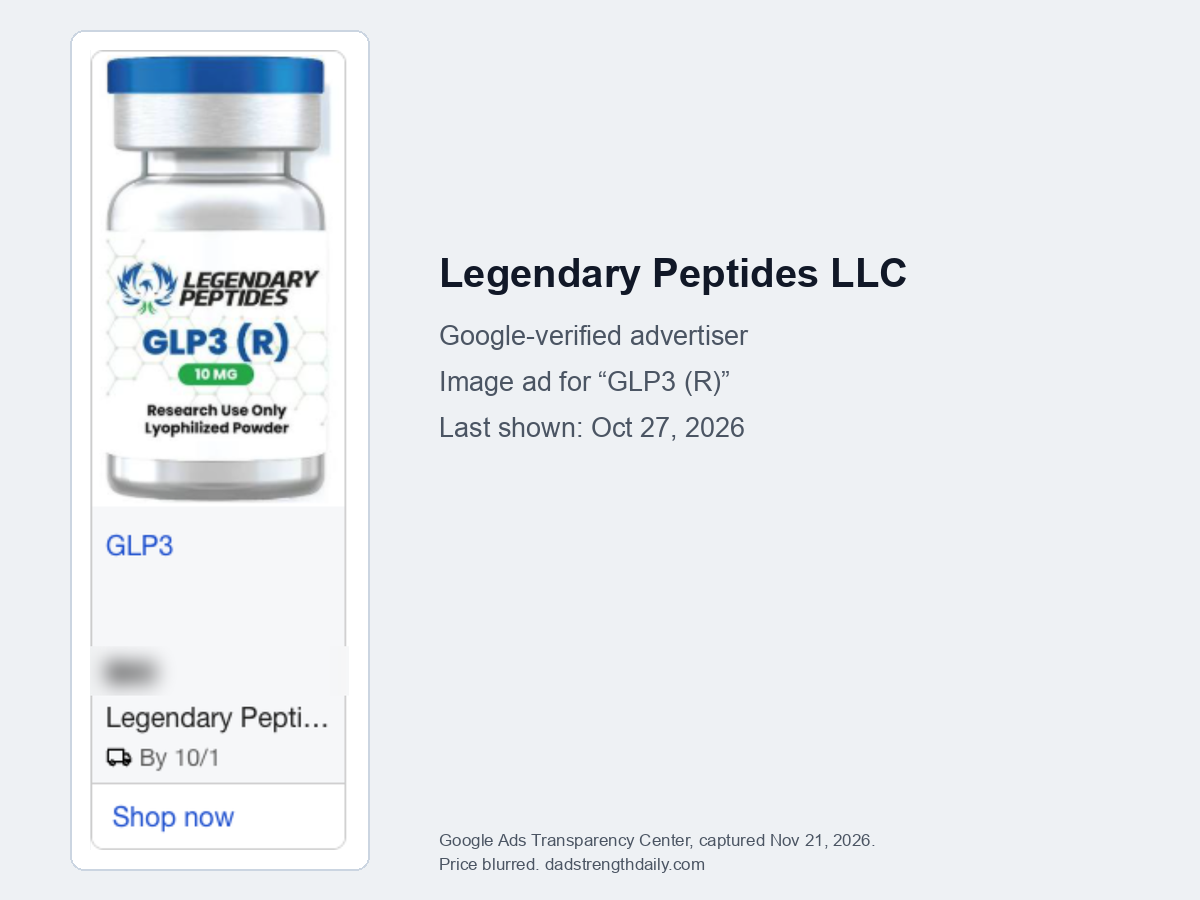
| Legendary Peptides Legendary Peptides LLC ✕ LegitScript: Rogue | 5none since Nov 8 | Zepbound’s drug lab certificate |
| PS Peptides A private person | 2newest Nov 15 | Zepbound’s drug product page |
Zepbound and Mounjaro share one drug, Ozempic and Wegovy another; Egrifta is prescribed for excess belly fat in adults with HIV and lipodystrophy. The product pages I could open carry research-only disclaimers, and none asks for a prescription.
Data Peptides’ ads run under DATA LAMPS LLC. Google doesn’t say where that company is registered; a Wyoming company of that name, formed in June 2026, has a website selling floor lamps and lava lamps. Google’s “verified” means it checked who the advertiser is, not what it sells.
Flagged by the FDA and LegitScript
In March 2026 the FDA sent a warning letter to Mile High Compounds LLC, the company Google verified as Mile High’s advertiser. It called the store’s “GLP-2 TRZ” an unapproved new drug and quoted the company’s “cheat sheet”: “GLP-2 TRZ (Tirzepatide) Uses: Weight Loss, Addiction Recovery. Dosing: Start: 2.5mg weekly.” The store now sells Zepbound’s drug as “MHC-2 TRZ,” and Google showed one of its ads on November 16.
In December 2024 the FDA sent a warning letter to Prime Vitality, Inc., doing business as Prime Peptides, calling two of its products, Ozempic’s drug and an experimental Lilly weight-loss drug, “unapproved new drugs.” Prime’s verified advertiser on Google has the addressee’s name, and the letter and the store both say Santa Barbara. I don’t know how Prime answered the FDA. Nearly two years later it still sells both drugs, plus Zepbound’s.
Google has paid for this before. In 2011 it forfeited $500 million to the Justice Department for letting Canadian online pharmacies target U.S. consumers with its ads, acknowledged that it had “improperly assisted” them, and agreed to “compliance and reporting measures” to keep it from happening again. In a 2014 settlement with its own shareholders, Google promised to retain LegitScript, a pharmacy-verification company, to check its ads, and to disable links to sellers it is told are “subject to action by governmental agencies, including … the FDA.” Those promises were binding for at least five years.
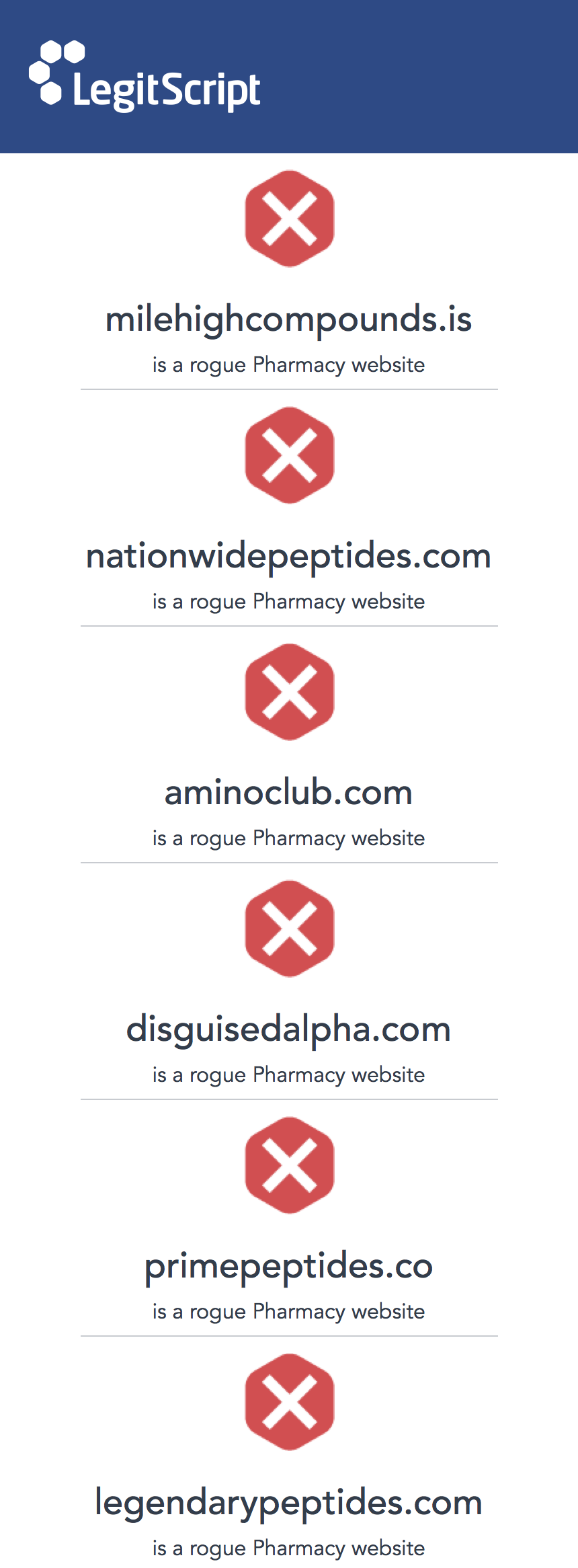
Google allows a U.S. online pharmacy to advertise only if it is accredited by LegitScript, which CBS News called “among the most powerful gatekeepers in selling health services online” in a story about sellers that slipped past it, or by the pharmacy boards’ association, NABP. These stores call themselves research suppliers, not pharmacies, but Google says it judges by what a site sells. I’ve looked up 15 of the 19 stores in LegitScript’s public checker. It classifies six, Mile High, Nationwide, Amino Club, Disguised Alpha, Prime and Legendary, as pharmacy websites, and as “Rogue”: its term for an unapproved pharmacy whose sale of drugs “reasonably appears to intentionally or knowingly violate, facilitate the violation of, or offer to facilitate the violation of applicable laws or regulations.” LegitScript gives no reasons or dates for each listing. The other nine return no result. Mile High, Nationwide, Amino Club and Disguised Alpha have all advertised since my reports; Prime’s newest ad dates from October 5, Legendary’s from November 8. When deciding whether a store breaks its rule, Google says it may weigh “third-party sources”; LegitScript’s checker is public.
“Research use only” is a sticker
These stores say they sell to labs, not patients. Data Peptides says it “is a chemical supplier,” not a compounding pharmacy. That label isn’t meaningless: under federal law, intended use is what makes a chemical a drug. In both FDA letters, the agency found evidence the products were meant for people despite the disclaimers; the Mile High letter cited the store’s sale of bacteriostatic water, used to mix injections. For the other stores I have only what they publish; I didn’t go through checkout to see whether a prescription is requested at the end.
I still don’t buy the label. Cenexa’s own tesamorelin page says the drug’s “commercial availability is restricted to prescription use under medical supervision for the approved indication only,” and sells it anyway. None of Google’s drug-ad policy pages I read mention research labels.
I reported all 20
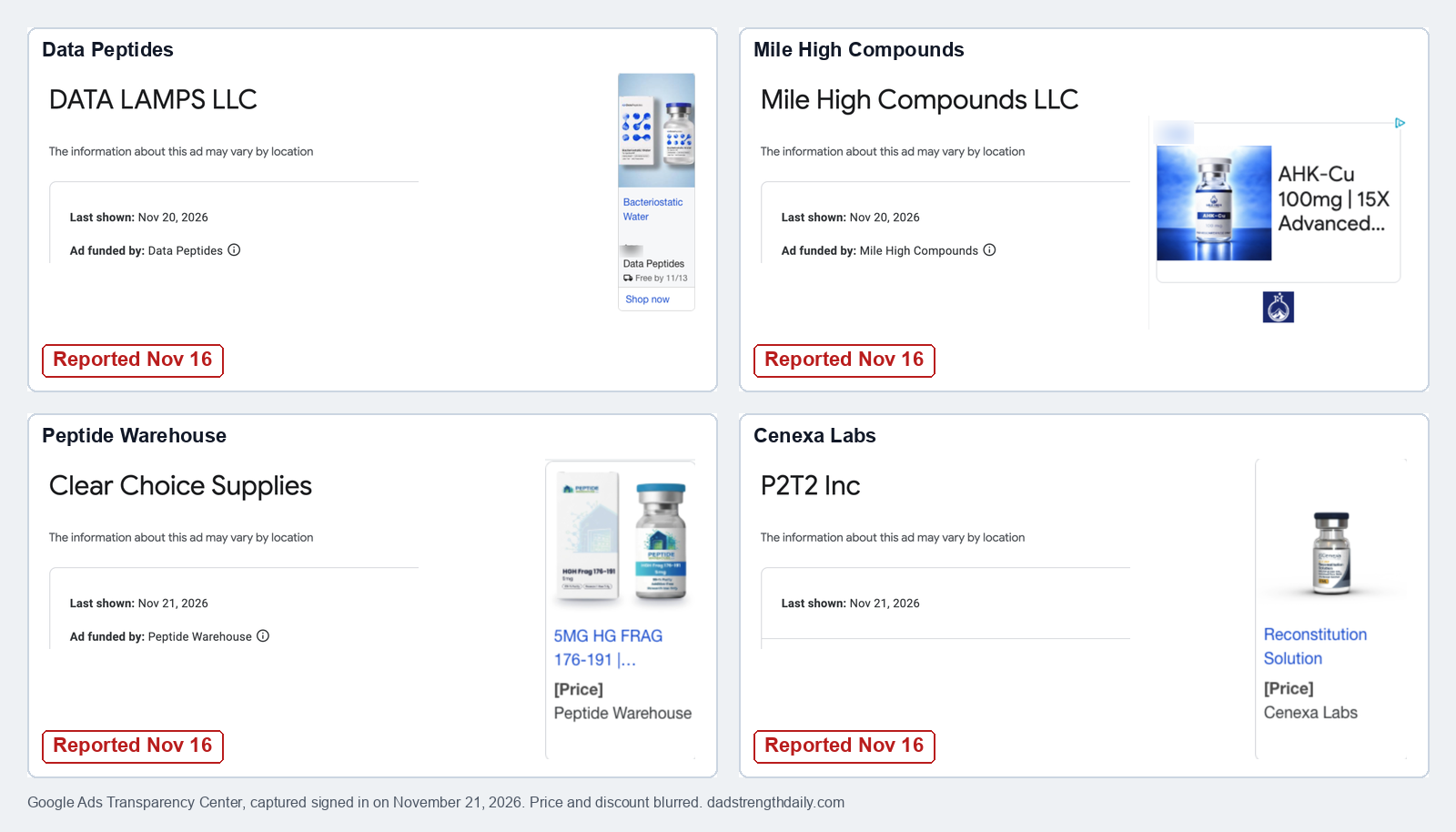
Maybe Google just never noticed. So on November 16 I reported one ad from each advertiser with Google’s “Report this ad” button, quoting the policy and linking the product page. Twenty automated replies came back that morning: “Our team will review your report and take action if appropriate.”
Four days later, one more email: Google had “decided to take action against this ad, which could take up to 24 hours for full effect.” It doesn’t say whose ad, or that any advertiser was suspended. The other 19 reports have no verdict yet.
I checked all 20 again, signed in, on November 21 and on November 23, a week after my reports. Google’s library keeps past ads, so still being listed doesn’t mean an account is active. The dates show what happened: on November 21, 17 of the 20 had shown an ad since my reports. On November 23 all 20 were still listed, and the same 17 had each shown an ad on November 22 or 23, six or seven days after I filed. The other three hadn’t shown one since before my reports.
I asked Google’s press office for comment on November 22; it had not responded by publication. Google may still be reviewing, or handling these stores under its gentler rules; I can’t tell from the outside. Either way, they kept advertising a week after I reported them, under a policy that promises suspension “upon detection and without prior warning.” I’ll check again on November 30 and update this post.
These are paid ads. I don’t know whether Google considers these advertisers within its rules, but it kept running their ads after I told it what they sell.
Get the next one in your inbox
I write about GLP-1s, training, and preventive health once a week — what the evidence actually says, from someone using it. Free, no spam, unsubscribe whenever.
If this was useful, read next
- YouTube terminated my channel. 172 peptide promos are still up — the videos YouTube left up while it banned me
- I checked 93 “research use only” peptide stores — what these stores publish beyond the label
- There is no legal retatrutide to buy — the lawsuits against the stores that sell it