
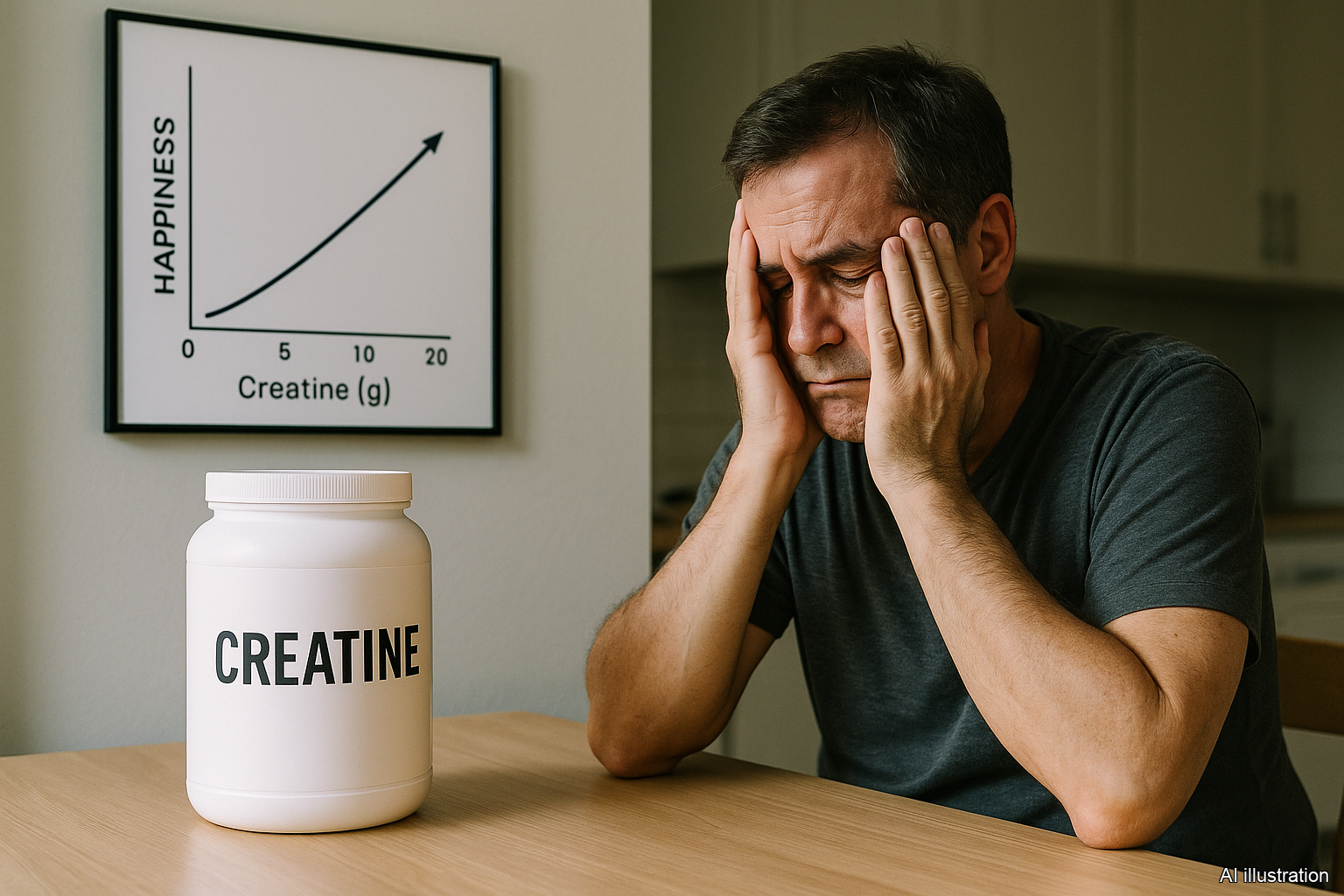
I take 5 grams of creatine a day. I have for years. I started because the evidence on muscle and strength is about as solid as supplement evidence gets, and I have never gone above the standard dose because every meta-analysis I have read shows the benefit curve flattens fast.
I will admit to FOMO. The creatine dose charts on health Twitter look like inflation. Five grams used to be the consensus. Then it was ten. Then twenty. By next year someone will probably claim they take it by the spoonful, eyes closed, no chaser. The push toward higher doses is being driven by claims that creatine does more than build muscle. It supports cognition. It improves mood. It protects against neurodegeneration. The higher dose is supposedly the price of admission for the brain benefits.
This week I read a new Cell Metabolism paper that connects creatine specifically to depression, and saw a thorough analysis of the broader literature by Nic Verhoeven, PhD, who runs the Physionic channel and is one of the better evidence-breakdown voices in this space. I have a personal stake in this one. I went through a stretch of pandemic-era anxiety and depression that was real and real unpleasant. So a study suggesting that a supplement I already take might support recovery from depression is exactly the kind of thing I want to take seriously but also be careful about overreacting to.
The short version is that this paper does not say what the dose-creep crowd is going to claim it says.
What the new Cell Metabolism paper actually showed
Get the next one in your inbox
I write about longevity, training, and preventive health weekly — without the guru worship. Free, no spam, unsubscribe whenever.
Lu and colleagues compared people with major depressive disorder to non-depressed controls and measured creatine in three compartments: blood, cerebrospinal fluid (the liquid around the brain), and feces. The depressed group had less creatine in blood and CSF and more in their stool. In other words, the creatine was getting into them but not getting absorbed where it counts.
The next step is the part that makes this paper unusual. The researchers took gut microbes from depressed humans and transplanted them into mice. The mice ended up with reduced blood creatine. The microbiome of depressed people appeared to be doing something to block creatine absorption in the gut. The team then identified a specific bacterium, Bifidobacterium pseudolongum, that was significantly reduced in depression and that correlated with the impaired absorption. The proposed mechanism is that this bacterium produces acetate, which drives expression of a creatine transporter called Slc6a8 in intestinal epithelial cells. No bacterium, no transporter, less creatine getting into the body.
To close the loop, the team ran a small clinical trial. Patients with clinically diagnosed depression who were already taking antidepressants got either placebo or creatine plus Bifidobacterium. The group on creatine plus the bacterium had higher plasma creatine and lower depression scores than placebo. The effect size was meaningful, though some of that improvement was placebo (it always is).
That sounds like a clean story. It mostly is. But the headline version that is going to make it into wellness Twitter, “creatine treats depression,” leaves out the population, the co-treatment, and the size of the existing literature.
The throughline across 17 studies
Verhoeven walked through 17 studies on creatine and depression in his recent video, and the pattern is worth keeping in mind every time someone on social media claims creatine helped their mood.
Nine studies showed an effect. Seven did not. One meta-analysis of eleven randomized trials found a statistically real but clinically small overall benefit, partly dragged down by a large Parkinson’s-specific trial that was not really about depression.
The studies that showed a benefit were almost all in people with clinically diagnosed depression. Most had treatment-resistant depression. Almost all of them were already taking antidepressant medication. Creatine alone, in any of these settings, did not show meaningful effects.
The studies that showed no benefit were either tiny, conducted in unrelated populations (stroke recovery, Parkinson’s), or designed for non-depression primary endpoints with mood measured as a secondary.
The honest summary is that creatine, on top of antidepressants, in clinically diagnosed depressed patients, probably helps a little. Creatine alone in healthy people for vague “mental wellness” reasons has no real evidence behind it. The supplement industry is about to ignore that distinction.
What this means for my 5 grams
I am not currently depressed. I went through a real depressive period during the pandemic, and I came out the other side through a combination of therapy, lifestyle changes, and eventually TRT. I take creatine for the muscle and strength benefit, which still has the strongest evidence base of any creatine claim and works at 3 to 5 grams a day.
If you are currently clinically depressed and on antidepressants, this Cell Metabolism paper should probably change your approach. I would ask my doctor about adding creatine to my regimen and consider a Bifidobacterium probiotic. The mechanism makes sense, the data is now better than it used to be, and the side-effect profile of creatine is well known and benign. That is an honest “this might help” conversation.
The dose-up-to-twenty-grams-for-mood pitch is based on a much shakier evidence base than the dose-up-to-twenty-grams-for-muscle pitch, which is itself shaky. Both arguments lean on brain-creatine measurement studies that show higher doses raise brain creatine more reliably than blood creatine alone does. That is interesting biology. It is not yet an outcome.
I am staying at 5 grams.
The dose arms race
There is a recognizable wellness-culture pattern where a real but modest finding in one population gets generalized into a louder, more expensive product for everyone else. NAD got that treatment last year, and I wrote about why the foundational claim never replicated in humans. Creatine is now getting that treatment for mood and cognition.
The biology in clinically depressed patients on antidepressants is genuinely interesting. The Cell Metabolism paper is well-designed and the mechanism is novel. If you fit the profile that the paper studied, talk to your doctor about it.
If you are just trying not to feel mid in the afternoon and you bought a tub of micronized creatine because someone on a podcast suggested 15 grams, the new paper does not change much for you. The dose creep happening across the longevity influencer space is not coming from new outcomes. It is coming from people who already had a creatine business looking for new reasons to sell more of it.
I will keep my 5 grams. If I ever go through another bad depressive period, this paper is on the list of things I would discuss with my doctor. Until then, the FOMO can wait.
About Gunnar
Gunnar is 53. He lost about 170 pounds, trains in a garage gym, and writes DadStrengthDaily from personal experience, citing primary sources where he can. He also moderates r/ProactiveHealth. He is not a doctor, and nothing here is medical advice. Talk to your own doctor before acting on anything, especially GLP-1s, TRT, blood pressure, sleep apnea, and cancer screening.