
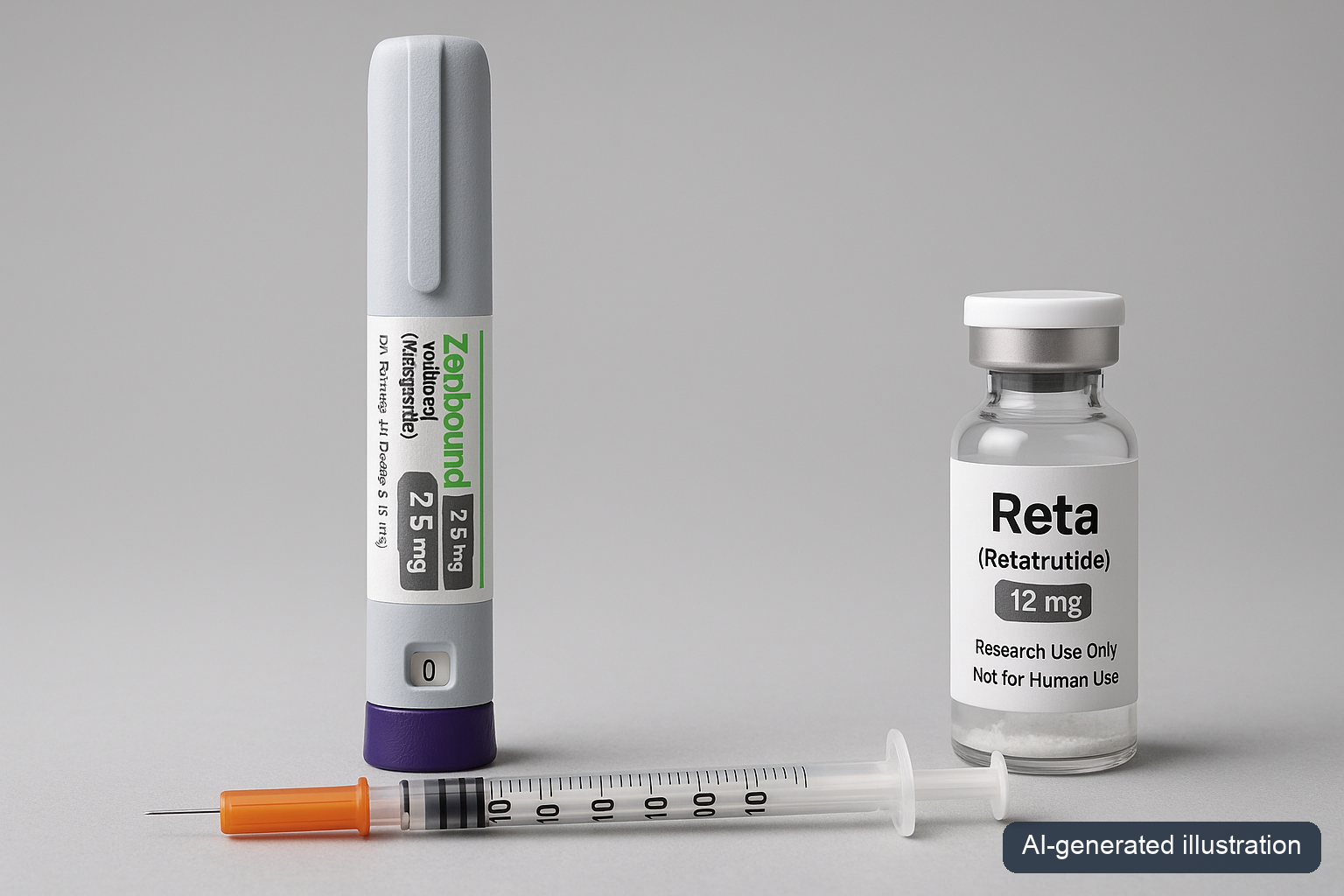
I’m on Zepbound at a normal dose, the kind a doctor prescribes and a pharmacy fills. A reader sent me a video this week that’s a good way into a question I keep getting asked. In it, the New Zealand GP Brad Stanfield, who runs an evidence-minded health channel, explains that he injects 1.25 milligrams of tirzepatide a week. That is half the low starter dose. He isn’t diabetic and he isn’t overweight, and he says it straight out: no trial ever told him to do this. He does it anyway, and he spends fifteen minutes walking through why.
The same week, a Harvard endocrinologist named Jody Dushay published a piece in STAT arguing that microdosing GLP-1s “is not a thing.” No agreed definition, she writes, and no real long-term data. The two of them are describing the same trend and trying to send you home with opposite conclusions.
Part of the mess is that “microdosing” has come to mean a few unrelated things, and they don’t all earn the same answer.
Nudging the dose is normal, and it isn’t new
Get the free Bloodwork Decoder
I made the one-page cheat sheet I wish I’d had at my first physical: what every number on your labs actually means, what’s worth aiming for at 50, and what to ask your doctor. Subscribe free and I’ll send it straight to your inbox. No spam, nothing to sell.
The pens are adjustable, and good obesity doctors already use that. You can count the clicks on an Ozempic or Zepbound dial and land between the standard steps, which is exactly what a doctor does for someone getting flattened by nausea, or someone dropping weight fast on a starter dose where going higher would be silly. And once you’ve hit your goal, stretching the gap between shots, weekly to every ten days, say, is a sensible way to find the smallest dose that holds the line. That last question is the whole point of the SURMOUNT-MAINTAIN trial I wrote about. None of this is fringe, and Dushay wouldn’t call it microdosing either. It’s careful dosing of a real drug with somebody watching. If you get vials from LillyDirect you have total control, obviously.
What’s getting sold under the name
The version with a marketing campaign is a different story. Noom runs a “GLP-1 Microdose” program. Telehealth and compounding sellers pitch the same promise: smaller dose, smaller price, fewer side effects, same magic. STAT’s reporting was blunt about why the word caught on, calling microdosing a way to keep the compounding market alive as the official shortage ends and the rules tighten.
The trouble is what’s in the vial. It’s usually compounded, not the approved drug, at an amount nobody studied. There is no trial data for tirzepatide under 2.5 milligrams, none. A paper this spring flagged a common impurity running through mass-compounded tirzepatide-and-B12 mixes. The single-use vials some clinics draw “microdoses” from aren’t built to be punctured twice. And when Noom marketed the idea, Lilly got the claim pulled because there was nothing solid to back it. That’s the part to pay attention to: the version with the best marketing is also the one with the least underneath it.
The people doing it on purpose, and what they’re chasing
Back to Stanfield, because he’s the honest version of this. He isn’t trying to lose weight. He’s betting on the other thing these drugs turned out to do. He walks through SELECT, the trial of more than 17,000 people without diabetes where semaglutide cut cardiovascular events by about 20 percent, and where a chunk of the benefit didn’t track with how much weight came off. He cites FLOW, where the kidney protection was described as largely independent of weight loss. He points at the joint and cartilage signals. His logic is that he wants exposure to those mechanisms at a dose too small to touch his appetite or burn his muscle. He isn’t a lone crank about it, either. He name-checks a US internist, Michael Albert, who has written about two years of low-dose tirzepatide as a personal choice.
The effect Stanfield says he notices even at that dose is the one most users mention first: the food noise went quiet. That part is well documented at normal doses. The New York Times ran a good piece this spring on what food noise actually is, with the catch that matters here: the body seems to defend an old set point, so the noise comes back when the drug stops. Whether a dose this small quiets it for the long haul, in someone who didn’t have much to lose to begin with, nobody has measured.
Here is where I ease off the gas. Every one of those benefits turned up at full doses, in people who were genuinely sick: established heart disease, kidney disease, obesity. Nobody has shown that 1.25 milligrams in a healthy thirty-four-year-old delivers any of it, and to his credit he admits the trials never enrolled someone like him. So it’s a thoughtful bet on an unproven dose. That’s a fairer label than “biohack,” and it’s still a bet.
So is this an Ozempic thing or a retatrutide thing?
That’s the question I started with, and the answer wasn’t what I expected. The loud, marketed microdosing is all semaglutide and tirzepatide, the drugs you can actually get your hands on. Retatrutide sits apart for two different reasons.
For someone who truly needs to lose weight, retatrutide is potent enough that starting well under the trial doses is a defensible instinct, since the side effects ramp up quickly with the dose. But there’s no approved retatrutide, so every “microdosing reta” log online is research-chemical material of unknown purity, self-dosed, and even that crowd argues about whether the small doses do anything. One of the most-debated threads I came across is somebody laying out why microdosing doesn’t work on reta at all.
The mechanism crowd, meanwhile, rules reta out on purpose, and that’s the genuinely interesting wrinkle. Reta’s third action is on glucagon, which pushes your metabolic rate up. If you’re trying to lose weight across a population, that’s a feature. If you’re lean and trying to keep your muscle, it’s the wrong direction, and it raises resting heart rate more than tirzepatide does. So the molecule you’d assume is the natural one to microdose, on the theory that a little goes a long way, is the one the careful self-experimenters steer around.
Where I land
If side effects are the real problem, the answer isn’t a mystery vial. It’s working with your doctor to slow the ramp, count the clicks, or stretch the interval, using the drug that was actually tested. You get the gentleness microdosing promises without the guesswork. Personally, I am worried about Retatrutide effects on heart rate (I have an aortic aneurysm and anything touching heart rate or blood pressure makes me nervous). And the part I find genuinely exciting is the same part Dushay flags at the end of her piece: we may someday learn to use small, targeted doses of real GLP-1s for specific problems, joints or brain or liver, without flooding every receptor in the body. That deserves a proper study, not a compounded vial and a schedule someone posted on Reddit.
I’m staying on my boring, knowable dose. When there’s real data on the small ones, I’ll write about it.
I keep a running tracker of every GLP-1 and incretin drug, approved and still in the pipeline, with what each one targets, how far along it is, and what's coming next.
See the full GLP-1 Pipeline Tracker →About Gunnar
Gunnar is 53. He lost about 170 pounds, trains in a garage gym, and writes DadStrengthDaily from personal experience, citing primary sources where he can. He also moderates r/ProactiveHealth. He is not a doctor, and nothing here is medical advice. Talk to your own doctor before acting on anything, especially GLP-1s, TRT, blood pressure, sleep apnea, and cancer screening.